Planted Tank WPG Equivalent Calculator
Translate old watts-per-gallon rules into LED-era context using tank depth, fixture watts, photon efficacy, coverage, PAR estimate, photoperiod, plants, CO2, and fertilizing support.
🌿Planted WPG Presets
📐Tank, Light, and Growth Inputs
WPG Equivalent Results
🔌Light Tech Comparison Grid
📊WPG And PAR Plant Targets
| Plant class | Old fluorescent WPG | Substrate PAR aim | Typical schedule |
|---|---|---|---|
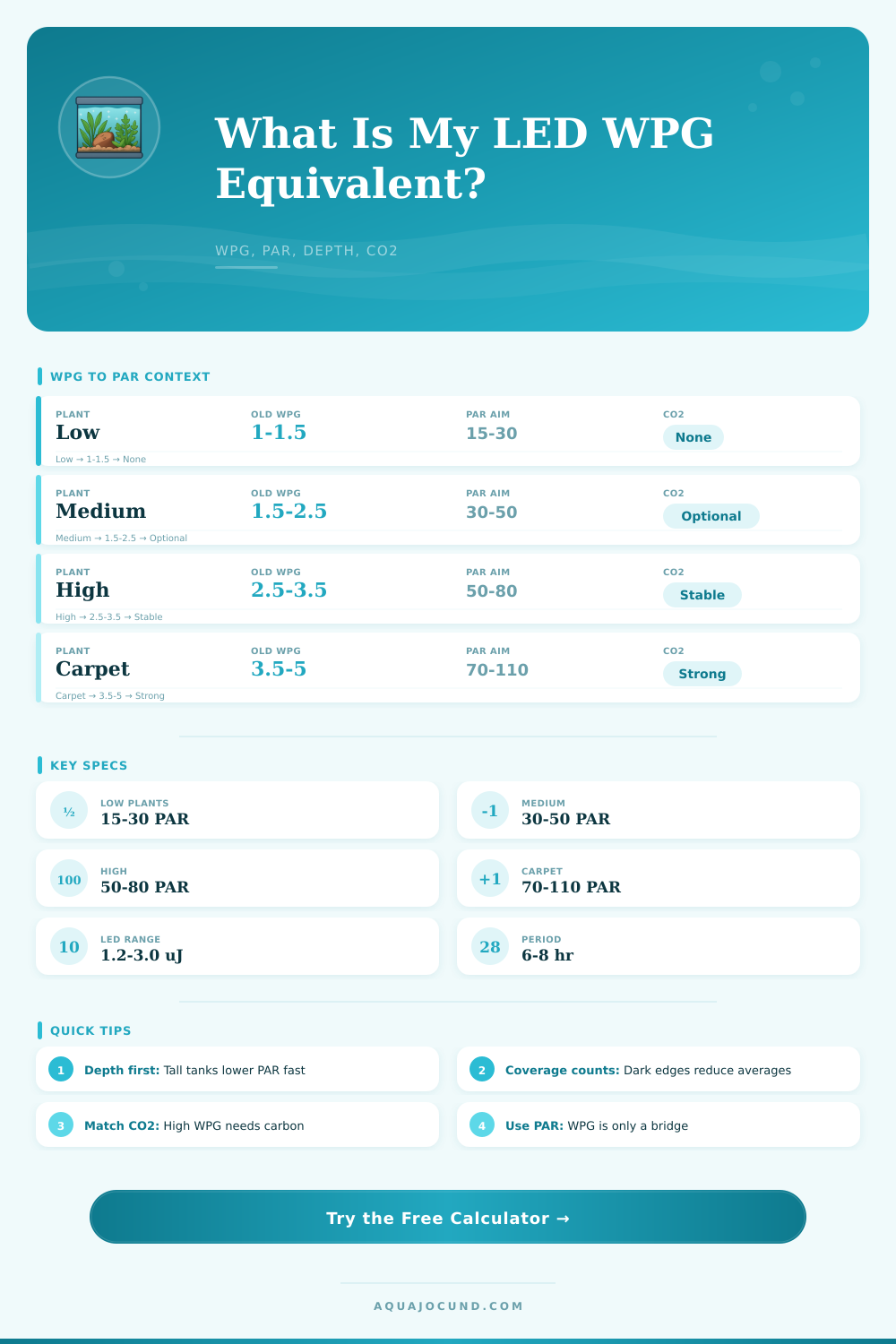
| Low epiphytes, moss, crypts | 1.0 to 1.5 WPG | 15 to 30 PAR | 7 to 9 hours |
| Medium stems and rosettes | 1.5 to 2.5 WPG | 30 to 50 PAR | 7 to 8 hours |
| High light colored stems | 2.5 to 3.5 WPG | 50 to 80 PAR | 6 to 8 hours |
| Carpeting foreground plants | 3.5 to 5.0 WPG | 70 to 110 PAR | 6 to 7 hours |
| Dense contest aquascape | 4.0 to 6.0 WPG | 90 to 140 PAR | 5.5 to 7 hours |
💡Fixture Technology Reference
| Technology | Typical photon efficacy | Spread behavior | WPG translation note |
|---|---|---|---|
| T12 fluorescent | 0.30 to 0.45 umol/J | Broad with reflectors | Classic low-tech WPG baseline |
| T8 fluorescent | 0.50 to 0.75 umol/J | Broad, moderate penetration | Useful for older planted-tank notes |
| T5HO fluorescent | 0.80 to 1.10 umol/J | Strong broad line source | High output for old WPG rules |
| Basic white LED | 1.30 to 1.90 umol/J | Often narrow on small strips | WPG reads low but PAR can be enough |
| Planted spectrum LED | 1.80 to 2.50 umol/J | Good spread on bars | Common replacement for WPG planning |
| High output RGB LED | 2.00 to 3.00 umol/J | High PAR, color-tunable | Needs CO2 and dosing at high output |
📏Common Tank WPG Conversion Examples
| Tank | Nominal size | 2.5 old WPG watts | Modern LED equivalent clue |
|---|---|---|---|
| 10 gallon planted | 20 x 10 x 12 in | 25 old fluorescent W | 10 to 18 efficient LED watts |
| 20 long planted | 30 x 12 x 12 in | 50 old fluorescent W | 22 to 35 efficient LED watts |
| 29 gallon tall | 30 x 12 x 18 in | 73 old fluorescent W | 35 to 55 LED watts for depth |
| 40 breeder | 36 x 18 x 16 in | 100 old fluorescent W | 40 to 70 LED watts with spread |
| 55 gallon tall | 48 x 13 x 21 in | 138 old fluorescent W | 55 to 90 LED watts for uniformity |
| 75 gallon planted | 48 x 18 x 21 in | 188 old fluorescent W | 75 to 130 LED watts with CO2 |
🌊Depth, CO2, And Fertilizer Context
| Context | Planning effect | Adjustment | Watch point |
|---|---|---|---|
| Shallow tank under 12 in | Higher PAR per watt | Use shorter photoperiod first | Algae on hardscape |
| Deep tank over 20 in | Lower substrate PAR | Add output or narrow-demand plants | Bottom leaf thinning |
| No added CO2 | Useful PAR ceiling is lower | Favor 15 to 40 PAR | Slow growth and algae swings |
| Stable gas CO2 | Higher light can be used | Pair with balanced macro and micro dosing | CO2 drop before lights on |
| Heavy floating plants | Coverage and PAR fall sharply | Reduce obstruction or raise fixture output | Patchy foreground growth |
Different terms is used by various folks. Some rely on watts per gallon (based off info from two decades ago), while others swear by PAR meters and photon efficacy. Each has its place. However, neither considers spectrum, depth, or technology, so neither gets it right. Old-school formulas aren’t applicable when we discusses T5 or LED lighting. Those formulas don’t account for any of that; they’re rooted in outdated T12 fluorescent bulbs. When you look at how much light penetrates water before reaching your substrate, the math don’t add up.
That’s why I created the calculator, to convert obsolete wattage numbers into real-world light levels. Because it doesn’t simply divide watts by gallons. Why? Light are absorbed as it travels down through the water. So a deeper 29 gallon tank require greater light output at surface to achieve similar PAR levels different than a shallow 10 gallon tank. To be even more accurate, the calculator considers things like lid coverage, floating plant, etc. Physical elements that affect light distribution.
Why Watts Are Not Enough For Your Plants
It is not the label on the power supply. Photon efficacy are the missing variable in most conversations about lighting upgrades. Newer LEDs produce more PAR for every joule of energy used then those old fluorescents did. And newer fixtures waste less energy as heat, a 30 watt LED bar might be better than a 50 watt T5. The calculator fill in this gap with estimated efficacies. It will tell you what kind of legacy power your new set up represents. That lets you make apples to apples comparisons between technologies.
In fact, tank size matter far less then plant choice. Some plants is happy with very little light while others requires intense coverage. Carpeting species want full-on lighting; low light plants (e.g., crypts, moss) does fine with very few. The tool’s reference table spells that out. Easy plants only need fifteen to thirty PAR; grasses will often ask for seventy or better. Tuning your light output to the plant needs ensures your tank won’t get a algae outbreak from excess photon power.
The other side of the equation is Carbon Dioxide (CO2). Plants needs carbon to photosynthesize well, and high light without sufficient CO2 make that balance unstable. Depending on how you dose (gas injection, liquid carbon, none at all), the calculator factors in your support levels and sets expectations to match. If you plan on a given intensity but don’t have a nutrient regimen capable of supporting that much, the calculator will tell you. That balance is key for long term success.
Other variables like lighting placement and shading affects final delivery as well. Driftwood and tannins absorbs certain wavelengths. Overall penetration goes down. Condensation and dirty lids scatter incoming light before it even reach the water column. You can factor those losses into the calculator and get an estimated PAR based on conditions you’re actualy dealing with versus some sort of idealized lab scenario. Messy tanks = real tanks. Accounting for your imperfections help inform better planning.
Intensity and photoperiod are another surprise to newbies. Twelve hours of max intensity = algae party. Keep light duration shorter and maintain intensity to give your plants a boost without drowning out competition. Based off CO2, the calculator provide guidelines by plant class. You’ll know when you’ve hit “just right”, vigorous growth, yet within your comfort zone. Changing patterns can be hard if you’re accustomed to following old wisdom, so don’t despair as you move into new metrics.
That said, you wouldn’t of had to shell out big bucks for a luxurius meter before you begin making educated choices. Equivalent values provides an initial reference point until you become familiar with your tank’s behavior. Observe your plants’ response to the recommended settings, then tweak accordingly through trial & error (and not via blind acceptance of data). Striking a balance between nutrients, carbon, and light will lead you down the path toward harmony. Everything else is tuning.
But the key is knowing what is really being measured. Electrical use is described in watts. Plant lighting output is described in PAR. And once you divorce those two, things begins to make more sense for planted tanks. You stop playing games with numbers that has no meaning and you begin maintaining a living system. That changes everything.