Planted Tank CO2 Demand Calculator
Estimate daily CO2 demand from tank volume, PAR, photoperiod, plant mass, degassing, delivery efficiency, surface agitation, and livestock limits.
CO2 demand estimate
| CO2 method | Typical efficiency | Best fit | Demand note |
|---|---|---|---|
| External reactor | 85-95% | Medium to large planted tanks | Lowest gas waste when flow is tuned. |
| Inline atomizer | 75-90% | Canister filter layouts | Fine mist improves contact but raises line pressure. |
| Ceramic diffuser | 55-75% | Nano to mid-size displays | Placement under flow matters more than bubble count. |
| Powerhead mist | 60-80% | High circulation aquascapes | Mist can feed dense carpets when livestock tolerate flow. |
| Sump injection | 45-65% | Planted systems with overflow | Degassing is higher unless the sump is covered. |
| Ladder diffuser | 35-55% | Small low-pressure systems | Works slowly and suits lower PAR tanks. |
| Bell or cup | 20-40% | Very gentle tanks | Passive contact gives uneven daytime concentration. |
| DIY passive bottle | 20-35% | Small experimental tanks | Output drifts as the yeast mix ages. |
| Plant demand profile | PAR range | CO2 target | Plant signal |
|---|---|---|---|
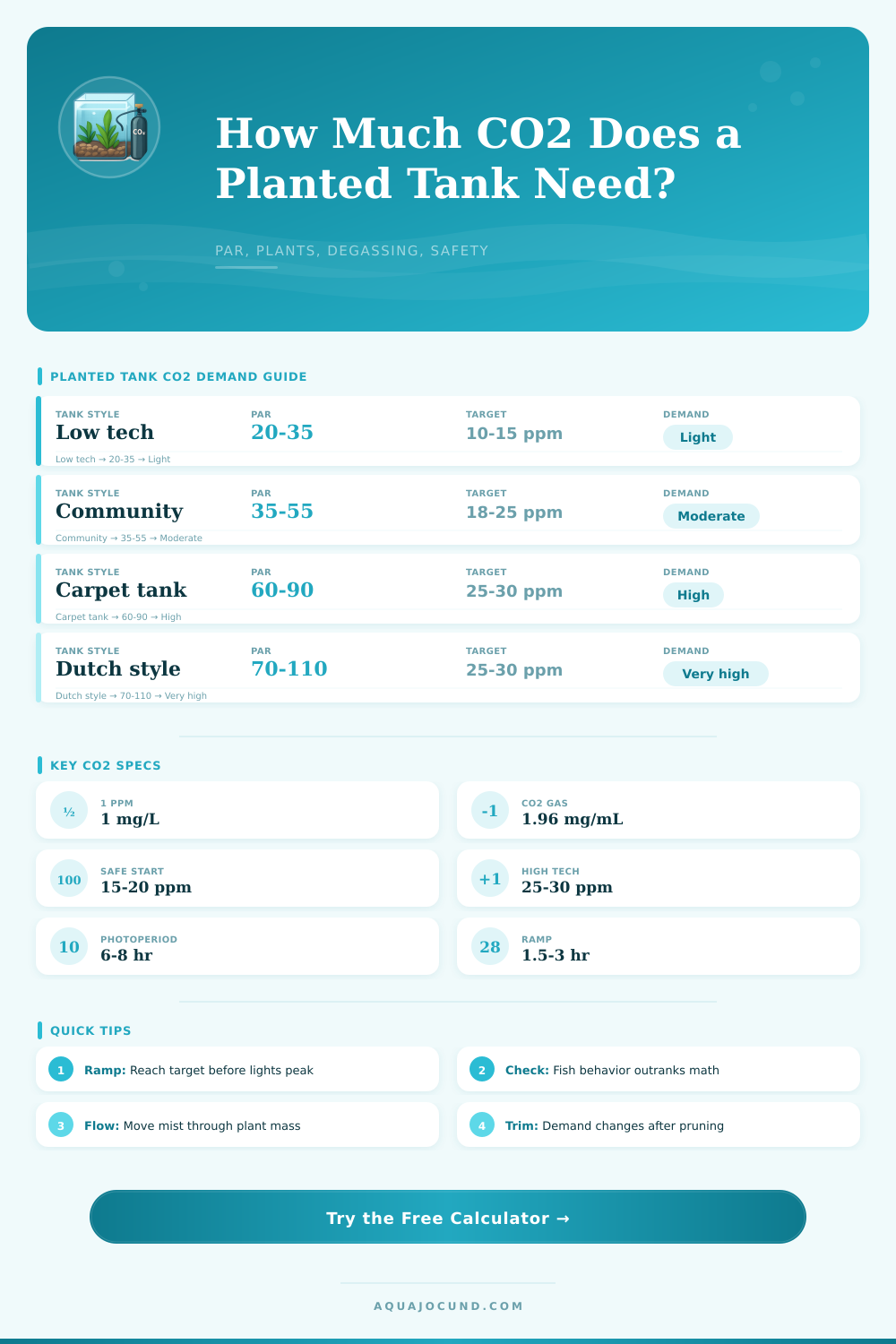
| Slow epiphytes and moss | 15-40 | 8-18 ppm | Stable leaves matter more than fast growth. |
| Mixed community plants | 30-60 | 18-25 ppm | Balanced default for swords, crypts, stems, and moss. |
| Fast stem plant group | 45-80 | 22-30 ppm | Demand climbs quickly after trimming and replanting. |
| Carpet focused scape | 60-100 | 25-30 ppm | Consistent concentration at substrate level is critical. |
| Dense Dutch style | 70-120 | 25-32 ppm | Large biomass and daily pearling can hide dead zones. |
| High biomass grow-out | 55-110 | 25-35 ppm | Plant mass and nutrient supply dominate the demand curve. |
| Common tank | Dimensions | Volume | Typical daily CO2 |
|---|---|---|---|
| 10 gallon planted nano | 20 x 10 x 12 in / 51 x 25 x 30 cm | 38 L | 0.4-1.2 g/day |
| 20 gallon high | 24 x 12 x 16 in / 61 x 30 x 41 cm | 76 L | 1.0-2.6 g/day |
| 40 breeder carpet | 36 x 18 x 16 in / 91 x 46 x 41 cm | 151 L | 2.4-5.8 g/day |
| 60P aquascape | 60 x 30 x 36 cm / 24 x 12 x 14 in | 65 L | 1.2-3.0 g/day |
| 55 gallon Dutch | 48 x 13 x 21 in / 122 x 33 x 53 cm | 208 L | 4.0-8.5 g/day |
| 75 gallon nature tank | 48 x 18 x 21 in / 122 x 46 x 53 cm | 284 L | 5.0-11.0 g/day |
| Livestock profile | Planning cap | Surface need | Response rule |
|---|---|---|---|
| Shrimp or sensitive fry | 18 ppm | Visible ripple | Back off at first signs of stress. |
| Sensitive community fish | 20 ppm | Light to moderate ripple | Raise target in small steps only. |
| Standard community fish | 25 ppm | Light ripple plus night aeration | Observe first two hours after lights on. |
| Hardy fish, strong aeration | 30 ppm | Moderate oxygen exchange | Use a drop checker as a lagging indicator only. |
| Plant-only holding tank | 35 ppm | Enough ripple to prevent stagnation | Target can be higher, but algae risk still rises. |
Even with eight-hour-a-day lighting, your stem plants remain pale and stringy. You’re doing everything right, or so you think, but the one thing you aren’t providing is building-block sugar (carbon dioxide), which most plant use to build sugars. Without enough nutrients, your lights only feed algae instead of growing plants, and you have no idea how much gas you should of be delivering. Hobbyists typically make a blind stab at this by cranking on a regulator until they see a few bubbles. Pretty doesn’t mean sufficient.
So what does this do? If you enter your tank parameters (dimensions, surface agitation, etc.) and plant mass, the calculator will do all that math for you to find your target net gain. The end result is that you no longer need to guess it factors in variables that many people don’t consider. One example is the amount of CO2 that escapes the water column before reaching the plants. A lot of gas escapes through the water surface before it ever reaches the plant. So if you’ve got a high flow on your overflow return or you have direct surface agitation, then you’re going to lose a ton of your injected gas to the atmosphere. You may be blowing 25 parts per million into the tank, but the plants only see 15. The remaining 10 degassed out before they could reach the plants and get used up during photosynthesis.
How Much CO2 Your Tank Needs
But how do you get it into the water is as important than how much. An inline atomizer or external reactor gets up to 90% of the gas by transforming it into a very fine mist that immediately dissolves. Cheaper units, like a basic ceramic diffuser, may have efficiencies as low as 65% depending on position and bubble size. This forces you to add far more gas using a no-frills disc to reach desired end concentration compared to using a top-of-the-line reactor. This built-in correction factor accounts for variations in hardware, letting you know the real-world net uptake in the water column instead of simply what came out of cylinder.
Don’t neglect the fact that a newly planted, sparsely covered tank doesn’t need many plant at first. Don’t force it, especially since forcing it can be harmful to your livestock by creating localized dead zones of carbon-rich but otherwise stagnant water. Let it grow naturaly without high CO2 requirements. You’ll first begin to see this as the carpets expand and your moss thickens. Its collective appetite will increase and you’ll suddenly start seeing some pearling bubbles on the leaves or a drop in pH. With the calculator, you can add new plant and scale up your injection rate ahead of time. This helps you anticipate changes instead of reacting to them once things has declined.
All this planning goes out the window when we reach the hard limit of livestock safety. You can’t just blast as much CO2 into a tank full of shrimp and expect that they will live happy lives. Lower caps is needed for sensitive invertebrates (eighteen parts per million) and fry (often around eighteen ppm). Hardy barbs and tetras can tolerate higher numbers of up to thirty or more if there is enough oxygen. It’s a balancing act between animal tolerance and plant hunger. The tool factors in your choice of livestock profile to make sure the suggested rate doesn’t exceed safe limits for your inhabitants.
Another pro move: To avoid stressing plants by confusing them (and yourself), ramp up the CO2 gradually as lights are coming up to full strength. Biological systems adjust more smoothly if the rise happens slowly. Like sunrise does naturaly, over an hour or two. This logic automatically matches your injection schedule to the best light and CO2 windows.
CO2 should be considered a dynamic variable. Each significant piece of trimming decreases immediate demand, but with each new carpet, you increase demand. This means that the tool allows you to get a starting point (while observation is still most important) and prompts revisiting the values periodically instead of setting them and forgetting them. Pay attention to how your fish behave. Do they sit there like a lump? Are they gasping up at the surface? Adjust flow immediately, even if the math tell you otherwise. Math helps guide us, but biology will have the last word. Measure your KH to check its stability. Carbonate hardness that is too low can result in dangerous pH crashes for your livestock. Start with conservative estimates and inch upwards gradually.
When you carefully balance your light, nutrients, and carbon, you’ll be rewarded by the tank with lush density and vibrant color, it no longer looks like a planted aquarium, but rather feels like a livig ecosystem. That is where the change begins, however. It does not start by buying more equipment, but by understanding exactly how much gas your specific setup use to stay alive and thriving. This allows you to grow steadily and predictably while avoiding stress on the animals who share the tank.