Fish Rack Weight Load Calculator
Estimate a multi-tier aquarium rack load from water volume, glass weight, substrate, rock, equipment, shelf span, load rating, and safety factor.
📏Tank and tier layout
Extra center depth beyond the rectangular back-to-front width.
⚖Materials and contents
🔧Rack and shelf rating
Calculation Breakdown
Load and Material Comparison
📊Load constants snapshot
🧱Reference tables
| Substrate | Working density | Typical load behavior | Rack note |
|---|---|---|---|
| Bare bottom | 0 lb/ft³ / 0 kg/m³ | No substrate load | Equipment and glass dominate small tanks. |
| Wet aquarium sand | 100 lb/ft³ / 1600 kg/m³ | Dense and predictable | Thin layers still add noticeable tier weight. |
| Rounded gravel | 105 lb/ft³ / 1680 kg/m³ | Heavy with trapped water | Use actual bag weight if known. |
| Aquasoil | 55 lb/ft³ / 880 kg/m³ | Lighter porous planted substrate | Good for multi-tank plant racks. |
| Crushed coral | 90 lb/ft³ / 1440 kg/m³ | Moderately dense carbonate | Watch stacked cichlid shelves. |
| Lava rock substrate | 50 lb/ft³ / 800 kg/m³ | Porous and lighter | Rock decor may exceed substrate load. |
| Common tank | Dimensions | Filled load estimate | Typical shelf planning |
|---|---|---|---|
| 10 gallon | 20 x 10 x 12 in / 51 x 25 x 30 cm | 105 to 130 lb / 48 to 59 kg | Often two per 36 in shelf. |
| 20 long | 30 x 12 x 12 in / 76 x 30 x 30 cm | 220 to 255 lb / 100 to 116 kg | One tank per light-duty wire shelf. |
| 29 gallon | 30 x 12 x 18 in / 76 x 30 x 46 cm | 310 to 360 lb / 141 to 163 kg | Check span and center support. |
| 40 breeder | 36 x 18 x 16 in / 91 x 46 x 41 cm | 430 to 500 lb / 195 to 227 kg | Needs strong shelf and full support. |
| 55 gallon | 48 x 13 x 21 in / 122 x 33 x 53 cm | 590 to 680 lb / 268 to 308 kg | Long narrow span is demanding. |
| 75 gallon | 48 x 18 x 21 in / 122 x 46 x 53 cm | 820 to 930 lb / 372 to 422 kg | Use purpose-built stand framing. |
| Shelf material | Good use | Load behavior | Calculator factor |
|---|---|---|---|
| Commercial wire shelf | Small tanks and tubs | Rating assumes even static load | 0.85 base factor |
| Plywood over frame | Spreading glass tank loads | Improves contact area over rails | 0.95 base factor |
| Steel angle frame | Medium and large racks | Strong edge support when braced | 1.00 base factor |
| Wood 2x4 frame | DIY fish room racks | Depends on joints, span, and bracing | 0.90 base factor |
| Aluminum extrusion | Modular precision racks | Connector and span limited | 0.88 base factor |
| Welded steel stand | Heavy display tiers | Usually governed by welds and floor | 1.05 base factor |
| Safety factor | Read | Use case | Action |
|---|---|---|---|
| Below 1.0x | Over rating | Not acceptable for filled tanks | Reduce load or rebuild support. |
| 1.0x to 1.25x | Very lean | Only temporary testing | Add span support or lower water volume. |
| 1.25x to 1.5x | Marginal | Light-duty controlled rack | Prefer extra bracing. |
| 1.5x to 2.0x | Usable target | Normal static fish rack | Still verify level and fasteners. |
| 2.0x or higher | Conservative | Long-term or public spaces | Also check floor and seismic restraint. |
✅Rack load tips
So you’re standing before a blank shelving unit and imagine what will be. You see serene rows of brightly colored fish, floating plants, and gleaming glass containers holding sparkling water. It’s tranquil. Then again, before you even hoist your first tank from the ground, physics has set a trap for you. Water weigh something. Glass is weighty. Substrate accumulates. Together they pose a weight that can buckles weak structures unless you consider the numbers.
Why? You need to estimate how much rack strength are required before you add a drop of aquarium water to sand. By entering your material/size/fill information into the calculator (above), it spits out the answer for you. It takes all the guesswork out. It combines substrate mass, water weight, glass density, and equipment into one single number.
How to Calculate Shelf Weight for Safety
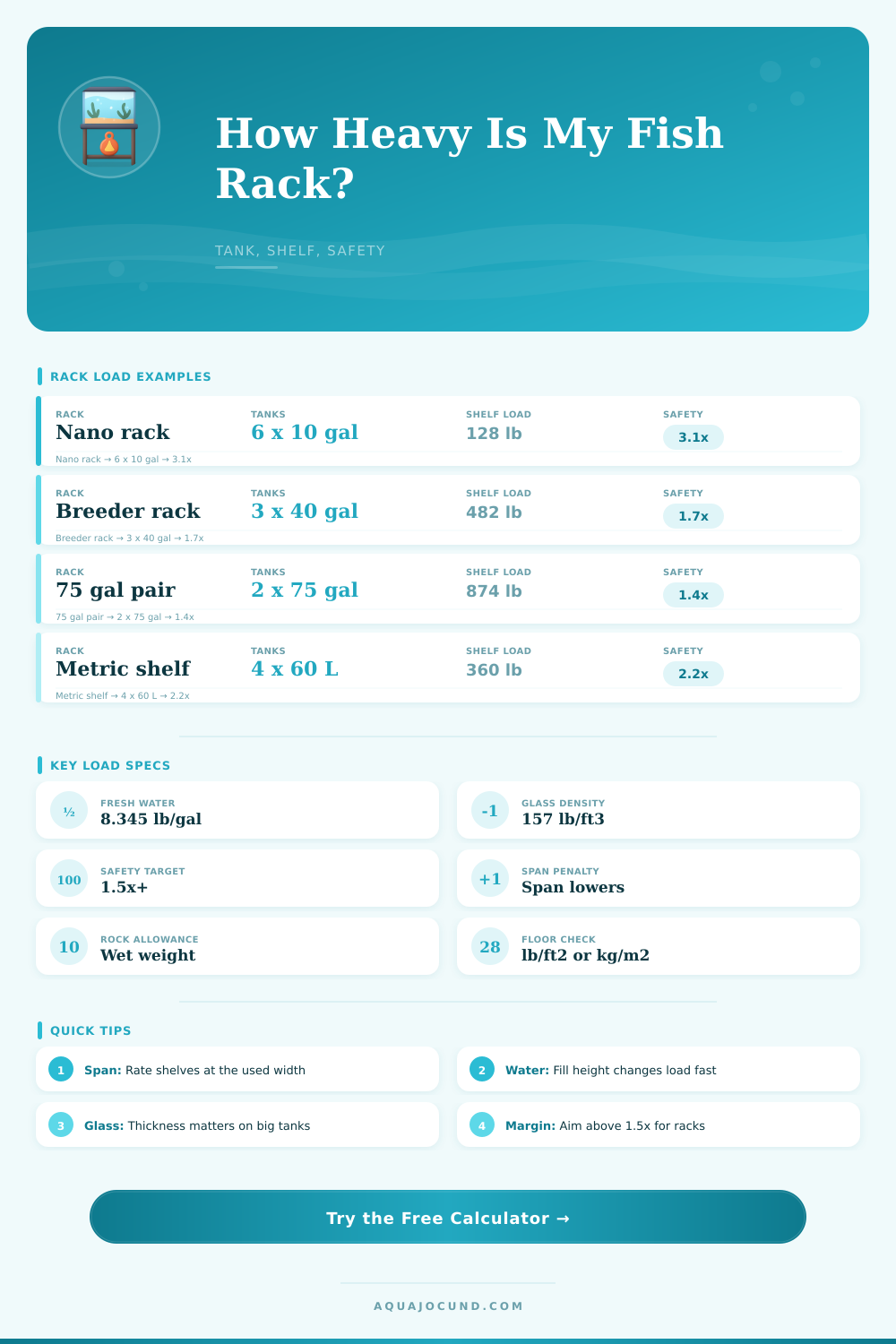
Where the wizardry comes in is knowing what exactly is getting measured. Most hobbyists look only at volume of their tanks and mistakenly believe that a fifty gallon tank must weigh fifty pounds. That’s where the dangerous oversimplification happens. When you add up heavy glass panes, water, and the gravel lining floor, you’re looking at a tank around six-hundred pounds when full. This tool converts those numbers for you. You don’t need to remember specific gravity of wet sand or density of silica.
The thing that everyone overlooks is the span variable of the shelf. Even though maybe a rack could holds X amount of load in ideal lab conditions where it has supports directly below each corner, that’s not your house. If you have tanks spanning from one post to another without any support underneath, then horizontal beam is exposed to much more bending force. That’s why the effective rating will change as distance changes. Different materials act different when cantilevered (like plywood vs wire shelving). Plywood absorbs the load quite well but sags across long distances. If you use wire shelves, the thin bottoms of tanks can crack under heavy weight at just a few points of contact. It’s all laid out neatly on page in the reference table so you know how that impacts safety by selecting materials.
The other silent weight factor is substrate depth. While two inches of aquasoil may not sound like much in a nano tank, multiply this by six tanks on three shelves and youve added dozens of pounds to top shelf. All of this additional weight is also furthest away from the floor, making its leverage against your rack joints even greater. And while it sounds like a small thing, over time, it’s something you shouldn’t of mess around with when talking about long term structural integrity. Ideally, you want your safety factor to be comfortabley above one point five times the actual load. This margin takes into account all of the dynamic force from loading and unloading tanks. This force puts more stress on the structure than static weight alone. If your safety ratio comes out lower then one, you’re already in dangerous territory.
The last part of the equation is floor load. Sure, maybe a rack will hold itself up just fine. But eventually, it puts eight hundred pounds of weight on a tiny area of hardwood flooring and that will buckle the joist beneath. Make sure your subfloor can support the concentrated weight. Gravity doesn’t give a damn about how pretty you want your room to look. Braced and redundant, the best racks keeps all the force heading down into the structure instead of allowing shelves to bow out.
So how do you start? Conservatively estimate the weight of rocks plus thickness of the glass. If you overestimate the load, you pay a bit more in weight for your rack. You don’t lose anything by overestimating. But if you underestimate, you’ll have damaged floors, busted furnitures, and maybe an angry livestock animal to boot.
Once you understand what the inputs are, the math is simply arithmetic. But getting those inputs correct takes understanding the reality of the build vs the product description. So check your span. Understand weight of water. Build with margin. Get this right and you won’t just have a functional shelf. You will have a foundation where you can relax and enjoy the view, without worrying if the thing holding all that water will hold up.