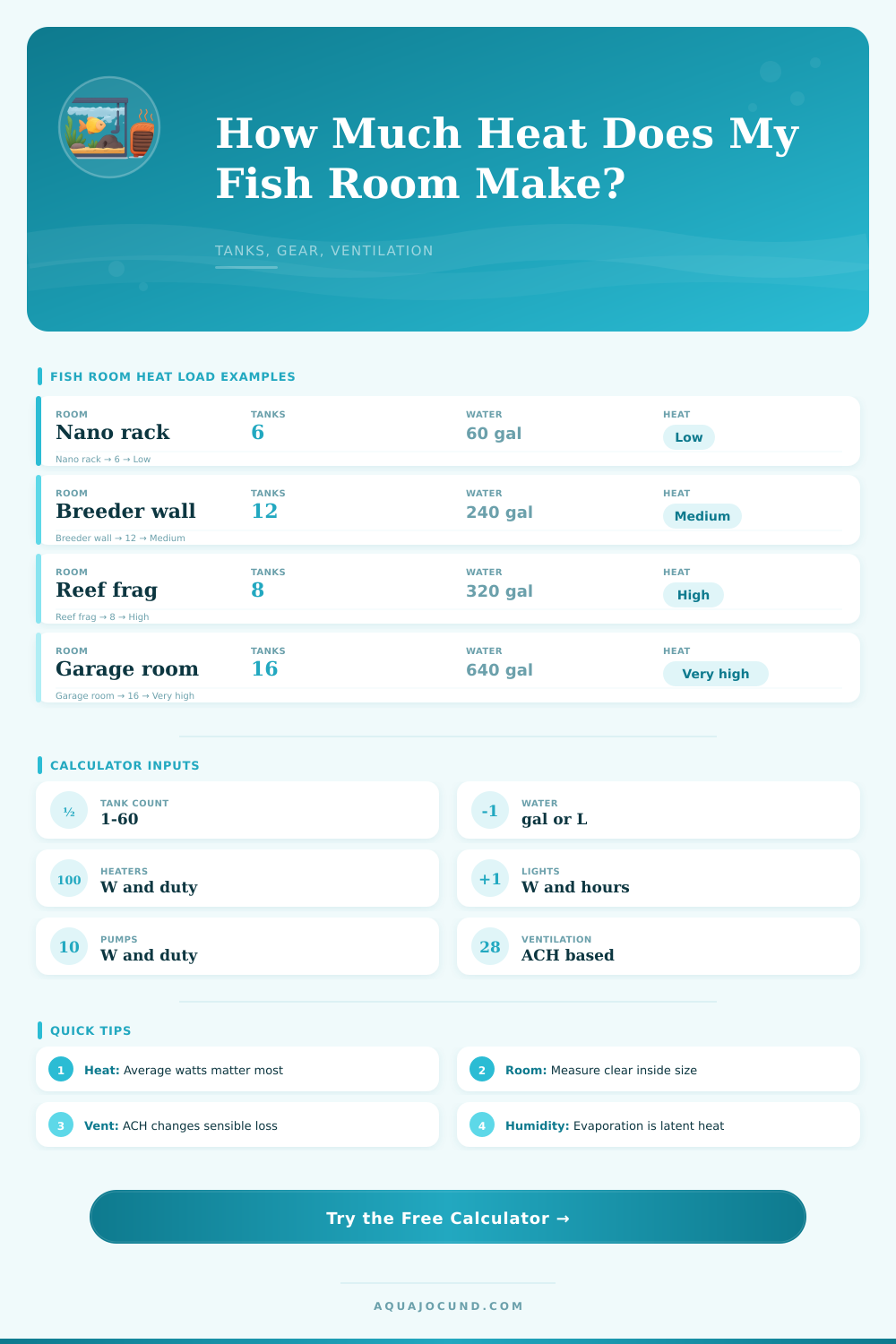
Fish Room Heat Load Calculator
Estimate the heat a fish room gains from tanks, heaters, lights, pumps, and moisture, then compare it with shell loss, ventilation, and your target room temperature delta.
⚙Start With A Fish Room Preset
🐟Tank Inventory And Water Mass
Positive means the fish room target is warmer than the adjacent/outdoor design temperature.
📏Room Size And Ventilation
⚡Equipment Heat Inputs
Fish Room Thermal Balance
📊Equipment Heat Comparison Grid
Electrical watts become room or water heat unless exported outside.
High peak draw, but average heat depends on duty cycle.
Use average watts across the photoperiod, not only peak.
Usually always on and often the steady baseline load.
Central blowers can dominate racks with sponge filters.
Evaporation removes latent heat but raises dehumidification load.
BTU/h equals CFM times temperature delta times 1.08.
A reasonable planning value for an insulated utility room.
🏠Room Profile Heat-Loss Assumptions
| Profile | U-value BTU/h ft² °F | Use Case | Planning Note |
|---|---|---|---|
| Interior conditioned room | 0.12 | Bedroom, office, spare room | Least shell loss; humidity is often the bigger issue. |
| Basement against earth | 0.18 | Concrete basement fish room | Earth moderates swings but can hold damp air. |
| Insulated fish room | 0.24 | Finished utility room | Good general planning assumption. |
| Attached garage | 0.45 | Garage racks or vats | Shell loss rises quickly in cold weather. |
| Sunroom or windowed room | 0.55 | Glass-heavy room | Solar gain and night loss can both be large. |
| Open rack with many lids off | 0.30 | Breeder racks | Moderate shell loss, higher humidity factor. |
| Reef room with sump heat | 0.28 | Sump and frag systems | Equipment heat is often high and steady. |
| Hatchery or utility space | 0.38 | Large air system or floor drains | Plan extra ventilation and margin. |
📘Common Fish Room Heat Examples
| Setup | Typical Water | Equipment Pattern | Heat Load Tendency |
|---|---|---|---|
| Desk trio | 15-30 gal / 57-114 L | Small heaters, compact LEDs, air pump | Low heat, localized humidity. |
| Shrimp rack | 60-120 gal / 227-454 L | Low heaters, sponge filtration, modest LEDs | Steady moisture, mild heat. |
| Breeder shelf | 180-300 gal / 681-1136 L | Central air, many small heaters | Moderate heat with high evaporation. |
| Discus room | 240-500 gal / 908-1893 L | High temperature setpoints and heaters | Often needs winter heat support. |
| Frag rack | 250-500 gal / 946-1893 L | Strong lights, returns, skimmer, sump | High sensible heat and moisture. |
| Garage tank bank | 400-900 gal / 1514-3407 L | Large heaters, pumps, seasonal delta | Large shell and ventilation penalty. |
🌬Ventilation And Humidity Reference
| ACH Range | Typical Use | Heat Penalty | Humidity Effect |
|---|---|---|---|
| 0.3-0.7 ACH | Covered tanks in conditioned room | Low | May need dehumidifier if evaporation is high. |
| 1.0-1.5 ACH | Mixed fish room with lids | Moderate | Good first estimate for many rooms. |
| 2.0-3.0 ACH | Open racks or warm water tanks | High | Better moisture removal with more heat exchange. |
| 4.0+ ACH | Wet room, vats, floor drain space | Very high | Use make-up air planning in cold climates. |
🌡Temperature Delta Planning Table
| Target Delta | Meaning | Vent Loss Per 100 CFM | When It Matters |
|---|---|---|---|
| 5°F / 2.8°C | Mild room offset | 540 BTU/h / 158 W | Interior rooms and mild seasons. |
| 10°F / 5.6°C | Noticeable warm fish room | 1080 BTU/h / 317 W | Most small heated rooms. |
| 20°F / 11.1°C | Cold garage or winter basement | 2160 BTU/h / 633 W | Large racks and outbuildings. |
| 30°F / 16.7°C | Severe cold-weather planning | 3240 BTU/h / 949 W | Unconditioned spaces need careful heat support. |
The tanks is built in a spare room of the basement. Glass is full of water and racked. Racks are wired and tanks is set up. Fish are in their new homes swimming around. Everything inside look perfect.
Winter comes along. Thermostat goes down. Garage door closes. Electric bill go up. Your tropical room gets cold. What happened?
How to Keep Your Fish Room Warm and Save Money
It’s a common aquarium keeping trap. We spend time on feeding schedule and water quality. Rarely do we think about heat… Until it stresses our fish or costs us money.
Pumps, lights, heaters… Anything you plug into the wall generate heat. That’s thermodynamics; something most hobbyists tend to forget. If you purchase a three-hundred-watt heater, for example, do you think it contribute three hundred watts to the load of the room every second of every day? Nope. It kicks on/off as needed to make up for what the room loses. Your duty cycle (the percent of time the item operates) determine its actual effect. Knowing the average load versus the peak draw will affect how you build out your heating/ventilation system.
The other side of the equation here is room structure. A well-insulated interior shell, such as a finished bedroom within the home structure, are warm due to sharing it heat load with rest of the house. Because there is little shell loss, your equipment is running very little if at all.
Bring those tanks into your sunroom or your attached garage, however, and the dynamic change immediately. Single-pane windows and concrete walls is thermal problems and will suck warmth out of your water like a vacuum cleaner. The building itself is working against you and you’ll burn through energy trying to keep things stable. That is another reason to measure inside dimensions when planning insulation values.
One other common tripping point is ventilation. We understand that fresh air removes stale smells as well as controls humidity. But it also pull heat from the room. If your tank room is stuffy in the summer, ramping up air exchanges will reduce room temperatures. That is not bad.
In the winter, every time you pull warm indoor air and replace it with cold outdoor air you incur a big thermal penalty. If you don’t compensate for this “temperature delta” between inside and outside, you literal blow money out of the ventilation shaft. The key is determining that balance point. You must eliminate moisture before it condenses onto surfaces, but retain enough heat so heaters aren’t running full bore all the time.
There are some less obvious factors here: humidity. Heavy aeration and open top configurations greatly increase that latent load. The heat cause evaporation on water surface (good for preventing overheating during the summer) while loading up the room with moisture. That moisture has nowhere to go if there’s no ventilation, so you end up getting rusted equipment and moldy drywall well before your fish start to suffer from stress. That humidity build-up isn’t immediate (you may not notice the heat change), but it’s still there and it persists. It takes managing the entire room as a system instead of a bunch of separate tanks.
This isn’t engineering… You don’t need to be an engineer to get it right. Just know your load drivers. Do you know how much air exchange you’re doing? How well insulated is your room? What’s the wattage of your equipment? Plug in those rough numbers into the calculator above and let it do the hard work. It’ll turn your thermal problem into a relatively easy budget issue.
The calculator help you decide whether to buy a larger dehumidifier, add some extra insulation, or just go with a smaller rack configuration. Most folks tend to overestimate their heating demands and under-estimate their cooling ones. That’s because we typically only think about the cold winter months. But high output filtration and lighting can generate just as powerful a heat load during the summer. If the room isn’t capable of shedding it efficient, that heat will be punishing.
Begin with a simple configuration. Then monitor how the temperature fluctuate through a full season. Assemble your tanks incrementally so that you know how much heat (or lack thereof) your area will hold. Building a huge glass wall and then trying to insulate/ventilate it later is much more difficult than simply adding equipment gradually. Remember, stable is better; dense isn’t always best.
Keeping fish healthy requires a comfortable environment, which also helps keep your electricity bill steady. In the end, a great fish room is simply a balanced system that doesn’t make anything work to hard to keep everything else happy.