Aquarium Temperature Loss Power Outage Calculator
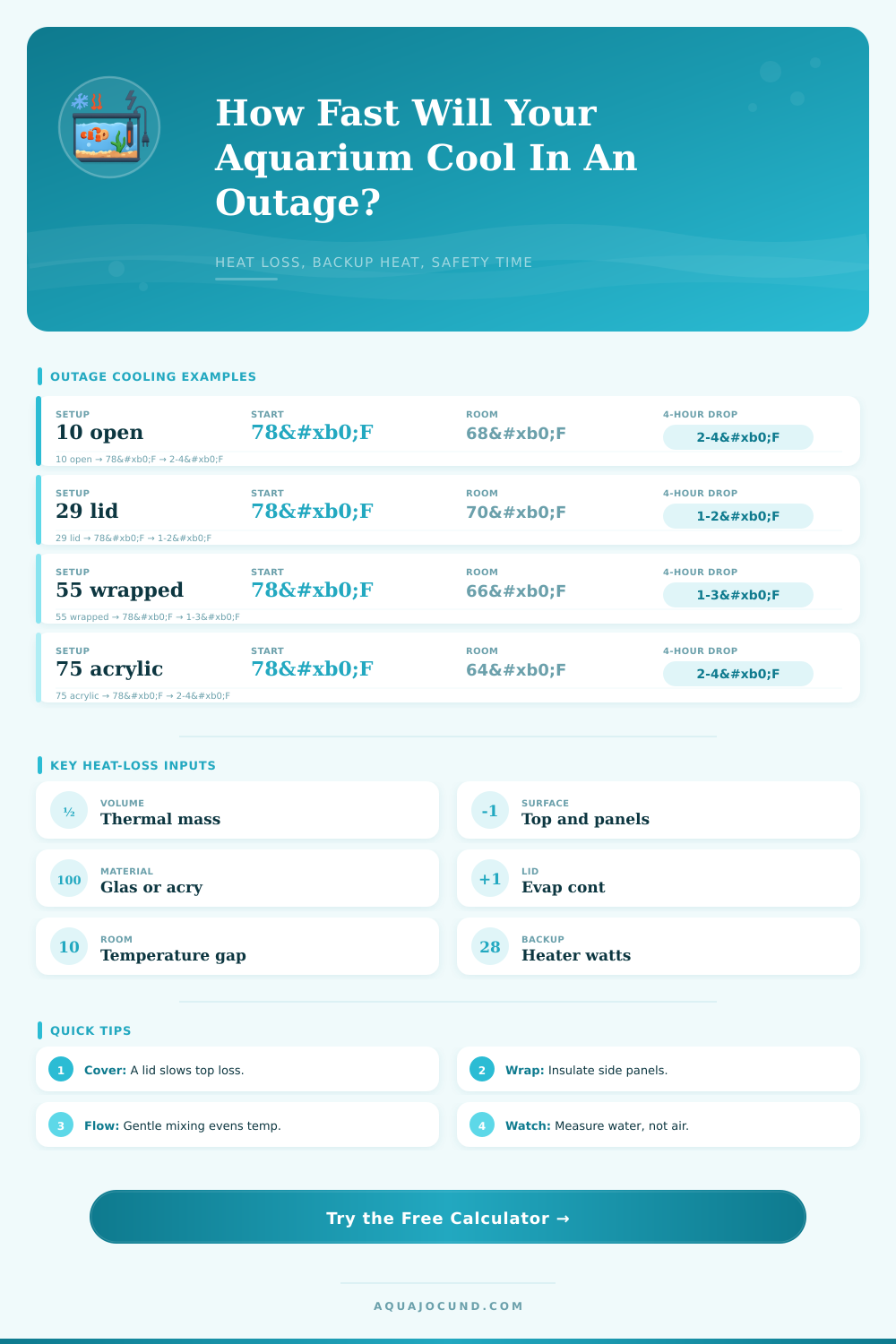
Estimate passive cooling during a power outage from water volume, surface area, glass or acrylic type, lid insulation, room temperature, backup heater watts, and water movement.
🔧Outage presets
⚙Tank, room, and backup inputs
📊Heat-loss factor snapshot
🧱Material and panel comparison
| Material type | Wall loss factor | Best matching input | Outage interpretation |
|---|---|---|---|
| Standard 6 mm glass | 1.00x | Small rimmed glass tanks | Baseline side-panel heat transfer |
| Standard 10 mm glass | 0.93x | Medium glass aquariums | Slightly slower panel loss |
| Low-iron glass | 0.96x | Display tanks with clear panels | Similar to standard glass for heat planning |
| Thick glass 12-15 mm | 0.86x | Large or rimless glass tanks | More panel mass and lower wall loss |
| Acrylic 6 mm | 0.80x | Nano acrylic aquariums | Acrylic insulates better than glass |
| Acrylic 12 mm | 0.72x | Larger acrylic tanks | Strongest normal panel insulation |
| Wrapped side panels | 0.58x | Glass with towel or foam sides | Emergency insulation cuts panel loss |
| Plastic tub | 0.78x | Holding tubs or stock tanks | Usually less wall loss but more exposed top |
🛡Lid, insulation, and movement grid
| Condition | Top loss factor | Movement factor | Use in calculator |
|---|---|---|---|
| Open top | 1.25x | Depends on ripple | Fastest evaporative and convective loss |
| Screen lid | 1.10x | Air can still move freely | Only a small improvement over open top |
| Glass canopy | 0.82x | Good with gentle circulation | Common first emergency step |
| Enclosed canopy | 0.70x | Air exchange reduced | Useful if oxygen is still handled separately |
| Towel wrap | 0.62x | Keep dry and away from outlets | Quick side-panel insulation |
| Foam board wrap | 0.50x | Best on sides and back | Strong short-term heat retention |
| Emergency blanket | 0.46x | Needs air gap to work well | Useful around outside panels |
| Insulated box wrap | 0.36x | Most practical for small tanks | Slowest modeled heat loss |
📐Common tank size heat-loss reference
| Tank | Dimensions | Volume | Heat-loss planning note |
|---|---|---|---|
| 5 gal betta | 16 in × 8 in × 10 in / 41 × 20 × 25 cm | 5 gal / 19 L | Small mass cools quickly; lid helps a lot |
| 10 gal | 20 in × 10 in × 12 in / 51 × 25 × 30 cm | 10 gal / 38 L | Open top can drop noticeably overnight |
| 20 long | 30 in × 12 in × 12 in / 76 × 30 × 30 cm | 20 gal / 76 L | Large top area makes lids important |
| 40 breeder | 36 in × 18 in × 16 in / 91 × 46 × 41 cm | 40 gal / 151 L | Broad surface benefits from foam or canopy |
| 55 gal | 48 in × 13 in × 21 in / 122 × 33 × 53 cm | 55 gal / 208 L | Good water mass, but high panels still lose heat |
| 75 gal | 48 in × 18 in × 21 in / 122 × 46 × 53 cm | 75 gal / 284 L | Often stable longer if covered |
⚡Backup heater and outage planning table
| Backup heat setup | Typical heater duty | Calculator entry | Temperature-loss effect |
|---|---|---|---|
| No powered heat | 0% | 0 W and 0% duty | Tank cools toward room temperature |
| Small UPS on nano heater | 20-60% | Heater wattage times expected duty | Can flatten short outages for small tanks |
| Inverter on larger heater | 10-40% | Actual watts available to heater | Often limited by battery size |
| Generator cycling | 25-75% | Average on-time across outage | May hold water near starting temperature |
| Room heat restored first | 0-30% | Raise modeled room temperature | Reducing the room gap can matter most |
When your heater goes out in the middle of the night and the lights go out too, you might be panicking. It’s usually at 12:00am. You are no longer thinking about thermodynamics, but rather worrying whether your fish will freeze.
Yes, water is a great heat reservoir, but it also gives up its heat to the air. That is why understanding how this works keep fish alive during grid failures or winter storms. When you know the dimensions, the calculator do the math for you. You don’t have to guess how fast that thermal mass will bleed off into a cold basement.
How to Keep Fish Safe When the Power Goes Out
Volume is all most aquarists think about. Bigger tanks must be better in case of outages. That’s not completly correct. While volume is a buffer, surface area determine how fast it leaks. A short, wide tank can contain more water than a narrow, tall tank. However, it also loses heat faster since it exposes more surface area (wall plus top) compared to its mass. It’s not just about the gallons; it’s also about geometry.
Now consider the lid. Rapid evaporative cooling will occur if you leave the lid off. Placing cardboard or a glass cover over the tank traps warm, humid air above the water and slows this rate of loss. I know, but it is simple. Using foam board or towels wrapped around sides also helps. Glass conducts heat out of the water and into the cooler room air. Here acrylic tanks actualy have an advantage; the material is a slight buffer against heat loss versus thin glass. Unless you’re measuring in small increments, most hobbyist don’t realize this until it’s too late.
Room temperature is the great equalizer. Even a well insulated fifty-five gallon tank will eventually get close to ambient air temperature if your home cool to fifty degrees when you’re gone for a week. The rate of loss depends on the gap between room temperature and your starting water temp. The larger the gap, the faster it cools. Knowing how long until your water reaches some critical point (depending on what you have in there) can be enlightening. A minimum comfort floor could of been useful when you have a plan, which is why we included it as an option on the tool.
A few notes on backup heaters: If improperly used, they can create a false sense of security. For example, plugging your heater into a regular UPS may extend its life by an hour or two, provided that the watts drawn are within the capacity of the battery. With this tool, you can include generator and inverter partial duty cycle, which will give you a better idea about how much heat will be retained compared to 100%.
More often than not, just warming up the room by a couple degrees can do more good than fighting the water temp straight up. It reduces the temperature difference through glass walls.
Do not neglect oxygen. Cold water can hold more dissolved oxygen than warm water; that’s good. However, turning off your filters and pumps to save power will slow down the gas exchange process (and stop any surface agitation). Before your fish get cold-stressed, they may be stressed out because of insufficient oxygen. A battery-operated air stone on very low flow can provide some circulation while sucking very little power from your backup source. That’s just a little insurance that provides stability.
What do most people do? At the last moment they get a blanket to wrap their tank(s) in and/or buy some heat packs. It makes sense; I get that, but it’s a reactive response. To plan is proactive, it’s understanding how your particular tank cools down based off its size/shape and insulating features. Try it out right now in cooler temps and turn everything off in your tank for an hour and see how quickly it cools down. That actual experience will beat any guess as each house has different humidity and draft conditions.
If/when your power comes back on… Don’t be tempted to rush to get the water heated back up again. The fish will be shocked by a sudden change in temp much more then a gradual decrease. If at all possible, let the tank and surrounding room gradually return to normal temp. Panic is a big no-no here, not only do you make dumb decisions (i.e., add unnecessary chemicals/move fish), but you stay calm too. Remember, a slow temp drop is easier on your fish than any quick “fix”. All you realy need to do now is leave that water alone and covered until the lights come back on.