Power Outage Tank Survival Time Calculator
Estimate a practical oxygen watch window from tank volume, stocking, temperature, surface movement, and backup aeration.
🔧 Outage presets
⚙ Tank conditions
📊 Oxygen demand reference
📝 Stocking and system factors
| Profile | Demand factor | Best use | Outage note |
|---|---|---|---|
| Shrimp or tiny nano fish | 0.45x | Shrimp colonies, lightly stocked nanos | Lowest animal O2 demand |
| Light community fish | 0.70x | Small tetras, rasboras, single betta | Good margin if cool and clean |
| Normal community fish | 1.00x | Typical mixed freshwater tank | Use as the baseline estimate |
| Active schooling fish | 1.25x | Danios, barbs, rainbows | Higher demand when warm |
| Goldfish / messy coolwater fish | 1.55x | Goldfish, large livebearers | High bioload despite cooler water |
| Large cichlids / predators | 1.70x | Oscars, large cichlids, predators | Low count can still mean high demand |
| Mixed reef fish and inverts | 1.45x | Reef tanks with rock, coral, fish | Night respiration adds uncertainty |
| Hospital or quarantine tank | 1.80x | Bare tank with stressed fish | Use conservative estimates |
🌡 Temperature and oxygen capacity
| Temperature | Freshwater saturation | Saltwater estimate | Outage meaning |
|---|---|---|---|
| 68°F / 20°C | About 9.1 mg/L | About 8.4 mg/L | Cooler water holds more oxygen |
| 74°F / 23°C | About 8.6 mg/L | About 7.9 mg/L | Moderate baseline for many tanks |
| 78°F / 26°C | About 8.1 mg/L | About 7.5 mg/L | Common tropical range |
| 82°F / 28°C | About 7.8 mg/L | About 7.2 mg/L | Less reserve and faster metabolism |
| 86°F / 30°C | About 7.5 mg/L | About 6.9 mg/L | Shorter watch windows are expected |
⚡ Backup aeration comparison
| Agitation status | Approx O2 recovery | Best interpretation | Risk level |
|---|---|---|---|
| Covered and still surface | Very low | Little gas exchange | High |
| Still open surface | Low | Some passive diffusion | Moderate high |
| Manual stirring | Low to moderate | Helps if repeated gently | Moderate |
| Weak battery splash | Moderate | Often enough for lighter tanks | Moderate low |
| Battery air stone | High | Best practical emergency step | Lower |
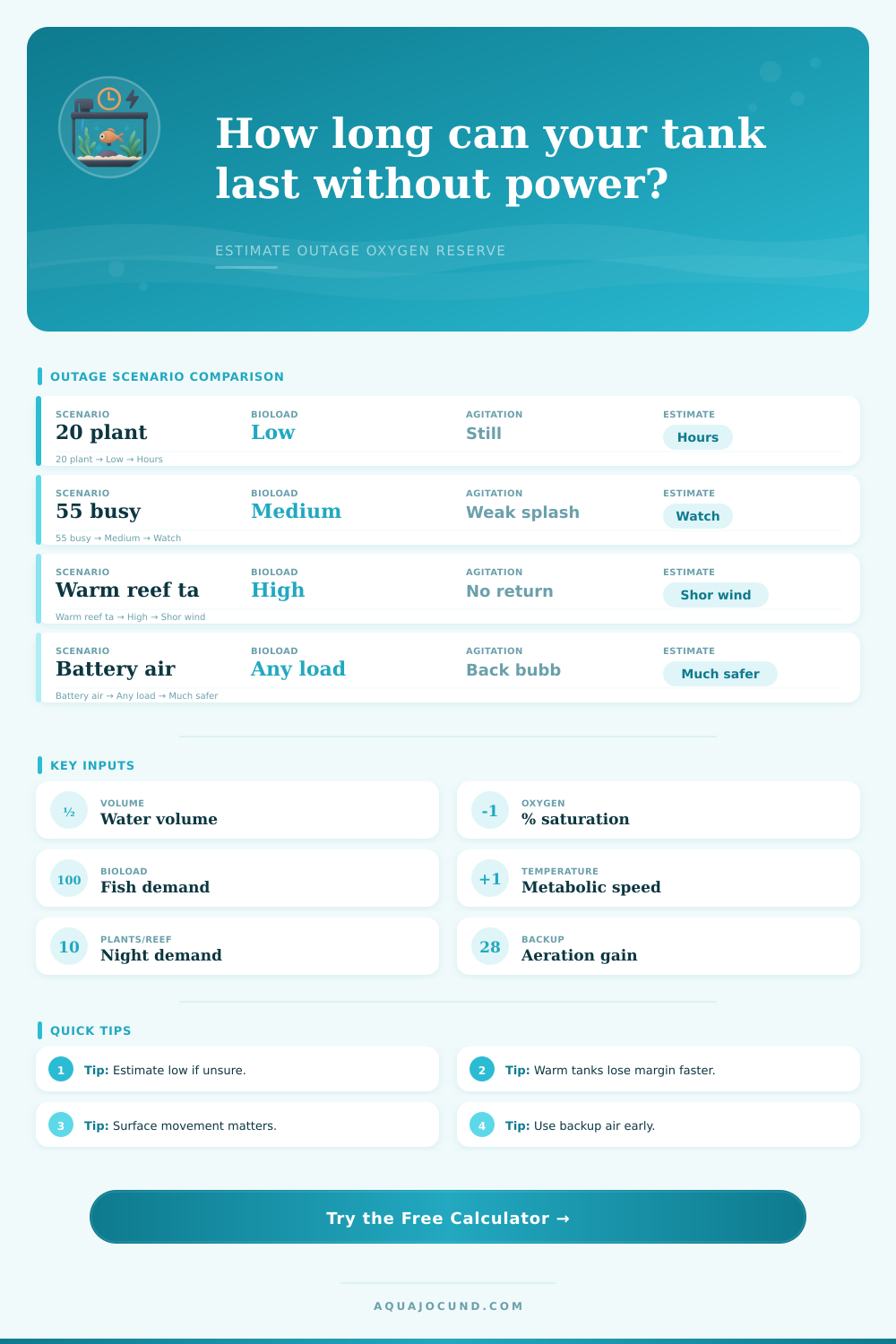
🧭 Risk and survival comparison grid
| Tank condition | Light bioload | Medium bioload | Heavy bioload |
|---|---|---|---|
| Cool tank, open surface | Longer watch window | Moderate watch window | Watch early |
| Warm tank, still surface | Moderate watch window | Short watch window | Urgent backup air |
| Heavy plants or reef at night | Watch closely | Shorter than baseline | Very high risk |
| Battery air stone running | Much improved | Improved | Still monitor closely |
The lights dim, the filter ceases to hum, and you’re faced with a power outage. What was once noisy silence has now become quiet darkness as you stare at a blank tank. It’s an aquarium keeper’s nightmare… A calm hobby that suddeny transforms into a race against time as oxygen slowly leave the tank. Whether it’s caused by storms and their accompanying power bills or otherwise, your fish don’t worry about electricity, only that water has become thinner.
Death from immediate suffocation isn’t usually sudden. Instead, there is a gradual decline in dissolved oxygen as the system idle itself to death, with bacteria eating up whatever oxygen is available in the water.
How to Keep Your Fish Safe During a Power Outage
To understand what’s happening with that blackout, however, it help to extend your vision beyond the halted pump. Anyone who has had a can of soda go flat knows that warm water doesn’t retain oxygen very well. It becomes harder for gas to stay dissolved in warmer water, much like warm soda.
That’s where the calculator (above) comes into play, you input your current conditions and tank volume and it does the math to save you from guessing how many hours margin you might have before things go sideways. For example, a 50g community tank at 78 degrees will act quite different than an all-coolwater goldfish setup at 65 degrees (even though they both may appear the same on surface).
The other major risk here is bioload. This isn’t simply a matter of headcount. It is also a matter of demand, which is the metabolic load per animal on your water column. If your tank contain many sloppy feeders or large cichlids, they will produce more waste and use oxygen faster then what can be passively diffused across a still water surface. This is why the table on the page assign demand factors for various stocking profiles. These help you understand how much buffer you have in a lightly stocked shrimp tank versus a heavily planted reef tank with corals that transition from an oxygen-producing mode during daylight hours to an oxygen-consuming mode at night. Many keepers don’t realize this until it’s too late, and that biological change is critical.
When the lights go out, a rippling surface are your best friend. When there’s no wave generated by a return pump, that glass surface acts as a lid. It keeps bad gases trapped inside and blocks oxygen from getting in. Breaking that seal with just a little bit of hand stirring once per hour can let fresh oxygen back into the tank and release those nasty gases. This can buy you some valuable time until you rig up battery-powered air pumps or wait for power company’s restoration crews. The impact of open versus closed is huge; it frequently means the difference between a fishless morning and a stressful afternoon.
Don’t freak out, although it’s tempting, panicking can be counterproductive at times. For example, you’d think that cooling the water down by adding some ice would of made sense because cooler water contains higher levels of dissolved O2. However, a sudden temperature change is stressful for fish, whereas small amounts of hypoxia are not. Better to shut off all feeding now because rotting uneaten food generates ammonia which consumes what little O2 remains. Make your tank an inactive area. No one produce any waste and everyone saves energy.
When it’s time to get ready for water changes, I’ll unplug the filter, remove the lid and powerhead, then place them on top of my tank while I clean out the sump. Keeping a battery-powered air stone charged and accessible can transform a high-risk power outage into a low-worry wait. Having a battery-powered air stone changes the entire equation, transforming a high-risk situation into a low-worry wait. It’s one of those tools where you can see just how safe that backup really is.
Now I know what my personal level of risk is, so I buy backup stuff based off that. It’s not rocket science; it’s respecting what you’ve set up and the parameters of the environment you’re trying to sustain. If the power goes out, you have no choice but to treat the tank as a closed system, one where your actions and starting state will determine survival or failure. You’ll be able to manage it if you know how agitation, bioload and temperature affects each other.
Eventually the lights might flicker back on…but in those silent hours, you learn something that makes you prepared for anything.