You go away for the weekend, and then you get a surprise. The power goes out. Your aquarium hums along happily in the blackness and your fish is now depending on forces of physics and chemistry rather than ease. Most aquarists freak out at this point. They scrounge around and grab whatever batteries is available and cross their fingers.
Backup runtime isn’t magic though, it’s arithmetic plus some fluid dynamics. If you know how to do some simple calculations, you’ll be able to figure out the runtime of your air pumps and plan accordingly. Will your present set-up keep your livestock breathin’ ’til Tuesday? Or will it conk out by midnight?
How to Calculate Backup Battery Runtime
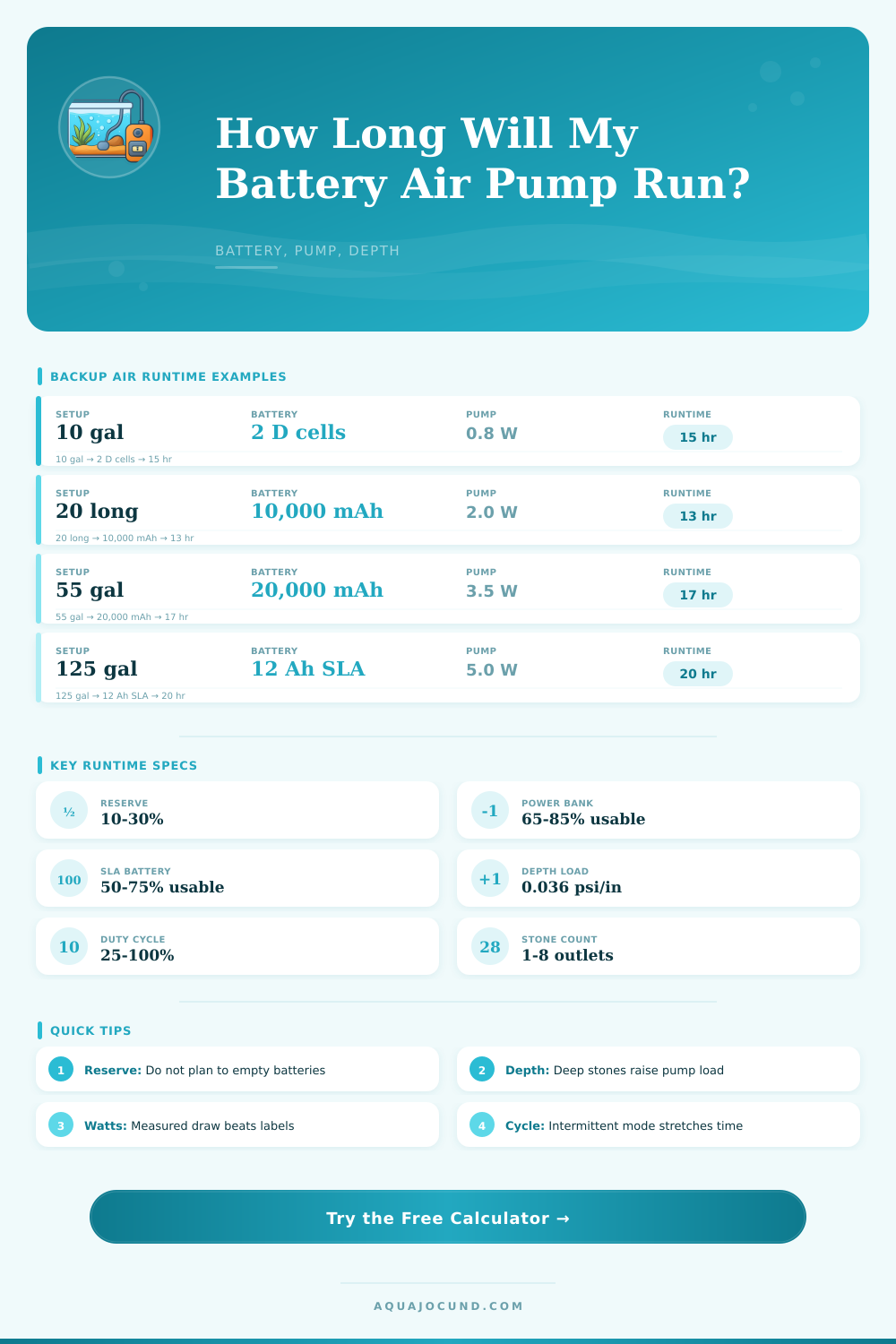
What’s confusing people is disconnect between a pump’s rating (what it can do) and what it actualy draws in watts. It sounds cool to have a high max spec, but it won’t tell you how much juice it burns. While some little pump-on-a-clip may say it pumps like crazy, how much power it uses will be largely determined by pressure behind it (aka backpressure). Once you know the watts your pump pulls and the size of your batteries, the calculator does the rest. No more trying to figure out how many watt hours are in a milliamp-hour yourself.
It also factors in the hidden losses that shorten runtimes, such as energy lost when raising voltage from a USB bank or the resistance caused by long tubing runs. Water itself also presses down on each and every inch of depth so even though many hobbyists think of “head” as a matter of volume only it’s not. Putting an air stone on the floor of a deep tank actually means the pump must work much harder to blow up that column of water. Remember, it isn’t just about volume; it’s about force. Just as a coarse stone or an open airline end requires less flow pressure from your pump then a fine pore diffuser does (it makes such pretty mist!), different sizes of restrictor also impact the load on your battery.
The chart on the page makes this very clear. It presents effect of different restrictors on the load they impose on your battery. Using a ceramic disk in a deep reef tank will require a far bigger battery bank than if you have a basic sponge filter in your shallow betta bowl.
Your backup window depends significantly based off battery chemistry. Stored energy is not all created equal. Alkaline D-cells seem simple, but their voltage drop steadily under load. But over time, their voltage plummets as they discharge. That last bit of juice is rarely useful for electronics requiring precision. Lithium-ion power packs keep their voltage steady for longer, but the management system inside will close the spigot if the draw is insufficient or if temperatures gets extreme. Sealed lead-acid batteries are inexpensive and rugged, but subject them to complete discharge and forget about having them last more than a cycle or two. These usable depth-of-discharge limitations are baked into the tool, so it won’t ask you to plan on using any energy that’s simply unavailable.
Duty cycle You should also consider whether you really need constant aeration during the outage. If the water quality isn’t terrible, fish can tolerate periodic blasts of air. Running in pulse mode or on a timer will dramatically increase battery life because you’re pulling power for just a portion of the hour. This is a small tweak that gives you precious time.
The key is how much reserve percentage you have versus what’s stressing you out. Having 20 percent of the battery capacity idle means it won’t drain down to zero, that saves the hardware from abuse and provides a cushion in case things run long. Testing beforehand is the best way to avoid a crisis state. Take your pump and plug it into whatever power source you plan to use then observe its runtime under normal circumstances. Compare this runtime to your estimate. If you’ve got your diffuser type and depth figured out properly, they’ll match pretty closely.
Next time the grid goes down, you won’t stress over the safety of your neon tetras. Instead, you can kick back with confidence that you ran the numbers, double-checked the connections, and prepped for the darkness. You should of tested them first.