Aquarium Siphon Flow Rate Calculator
Estimate water-change siphon speed from hose inside diameter, vertical drop, hose length, bends, tank water height, bucket back-head, clogging, and target volume.
🧪Hose and siphon setup
Measure from tank water surface down to the bucket floor or drain point.
Use 0 for a clear hose, 10 to 30 for gravel debris or a guard screen.
Calculation breakdown
📊Common siphon capacity markers
📏Siphon reference tables
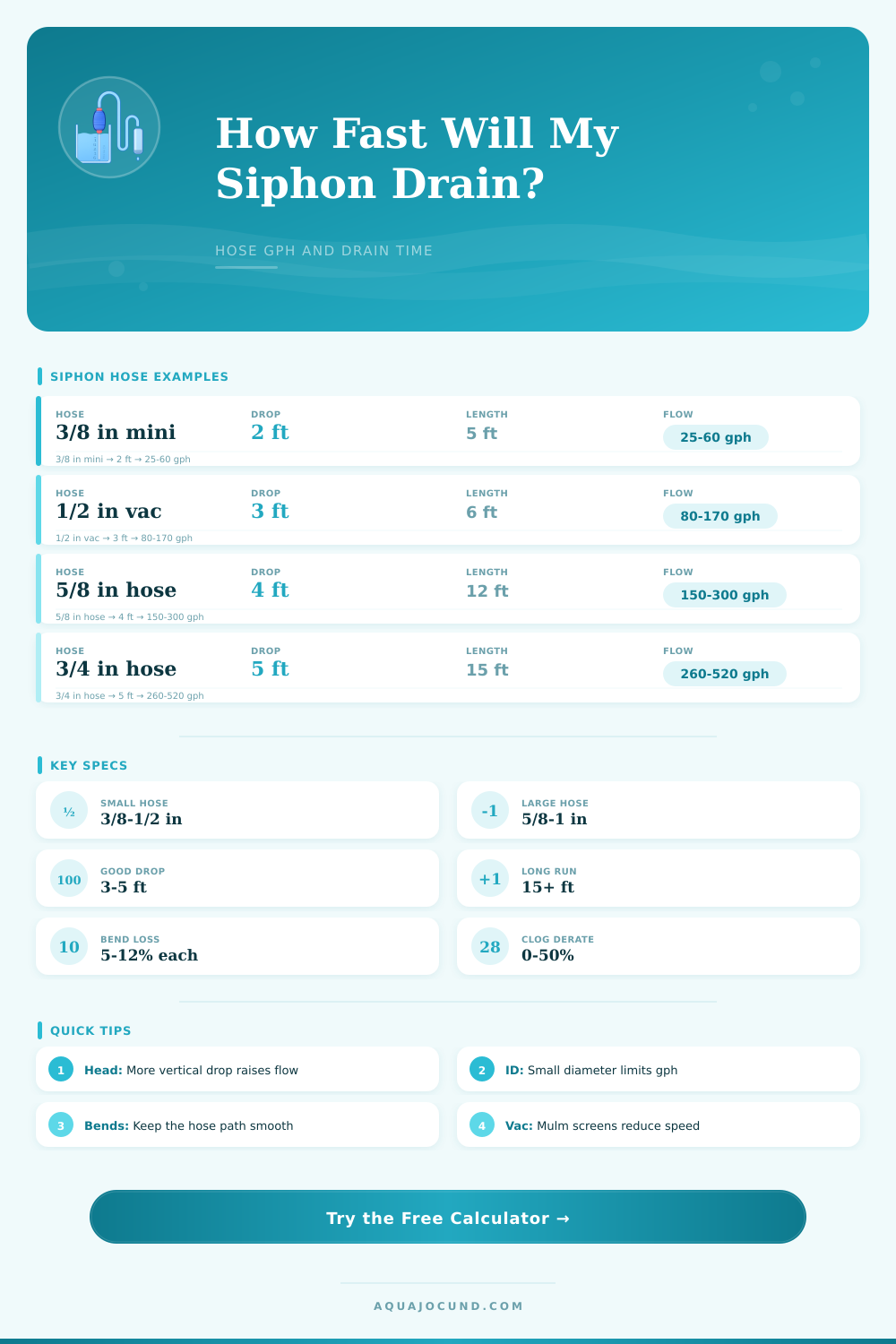
| Hose size | Typical inside ID | Practical flow band | Best use |
|---|---|---|---|
| Airline tubing | 1/4 in / 6 mm | 8-25 gph / 30-95 L/h | nano drip removal and fry tanks |
| Mini siphon hose | 3/8 in / 10 mm | 25-70 gph / 95-265 L/h | desktop tanks and careful substrate work |
| Standard gravel vac | 1/2 in / 13 mm | 80-180 gph / 303-681 L/h | 10 to 40 gallon aquariums |
| Medium change hose | 5/8 in / 16 mm | 150-320 gph / 568-1211 L/h | 40 to 90 gallon aquariums |
| Large change hose | 3/4 in / 19 mm | 260-520 gph / 984-1968 L/h | large tanks and fast bucket filling |
| Utility cleanout hose | 1 in / 25 mm | 500-950 gph / 1893-3596 L/h | sumps, ponds, and floor drains |
| Tank size | Example change | Flow to finish in 10 min | Flow to finish in 20 min |
|---|---|---|---|
| 10 gallon / 38 L | 2.5 gal / 9.5 L | 15 gph / 57 L/h | 8 gph / 30 L/h |
| 20 gallon / 76 L | 5 gal / 19 L | 30 gph / 114 L/h | 15 gph / 57 L/h |
| 40 breeder / 151 L | 10 gal / 38 L | 60 gph / 227 L/h | 30 gph / 114 L/h |
| 55 gallon / 208 L | 14 gal / 53 L | 84 gph / 318 L/h | 42 gph / 159 L/h |
| 75 gallon / 284 L | 19 gal / 72 L | 114 gph / 432 L/h | 57 gph / 216 L/h |
| 125 gallon / 473 L | 31 gal / 117 L | 186 gph / 704 L/h | 93 gph / 352 L/h |
| Hose or siphon method | Flow character | Restriction level | Best match |
|---|---|---|---|
| Plain open hose | Fastest for same ID | Low | Clear water removal and sump draining |
| Narrow gravel vacuum | Focused lift | Medium | Small gravel patches and sand edges |
| Standard gravel vacuum | Balanced lift and flow | Medium-high | Routine substrate cleaning |
| Wide gravel vacuum | Gentler intake velocity | High | Large gravel beds and bare-bottom tanks |
| Squeeze-bulb starter | Easy priming, slight loss | Medium | Bucket water changes with less mess |
| Faucet adapter drain | Long hose run | High | Remote sinks or floor drains |
| Adjustment | Low impact | Moderate impact | High impact |
|---|---|---|---|
| Vertical drop | 1-2 ft / 30-61 cm | 3-4 ft / 91-122 cm | 5+ ft / 152+ cm |
| Hose length | 3-6 ft / 0.9-1.8 m | 8-15 ft / 2.4-4.6 m | 20+ ft / 6.1+ m |
| Bend count | 0-1 smooth bend | 2-4 bends | 5+ bends or kinks |
| Debris restriction | 0-10% clear hose | 15-30% gravel mulm | 40%+ clogged screen |
| Bucket back-head | outlet above water | near water surface | deep submerged outlet |
💡Siphon calculation tips
How long does it take for your water changes? Five minutes? Twenty? When you look down at your fish and discover the latter, there’s a certain panic that kicks in. You’ve got a bucket and a hose (which appears bent on defying physics), and all you’re doing is watching water drip (not flow) as your fish stare back at you with indifferent judgment.
Why the frustration? This is typically because most of us don’t understand exactly how a siphon work. We mistakenly think that the larger the tank, the quicker the drain should be. In fact, it has less to do with volume and more to do with restriction and pressure. Plugging in your setup and hose dimensions into the calculator above takes care of the rest. You will no longer have to guess if your new vacuum can keep up with your cleanup schedule.
Why Your Water Change Takes So Long
As far as flow goes, head pressure, which engineers refer to as such, is king. Head pressure is nothing more than vertical difference between water’s surface inside your tank and its exit from the hose. Here again, gravity are doing all the work. If you have a lot of vertical distance (head) between the tank on its stand and bucket on the floor, you’re golden. But if you raise the bucket to waist height for example, you’ve lost that advantage. You’re battling against increasing water height within the receiving container, making the actual head smaller. That’s why most aquarists use low drain buckets (or actually put the bucket into a bathtub, when possible). The bigger the drop, the stronger the push of the water down the hose.
The inside diameter (ID) is what really matters (maybe even more), since width correlates directly to flow rate; it goes up exponentially. For example, a half-inch hose isn’t just twice as fast as a quarter-inch tube; it is often four to six times faster under the same conditions. It’s actualy four to six times slower under identical conditions. This is the reason. Area relates to radius in a square way. All those molecules of water are having to fight their way around the wall of the very narrow airline tubing. Friction develops, turning kinetic energy into heat and sound instead of movement. By stepping up to the three-quarter or five-eighth inch hose, you’re not just increasing hole size. You’re eliminating a big-time bottleneck that had been restricting your whole system.
More length and more bends cause loss. Additionally, bending a tube (such as a hose) adds friction that accumulates rapidly. Water flowing through any abrupt bend must change directions which generates turbulence, the enemy of efficiency. Even if you have an equal length of hose with several sharp turns (like on the floor), that setup will work better then a single straight drop into your bucket.
Gravel vacuums makes this worse. They often have wider intakes, tubes, or screens that prevent gravel loss during cleanings but reduce flow. While these is essential for doing their jobs, they also impede drainage relative to an empty open tube. There’s no free lunch when it comes to fluid dynamics, so you must compromise either performance or control.
Clogging is the wildcard. The math gets a bit messier in the real world, but the calculator handles it for you. Hair and mulm debris can shrink effective diameter anywhere from 10-30% or more. That’s a trickle instead of a steady stream, particularly if you’re vacuuming heavily soiled substrate. Fortunately, the calculator includes a clog derate factor specifically for this real world sloppiness. Because, face it, theory never equals practice when it comes to an aquarium we live with. So setting this parameter above zero (albeit a bit) provides a more realistic estimate of the actual time it’ll take you to do your chore. And that means no longer being disappointed because you got to the sink before the water did.
This is where knowing what your flow rate should be comes in handy. You’ll want to plan around it accordingly. For example, I may have determined that a ten-gallon removal will take fifteen minutes with my current setup without stirring up way too much detritus. This allows me to adjust accordingly (say I’m going to do a water change during work hours) or consider whether upgrading might be worth-while. Additionally, knowing your flow rate helps prevent accidentally sucking up your substrate. Experimenting until you find the best amount of flow that balances stability of your tank and cleaning efficiency is necessary. The reference tables on this page plot general ranges of common hose diameters so you can use these as a sanity check against your calculations.
Patience is the name of the game. Routine is the other part of the equation. There isn’t any single magic device that will make the wet part go away, but once you understand how things work, the mystery dissapears too. Suddenly, you’re not fighting your tools; you’re making them work for you. You know that a short drop helps things and a narrow hose slows things down. And when you realize this, you’ll make those adjustments before starting up the siphon.
The next time you find yourself standing above that bucket, you won’t be waiting for the water to come out. You’ll be watching the laws of physics in action…one gallon at a time.