Aquarium Glass Canopy Size Calculator
Size canopy cut panels from inside rim length, inside rim width, trim lip, clearance gap, rear cutout, hinge strip, panel count, overlap, material, and thickness.
📏Tank opening and panel layout
Measure the clear left-to-right opening where the canopy sits.
Measure front-to-back before deciding the rear equipment opening.
Use only the extra curved depth beyond the straight side width.
Eurobraced covers often sit inside the brace opening.
Leave space for filter tubes, cords, airline, heater cords, or overflow plumbing.
Canopy Sizing Breakdown
🧪Material and thickness comparison
📊Reference tables
| Common tank | Nominal tank size | Typical inside opening | Starting canopy layout |
|---|---|---|---|
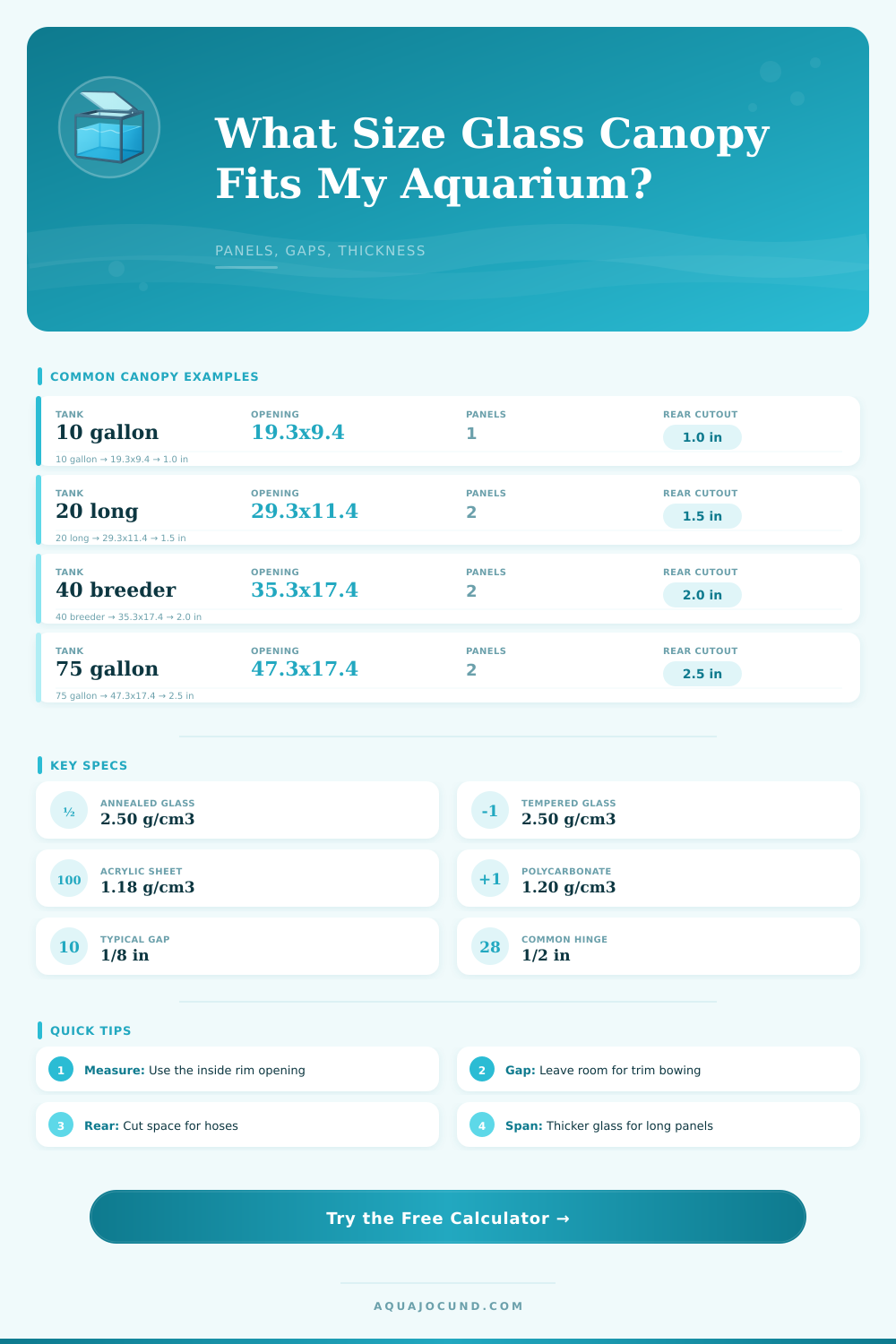
| 10 gallon | 20 x 10 x 12 in / 51 x 25 x 30 cm | 19.3 x 9.4 in / 49.0 x 23.9 cm | 1 panel, 1.0 in rear cutout |
| 20 high | 24 x 12 x 16 in / 61 x 30 x 41 cm | 23.3 x 11.4 in / 59.2 x 29.0 cm | 2 panels, 1.5 in rear cutout |
| 20 long | 30 x 12 x 12 in / 76 x 30 x 30 cm | 29.3 x 11.4 in / 74.4 x 29.0 cm | 2 panels, 1.5 in rear cutout |
| 29 gallon | 30 x 12 x 18 in / 76 x 30 x 46 cm | 29.3 x 11.4 in / 74.4 x 29.0 cm | 2 panels, 2.0 in rear cutout |
| 40 breeder | 36 x 18 x 16 in / 91 x 46 x 41 cm | 35.3 x 17.4 in / 89.7 x 44.2 cm | 2 panels, 2.0 in rear cutout |
| 55 gallon | 48 x 13 x 21 in / 122 x 33 x 53 cm | 47.3 x 12.4 in / 120.1 x 31.5 cm | 2 panels, 2.0 in rear cutout |
| 75 gallon | 48 x 18 x 21 in / 122 x 46 x 53 cm | 47.3 x 17.4 in / 120.1 x 44.2 cm | 2 panels, 2.5 in rear cutout |
| 90 gallon | 48 x 18 x 24 in / 122 x 46 x 61 cm | 47.3 x 17.4 in / 120.1 x 44.2 cm | 2 panels, 2.5 in rear cutout |
| 120 gallon | 48 x 24 x 24 in / 122 x 61 x 61 cm | 47.3 x 23.3 in / 120.1 x 59.2 cm | 3 panels, 3.0 in rear cutout |
| Material | Density | Useful thickness range | Canopy sizing note |
|---|---|---|---|
| Annealed float glass | 2.50 g/cm³ | 3 to 6 mm / 1/8 to 1/4 in | Common for small to medium hinged lids |
| Tempered glass | 2.50 g/cm³ | 4 to 6 mm / 5/32 to 1/4 in | Cannot be cut after tempering |
| Low-iron glass | 2.50 g/cm³ | 4 to 6 mm / 5/32 to 1/4 in | Clearer edge tint at the same weight |
| Laminated safety glass | 2.55 g/cm³ | 6 mm+ / 1/4 in+ | Heavier and thicker; check hinge fit |
| Cast acrylic sheet | 1.18 g/cm³ | 3 to 6 mm / 1/8 to 1/4 in | Light but needs shorter spans |
| Solid polycarbonate | 1.20 g/cm³ | 3 to 6 mm / 1/8 to 1/4 in | Light, impact resistant, flexible |
| Twinwall polycarbonate | 0.55 g/cm³ effective | 6 to 10 mm / 1/4 to 3/8 in | Low weight, thicker edge profile |
| Unsupported panel span | Glass thickness starting point | Metric thickness | Layout suggestion |
|---|---|---|---|
| Under 12 in / 30 cm | 1/8 in | 3 mm | Single or hinged small cover |
| 12 to 18 in / 30 to 46 cm | 5/32 to 3/16 in | 4 to 5 mm | Two panels reduce handling weight |
| 18 to 24 in / 46 to 61 cm | 3/16 to 1/4 in | 5 to 6 mm | Use cross support or 3 panels |
| Over 24 in / 61 cm | 1/4 in+ | 6 mm+ | Split into narrower hinged sections |
| Allowance | Typical range | Use when | Calculator effect |
|---|---|---|---|
| Clearance gap | 1/16 to 3/16 in / 1.5 to 5 mm | Plastic trim is uneven or bowed | Subtracts from length and depth |
| Trim overlap | 1/8 to 3/8 in / 3 to 10 mm | Glass rests on a rim lip | Adds support up to lip width |
| Rear cutout | 1 to 4 in / 25 to 100 mm | Filters, cords, overflows, airline | Reduces glass depth and coverage |
| Hinge strip | 3/8 to 5/8 in / 10 to 16 mm | Flexible vinyl or silicone hinge | Subtracts between panels |
| Finger notch | 3/4 to 1 1/4 in / 19 to 32 mm | Lifting a solid front panel | Subtracts a small semicircle area |
💡Glass canopy sizing tips
Getting accurate dimensions for cutting out custom canopies for an aquarium sounds easy enough…until you pull out the tape measure. You look at side of your tank, measure the interior width and length, and bam! Done! Well, most times, that’s where it fails. Over time the rim warps just a bit from the aging plastic, and then the glass has to have a little gap so it doesn’t bind against the plastic rim. If you get a canopy cut that fits snugly, as soon as you pick it up off the tank it cracks because it flexed too much in one direction. If you leave the trim bowed over long term, it’ll stay that way forever. The rim calculator above take your raw rim dimension measurements and converts them into accurate cuts that takes the physical allowances into consideration.
That brings me to the first factor: the actual interior size of the tank (as in the real inside opening). The outside dimensions are nominal (e.g., “twenty gallon long”), which can vary from manufacturer to manufacturer. Additionally, each batch produced have slightly different clear openings, even if made by the same company for the same size. The base measurement is the distance between the inside edge of the rim all the way around, width and length.
How to Measure Your Aquarium for a Custom Canopy
You then take away a slight gap to allow for the clearance of the glass; generally about an eighth of an inch on each side. It doesn’t sound like much, but without this space, you’ll end up with glass jamming into irregularities in the plastic lip. One second it will slide on; next time, it won’t go back on because you accidently scraped some algae off the front pane. Do you want clean lids that slide on easily or ones that jam?
The panel decision follows next. Although a single piece of solid sheet material look sleek, larger spans make it hard to handle quickly. Two hinged panels provide more manageable size and reduce chances of dropping a large sheet. When using several panels, consider the width of the hinge strip. That’s right; that’s room for the actual hinge mechanism (silicone/vinyl) to move in and out. Without it, you end up with panels that just butt together, not swing apart.
The table on the page show some typical layouts. These can give you an idea of what works for common tank sizes and how many panels makes sense for those sizes.
The price of materials impacts not only cost, but also weight. Rigid glass will crack in large pieces if handled roughly. However, it is inexpensive and standard annealed glass. Tempered glass provide additional strength, shattering into smaller cube-like pieces. It cannot, however, be cut once tempered. Acrylic and polycarbonate materials are much lighter, so consider how often you’ll need to remove the cover when maintaining or feeding your tank. Your choices in these materials decides the density and thickness values used by the calculator to estimate the final weight. Heavier canopies might needs stronger hinges and even more secure mounting locations.
The biggest factor in deciding what thickness is how long your cover panels will be. Front panels tend to have more unsupported length than side and rear ones, so they requires a thicker piece of glass to support their own weight without sagging. If you’re making panels smaller than a foot, then an eighth inch glass should of been sufficient. When you get up around eighteen-to-twenty-four inches, however, you’ll want to step up to three-sixteenths or a quarter inch just to keep things structurally sound. This is where the span limitations come in. The tool will recommend a thickness based off those spans. This ensures you don’t end up with something too floppy that wiggles out when you try to open it.
Remember the back cutout You’ll want some space behind the glass for things like heater cords, airline lines, and filter tubing (most setups require). Having that cutout in the design allows your equipment to breathe while providing enough air flow underneath the canopy so it doesn’t have to be lifted. It will also provide a natural lift point should you choose to add finger notches to the front edge. The little touches make this simple piece of plastic more than just another cover.
The right sizing of canopies will save you heartache and money down the road. Glass can be ordered wrong. The glass can be too big, meaning you have to pay for recuts. Or it can be too small, creating holes that allow humidity out and debris to fall into the tank. Measure slowly, account for the hinge spacing and additional clearance needed around the rim and then let math take over. The right fit is easy to maintain every day and protects the environmental conditions inside your tank.