Aquarium CO2 Refill Cost Calculator
Estimate planted-tank CO2 refill timing, monthly gas use, reserve capacity, and cost per effective gram without brand recommendations.
Capacity in lb of CO2.
Use your local refill or exchange charge.
Average count after needle valve settles.
Gas-on hours, usually before and during lights.
Estimated gas dissolved or retained in flow.
Display volume in gallons.
Use 22 for weekday-only dosing or 30 for daily.
Cylinder gas kept as a planning reserve.
Fine mist is lower; large counter bubbles are higher.
Allows for purging, leaks, and regulator adjustments.
This adjusts the suggested efficiency range in the reference notes; your entered percentage controls the math.
20 oz Paintball
2.5 lb Cylinder
5 lb Cylinder
10 lb Cylinder
Ceramic Disc
Inline Atomizer
External Reactor
Bubble Ladder
| Cylinder Size | CO2 Capacity | Best Fit | Planning Note |
|---|---|---|---|
| 20 oz | 567 g / 1.25 lb | 5-20 gal planted tanks | Frequent refills if bubble rate rises above 1 bps |
| 2.5 lb | 1,134 g / 2.5 lb | 10-40 gal aquascapes | Good size when cabinet space is limited |
| 5 lb | 2,268 g / 5 lb | 40-75 gal display tanks | Often the most convenient refill interval |
| 10 lb | 4,536 g / 10 lb | 75-180 gal planted systems | Lower refill frequency, needs more storage space |
| Bubble Rate | 7 Hr Raw Use | 30 Day Raw Use | Typical Tank Range |
|---|---|---|---|
| 0.5 bps | 1.0 g/day | 30 g/month | Nano and low light setups |
| 1.5 bps | 3.0 g/day | 89 g/month | 10-29 gal moderate planting |
| 3.5 bps | 6.9 g/day | 207 g/month | 40-75 gal high light tanks |
| 7.0 bps | 13.8 g/day | 415 g/month | Large display aquascapes |
| Diffusion Method | Efficiency Range | Cost Effect | When to Recheck |
|---|---|---|---|
| Ceramic disc | 60-80% | Moderate waste if bubbles reach surface | When the disc clogs or stream turns coarse |
| Inline atomizer | 70-90% | Better spread, may need higher pressure | After filter cleaning or hose changes |
| External reactor | 85-98% | Lowest wasted gas at steady flow | When flow slows or trapped gas builds |
| Passive bell | 25-55% | Low control, higher cost per dissolved gram | Any time plant demand changes |
| Tank Style | Gas Demand | Photoperiod | Cost Watchpoint |
|---|---|---|---|
| Low light planted | Low to moderate | 6-7 hr/day | Do not chase high bubble counts |
| Carpet aquascape | Moderate to high | 7-8 hr/day | Stable flow matters more than bursts |
| Dutch stem tank | High | 7-8 hr/day | Pruning can change uptake quickly |
| Large community display | Moderate to high | 6-8 hr/day | Reserve margin prevents surprise empty tanks |
Bubble math uses CO2 density near room conditions: about 1.96 mg per mL. Real bubble counters vary, so refill logs are the best calibration.
There’s nothing more worrying than watching your CO2 gauge drop and seeing the color leach out of your planted tank. Not only do the plants requires carbon, but you’re trying to save money too. You don’t want to pay for escaped gas that goes into room air, yet you want lush carpeting. Watching your plants lose color while your CO2 drops is a dual crisis of botany and budget.
Except for the monthly water refills, most maintenance costs for a planted aquarium aren’t spent on equipment. Most hobbyists are blindsided by this. They purchased the tank and lights…why does my utility bill look like I feed a small industrial plant? Once you plug-in your bubble rate and cylinder size, the calculator do the rest of the math for you. No need to guess at conversions or coefficients that wildly differ based off your setup.
How to Save Money on CO2
So what’s the catch? Bubbles are an awful measure of cost! You see, a bubble counter shows how much gas came out of the cylinder. That number does not reflect how much CO2 has been dissolved in water. The latter is what matters. You lose money in that gap.
The efficiency of the diffuser is the dividing line between budget conscious aquascaper and the one who is simply happy to have a bubble counter providing visual feedback. While a ceramic disc bubbling away merrily may appear to be doing a good job, it doesn’t mix well and most of the gas go straight up to the surface. In this case, you’re just wasting money as the gas escapes to carbonize your ceiling paint.
Near the end of the tank, there is also a loss due to regulator inefficiency and line loss which further worsens the math. That’s where having a reserve margin comes into play. If your cylinder isn’t empty before the needle valve starts to shake due to low pressure, most folks think they’re being frugal. They plan to use every single gram of gas inside the cylinder. Wrong. Low pressure regulators suck. They doses erratically, shocking your plants more than under-dosing them ever could. Having a reserve of ten or even fifteen percent means you’ll have a consistent dose for the entire usable portion of the fill. You pay no additional cost up front but avoid the headache of running back mid day to top off.
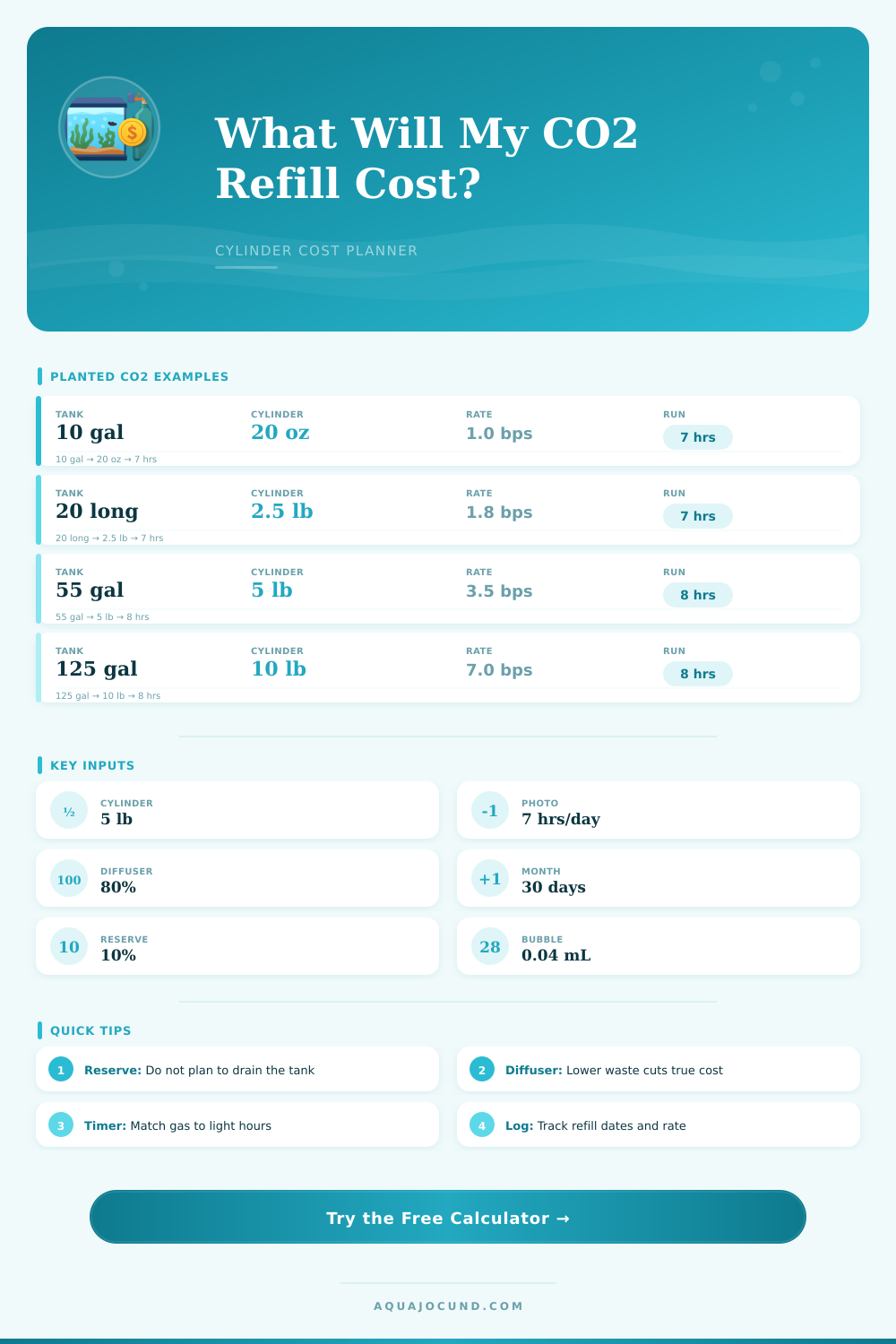
I have a reference chart here that shows this, pitting cylinder sizes against projected runtimes. It also explains quite well why smaller 20 ounce paintball cylinders can be an extremely costly trap when used on bigger systems. They simply don’t last long and you end up making many trips to the store. Those costs adds up in both money AND time which is usually significantly greater than actual price of the gas!
But examine your photoperiod objectively as well. It’s normal to turn on the CO2 injection at the same time the lights are turned on and shut it down shortly after the light go out. All that extra time you spend flowing gas is wasted because once the light goes out, so do the plants. They quit photosynthesizing. Anything you inject afterward will either escape into the air or be trapped in the headspace. Synchronize your injection time with your light time and you’ll have a much tighter budget. You’re forced to match your equipment to biology instead of habit.
A second frequently overlooked blindspot: the assumption that more bubbles mean better growth. Here’s where people screw up all the time. A higher bubble rate doesn’t equate to higher plant density or better water movement, it simply results in more waste. If the diffusion method is effective enough, then you can have a low bubble number and still look like an advanced tank.
External reactors and inline atomizers provide greater dissolution rates different than passive bells. That is, fewer bubbles result in the same amount of water saturation. Fewer bubbles mean less gas consumption. Less gas use results in longer refill intervals. The financial picture becomes clear when you stop looking at the price of the refill and start looking at the cost per effective gram dissolved in the tank. Half the gas dissapearing before it reaches a leaf doesn’t make for a bargain refill. Efficient diffusion matters. It completely changes the equation.
It turns this recurring expense into a manageable line item. By controlling your waste, you gain control of your hobby. You aren’t minimizing your spend, you’re maximizing the health of your plants for every dollar spent. If you’ve ever seen how much gas you’re throwing away, then you’ll never look at a bubble counter the same way again.
You should of known better!