💧 RO/DI Water Cost Per Gallon Calculator
Calculate your true cost per gallon of purified water including filters, membrane, DI resin & water waste
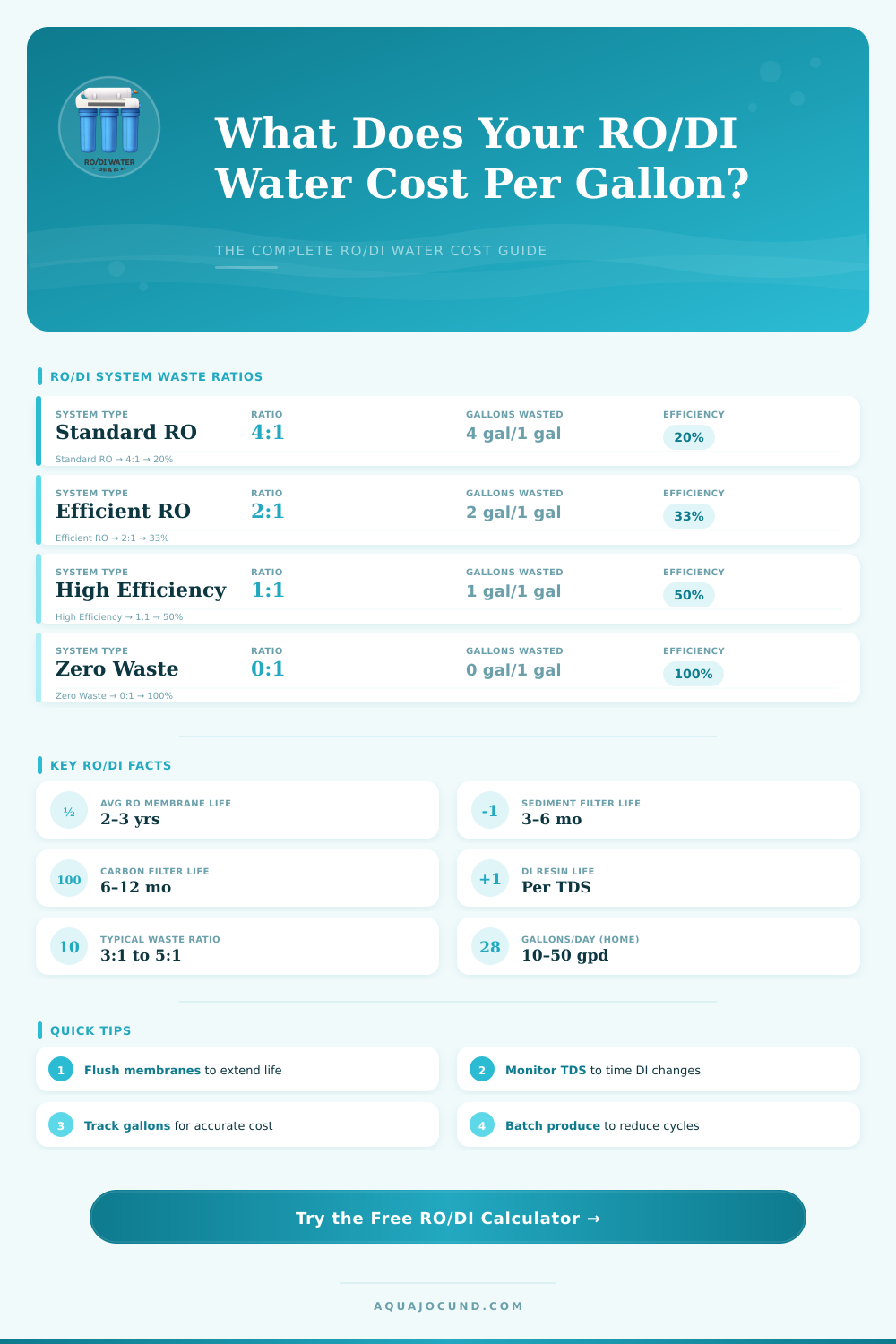
| Waste Ratio | Product Gallons | Waste Gallons | Total Used | Efficiency |
|---|---|---|---|---|
| 0:1 (DI Only) | 1 | 0 | 1 | 100% |
| 1:1 (Zero Waste RO) | 1 | 1 | 2 | 50% |
| 2:1 (Efficient RO) | 1 | 2 | 3 | 33% |
| 3:1 (Standard Home) | 1 | 3 | 4 | 25% |
| 4:1 (Budget Systems) | 1 | 4 | 5 | 20% |
| 5:1 (Old / Low PSI) | 1 | 5 | 6 | 17% |
| Component | Typical Life | Replace When | Typical Cost |
|---|---|---|---|
| Sediment Filter (5 micron) | 3–6 months | Flow drops / discolored | $5–$15 |
| Carbon Block Pre-Filter | 6–12 months | Schedule / chlorine test | $8–$20 |
| RO Membrane (50–100 GPD) | 2–5 years | TDS rejection < 75% | $30–$80 |
| DI Resin (Mixed Bed) | 500–2,000 gal | TDS meter reads > 0 | $20–$60 |
| Post Carbon Filter | 12 months | Schedule | $8–$18 |
| UV Lamp | 12 months | Annual regardless of use | $15–$40 |
| Booster Pump | 5–10 years | Low output / no pressure | $30–$80 |
| System Type | Setup Use Case | Approx CPG Range | Key Factor |
|---|---|---|---|
| DI Only | Top-off from pre-RO source | $0.02–$0.08/gal | Resin life |
| RO Only (50 GPD) | Drinking water home | $0.03–$0.10/gal | Waste ratio |
| RO/DI (100 GPD) | Reef tank / aquarium | $0.05–$0.18/gal | DI resin use |
| RO/DI + UV (100 GPD) | Lab / research / food | $0.08–$0.25/gal | UV lamp cost |
| High-Volume (500+ GPD) | Commercial / greenhouse | $0.02–$0.07/gal | Volume efficiency |
| Countertop RO/DI | Nano tank / apartment | $0.10–$0.30/gal | High per-unit cost |
| Imperial | Metric | Rate | Common Use |
|---|---|---|---|
| 1 US Gallon | 3.785 Litres | x3.785 | Tank volume |
| 1 Litre | 0.264 US Gallons | x0.264 | EU systems |
| 1 GPD | 3.785 LPD | x3.785 | System capacity |
| 100 GPD system | 378.5 LPD | x3.785 | Rating conversion |
| $1 / 1,000 gal | $0.264 / 1,000 L | ÷3.785 | Water utility rate |
| 1 psi | 6.895 kPa | x6.895 | Feed pressure |
If you’ve ever refilled a bucket with purified water for your reef tank, then you’ve been frustrated at how slow that bucket fills up. It’s like watching gallons go down the drain while only a few dribbles enter the bucket collecting the water. It seems like a waste, but until you calculate the cost, you have no idea how much it actualy is.
Enter the above tool, it will convert wasted water to a clear dollar/gallon value. A lot of folks believe that RO/DI water costs is limited to purchasing resin and filters. They figure that’s it; just regularly replacing sediment cartridges and refilling their DI column when necessary; and its no big deal. Wrong. Your actual expense may be your municipality’s water bill, and that’s where many variables exists.
Why You Should Calculate Your Water Cost
With a normal three-to-one waste ratio using a conventional system, you’re pouring down the drain three gallons of treated water for each gallon you retain. Depending on your utility rate, that can be more expensive then what you paid for that plastic membrane in your housing unit. To adjust for this, the calculator has a field where you can enter how much waste you produce (and if you want, what your local water cost is). It requires you to consider efficiency of your setup.
It may be an expensive investment at first, especially if you choose high efficiency or zero waste system. However, the numbers prove time and again that you’ll break even in one to two years thanks to reduced water bills. Remember, it’s not just improved filtration you’re purchasing… It’s the return on the water that you previous lost. It’s a relatively inexpensive piece of equipment that will have a large impact on your long term expenses.
Pre-filters: How much do they affect component lifespan? How long do the components last? It depends on what’s in your tap water. An RO membrane will be destroyed far quicker by hard water (high minerals) compared to soft water. Look at this chart from the page showing how pre-filters can save money since they is protecting more expensive components further down. Don’t neglect changing out those pre-filter just because they seem clean! That’s why they exist; to capture debris so it doesn’t get to the membrane. Running a pre-filter beyond its effective life span are gambling with your membrane.
The economics of DI resin is a bit of a puzzle as well. Resin doesn’t get old like filters do; it burns up based off how much it absorbs until it’s no longer able to hold any more ions. You’ll go through resin blocks faster if your source water has a high amount of total dissolved solids. Enter what you expect the resin life to be on the calculator, and it will tell you about how much it will cost per gallon. The TDS of your incoming water is far more important than what brand of system you have. A hundred gallons of pure water isn’t going to cost nearly as much if your source water begins at 50 parts per million instead of 250 parts per million.
I see many hobbyists attempting to stretch their budget with untested/unknown brand filters and other components. Seems reasonable at first glance until you recall that a bad carbon filter will spew particles back into the tank or not adequately eliminate chlorine, both of which is harmful to your RO membrane. The bottom line is quality = long life. It is not so much about the quality of the end product (water) as it is about the life of the system itself. A few extra bucks saved on substandard components today equals replacing them prematurely next month. Costing you an additional fifty dollars.
That’s when I realized: knowing how much it costs me per gallon of water will prevent guesswork. It takes a vague “it costs too much” feeling and makes it something concrete, something I can do something with. If my tank requires different filters, if I want to upgrade to a bigger tank, or if I want to change my filter routine, I can make those choices armed with numbers. I won’t have to wonder where the money went; I’ll be able to control things that affect the amount. The water will still take its sweet time filling up the bucket, but this time I’ll know what’s going on and how much it all cost me.