Aquarium Electricity Cost Per Month Calculator
Estimate monthly aquarium power use from continuous pumps, timed lights, heater duty cycle, UV, air pumps, controllers, and your local kWh rate.
🐟Real aquarium presets
💡Lighting and temperature load
Used for energy-per-gallon and heater reasonableness checks.
Use the delivered energy rate from your utility bill.
Example: 25 means the heater is on about 6 hours in a day.
🔌Pumps, filtration, and always-on equipment
Adds a small reserve for older equipment, meter variance, and seasonal swings.
Full electricity breakdown
📊Equipment load comparison grid
📘Reference tables
| Equipment | Typical watts | Runtime style | Calculation note |
|---|---|---|---|
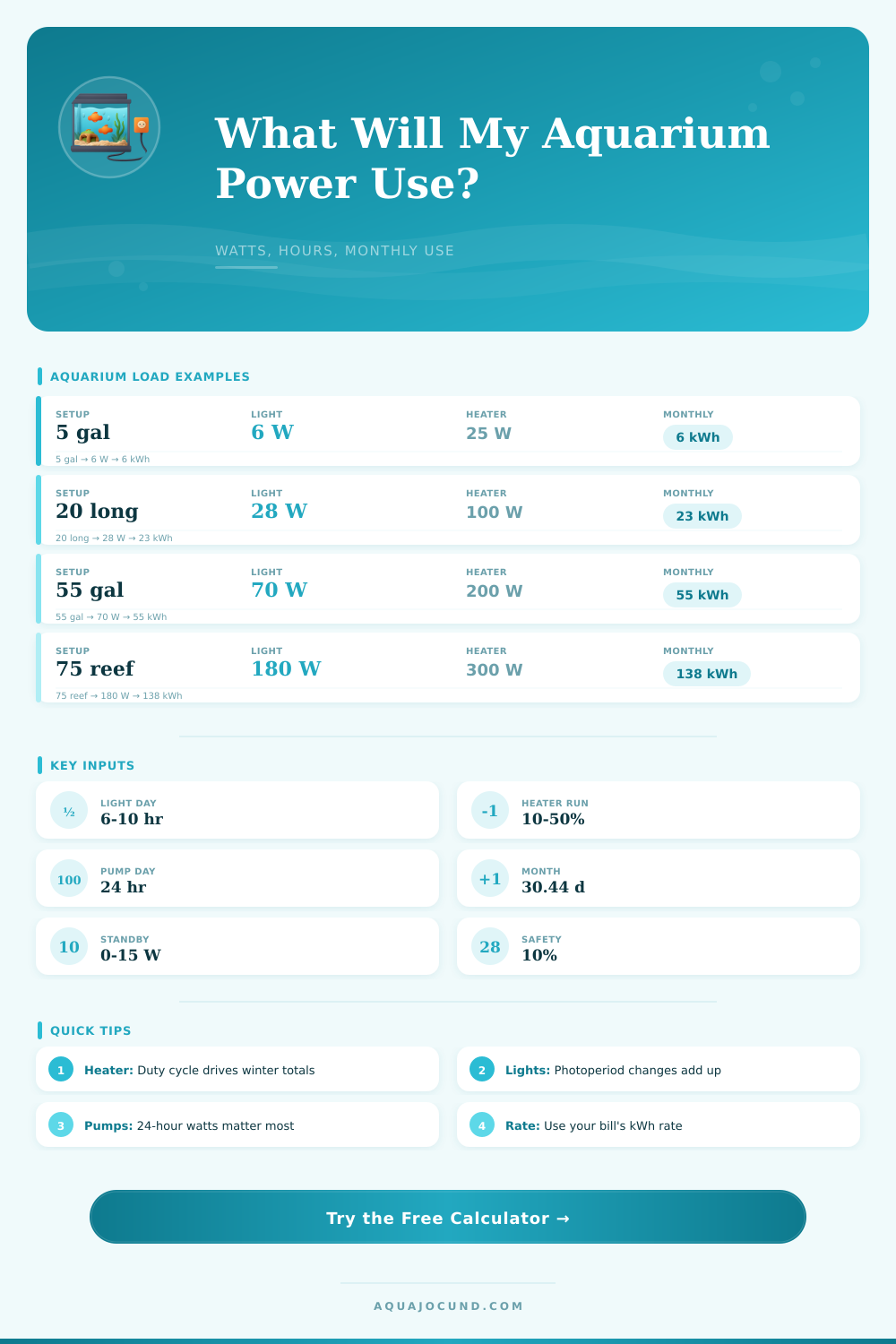
| Nano LED light | 5 to 15 W | 6 to 9 hr/day | Timed load, usually smaller than heat. |
| Planted LED light | 20 to 90 W | 6 to 10 hr/day | High intensity or long days raise kWh fast. |
| Hang-on filter | 4 to 18 W | 24 hr/day | Small wattage matters because it never stops. |
| Canister filter | 12 to 35 W | 24 hr/day | Flow setting and media load can change draw. |
| Return pump | 25 to 120 W | 24 hr/day | Sumps often shift the largest non-heater load here. |
| Powerhead | 3 to 40 W | 24 hr/day | Reef circulation can use several units. |
| Air pump | 1 to 8 W | 8 to 24 hr/day | Low draw, but continuous operation adds up. |
| UV or reactor | 5 to 40 W | Timed or 24 hr | Enter the real schedule used on the tank. |
| Tank style | Common loads | Heater duty | Monthly kWh pattern |
|---|---|---|---|
| Unheated shrimp tank | Light, sponge filter | 0% | Usually dominated by light schedule. |
| Small tropical tank | LED, heater, filter | 15% to 35% | Heater can pass all other loads in cool rooms. |
| Planted community | Stronger LED, filter, heat | 20% to 45% | Lighting and heating are often close. |
| Cichlid display | Filter, circulation, heat | 20% to 40% | Filtration draw is often the steady base load. |
| Goldfish system | Filter, air pump, UV | 0% to 15% | Lower heat load, higher filtration load. |
| Reef aquarium | Lights, return, waves, heat | 10% to 35% | Many 24-hour devices create a high base load. |
| Known wattage | Daily runtime | Monthly kWh | Use this for |
|---|---|---|---|
| 5 W | 24 hr | 3.65 kWh | Small air pump or controller. |
| 15 W | 24 hr | 10.96 kWh | Filter, small return, or UV. |
| 30 W | 8 hr | 7.31 kWh | Medium freshwater LED. |
| 75 W | 8 hr | 18.26 kWh | Large planted or low reef light. |
| 100 W | 25% duty | 18.26 kWh | Small heater cycling on and off. |
| 300 W | 20% duty | 43.83 kWh | Large heater in moderate room. |
| Heater duty cycle | On time per day | When it appears | Calculator input |
|---|---|---|---|
| 0% | 0 hr | Unheated or room-temperature tank | Enter 0 in heater duty. |
| 10% | 2.4 hr | Warm room with mild top-off cooling | Use for summer tropical tanks. |
| 25% | 6 hr | Common heated aquarium estimate | Good starting point if unknown. |
| 40% | 9.6 hr | Cool room, open top, or winter use | Use when heater cycles often. |
| 60% | 14.4 hr | Cold room or undersized insulation | Check measured use if possible. |
✅Electricity calculation tips
Every night at midnight, you’re standing before your tank listening to its low hum. Aquariums is living ecosystems powered by electricity. They consume energy continuous, and it builds up faster then you’d imagine.
Plug in your own equipment into calculator above. It’ll do the math for you. Save yourself from guessing, and conversion errors (for all those hidden variable). Turn a vague anxiety of monthly bills into a concrete number you can budget for.
How to Save Money on Your Aquarium Bill
Most new owners is also surprised by just how large a portion of the overall bill the heater represents. They see all those shiny LED fixtures so that gets their attention, but typically the largest consumer of electricity are the heater. Why? This happen because water is a poor conductor of heat and your tank becomes a giant radiator in your livig room.
The key to accuracy with this tool are the ability to adjust duty cycle percentage. Your 100 watt rated heater doesn’t pull 100 watts all day long. It turns on and off based off how far above or below room temperature the water is. The wattage on the label isn’t as critical than getting that percentage correct. For example, if your heater are in a drafty basement, it may run 40% of the time. If it is in a warm bedroom, it may run 10% of the time.
People pay a lot of lip service to lights, but running them is where you really save or spend. If you need a high output fixture to grow things and you only turn it on for six hours rather then ten, you’re going to save quite a bit per month. The calculator breaks this difference between light power and runtime so you can visualize the trade-off. It’s not all about energy-efficient bulbs; it’s also about controlling when they are turned on and off. Knocking one hour off your light schedule each day will save you more than switching to a different fixture because you’re knocking that off every single day for 30 days. That’s a pretty good compounding savings over just upgrading hardware.
Finally, there is those constant-draw machines: your pumps and filters. Each by itself draw only a modest amount of current. But each one operate 24/7/30 days per month. A couple of watts here or there gets you to a pretty significant baseline load if you run a reef tank with multiple wavemaker and return pumps. Using the tool helps break apart continuous loads so you can identify what’s drawing how much. You may discover that replacing your inefficient pump with more efficient one will pay for itself soon, not because it will save you hundreds of dollars, but because it’ll eliminate the always-on load that sucks energy all night long.
The other place that costs creep in unnoticed is standby power. Even when your heaters aren’t on and your pumps aren’t running, your controllers, dosers, and smart plugs still suck down a little bit of juice. Half a watt isn’t much but ten of them… well, it’s five watts constantly being used. That translates to nearly four kilowatt hours per month, and there’s a field for standby load on the calculator so you don’t forget those tiny drains.
The last bit of the puzzle is understanding how much electricity you use (your utility rate). Depending on where you are located, the time of day/year, etc., utility rates can differ greatly. For example, some utilities has higher rates during “peak” usage periods such as summer afternoons when people crank up their air conditioners. If you’re running your aquarium during peak summer hours, then you may be paying a premium per kilowatt hour. To account for this, the tool lets you enter your actual utility rate from your bill so the resulting estimate will reflect the real world versus an average. This is also where location becomes most important. Running a 5 gallon tank in California will cost you more than the exact same one in Ohio…just because of grid prices.
It’s not about penny pinching when it comes to your fish but rather knowing how the dollars are spent. When you have a breakdown, you’ll be able to make educated decisions. Maybe you can turn off the lights with a cheaper timer or leave the heater running through the winter. Maybe you want a second pump added; know that it won’t drive up your bill as much as you thought you should of. With knowledge comes control over your ecosystem and your wallet.
That midnight noise from your tank isn’t any different than before. Just now, you know exactly how much keeping that water moving and those lights shining costs.