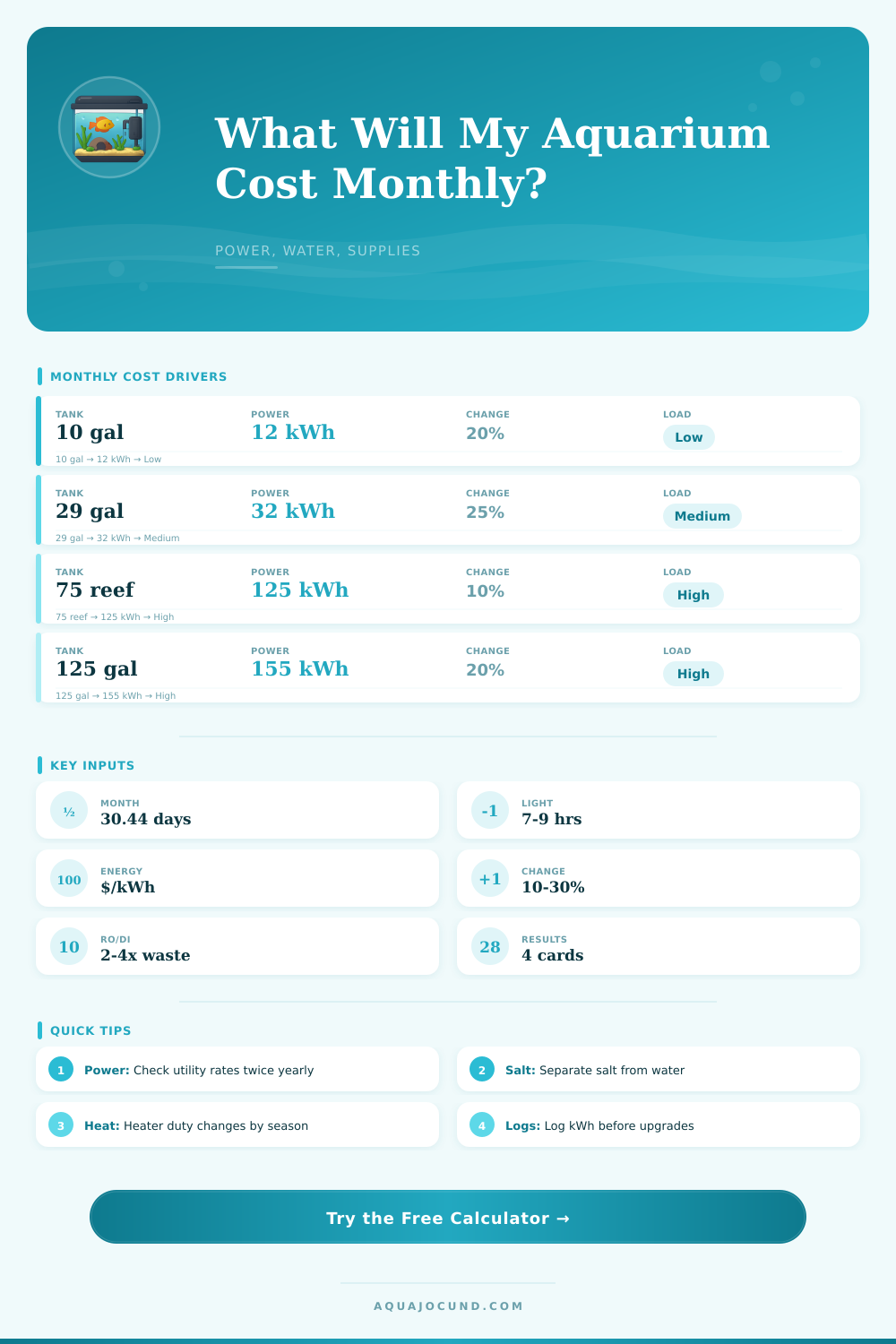
Aquarium Monthly Running Cost Calculator
Estimate monthly aquarium electricity, source water, salt or minerals, food, media, CO2, testing, and optional maintenance value from your own rates and tank routine.
📏Tank size and local rates
Use combined water plus sewer when your bill separates them.
⚡Equipment power profile
Enter the estimated percent of time the heater is actually on.
💧Water, salt, and consumables
Use 0 for plain freshwater, or enter salt, remineralizer, or buffer cost per prepared gallon.
Leave at 0 to calculate cash outlay only.
Full monthly breakdown
📊Monthly category comparison grid
🧪Cost profile reference
📘Reference tables
| Equipment category | Monthly formula | Typical driver | Cost note |
|---|---|---|---|
| Lights | Watts x hours x 30.44 / 1000 | Photoperiod and intensity | Usually predictable |
| Pumps and filters | Watts x 24 x 30.44 / 1000 | Always-on operation | Often the steady baseline |
| Heater | Watts x duty cycle x 24 x 30.44 / 1000 | Room-to-tank temperature gap | Can rise sharply in winter |
| Cooling | Watts x hours x 30.44 / 1000 | Warm rooms and enclosed canopies | Seasonal and tank-specific |
| Common tank | Usable volume | Water change range | Prepared water each month |
|---|---|---|---|
| 5 gallon betta | 4 to 5 gal / 15 to 19 L | 20% weekly or 30% biweekly | 2 to 5 gal / 8 to 19 L |
| 20 long planted | 17 to 20 gal / 64 to 76 L | 20% to 40% monthly | 4 to 8 gal / 15 to 30 L |
| 55 gallon cichlid | 48 to 55 gal / 182 to 208 L | 25% to 50% monthly | 14 to 28 gal / 53 to 106 L |
| 75 gallon reef | 65 to 75 gal / 246 to 284 L | 5% to 20% monthly | 4 to 15 gal / 15 to 57 L |
| 125 gallon display | 110 to 125 gal / 416 to 473 L | 10% to 30% monthly | 13 to 38 gal / 49 to 144 L |
| Aquarium type | Power pattern | Consumable pattern | Watch closely |
|---|---|---|---|
| Betta or nano freshwater | Small heater and light dominate | Food and conditioner are minor | Heater duty in cool rooms |
| Community freshwater | Filter, heater, and light are balanced | Food and filter media are steady | Water change volume |
| High tech planted | Lighting and CO2 support growth | Fertilizer and CO2 add monthly spend | Photoperiod creep |
| Messy freshwater stock | Filtration and water changes rise | Food and media often increase | Nitrate control routine |
| Mixed reef | Lights, pumps, and heaters stack up | Salt, tests, media, and food vary | Prepared saltwater volume |
| Input to verify | Where to get it | Why it matters | Calculator effect |
|---|---|---|---|
| Electricity rate | Utility bill total cost divided by kWh | Local rates vary widely | Changes every power category |
| RO/DI waste ratio | System gauge, manual, or measured buckets | Wastewater can exceed product water | Raises source water cost only |
| Heater duty cycle | Smart plug log or timed observation | Heater nameplate watts are not continuous | Changes seasonal kWh estimate |
| Prepared water cost | Salt/mineral amount divided by mixed gallons | Mixing cost belongs to changed water | Separates water cost from salt cost |
| Maintenance time value | Your own optional hourly value | Not a cash bill unless you count it | Added separately in upkeep |
💡Running cost tips
New aquarists tend to concentrate on purchase cost of both the tank and the fish. That’s fair since there is a cash outlay up front. You get the tank and fill ‘er up; congratulations, you’ve launched your first system! But then comes next bill: your utility bill. And the utility bill will have one or more line items that are unexpected. One is typicaly a surprise that makes you say, “What?! Why is my water bill so high? It’s like there’s just a bowl of water sitting here in the corner.
An aquarium isn’t a very intuitive monthly expense. Your monthly cost include electricity, water, sewer fees, consumables like filters and heaters, and maintenance labor. If you understand big picture at the time of purchase, you won’t lose money. Nor will you be tempted to sell system later or neglect its upkeep. After plugging in your local rates and your equipment wattage, the calculator (above) will do the rest of the math for you. No more guesswork about how much electricity your heater draw in thirty days.
The Real Cost of Keeping an Aquarium
Heating, along with pumps and lights, are typically the biggest expense. Most people think that their heater is running 24/7, which isn’t true. Instead, it’s cycling. Turning on/off as necessary. The cycle depends based off the difference between the set point temperature and room temperature. A heater running a tank in climate controlled living room will draw less electricity then a heater running a tank in a cold basement. That is why two otherwise similar systems may differ in their electric bill.
Water is lost through evaporation and volume changes when you change water. People often don’t realize that they are paying for the same amount of water in losses due to evaporation and other changes, such as using a reverse osmosis unit which create wastewater. If you have a poor waste ratio RO/DI system, then you’re paying three or four times over for every gallon of purified water that actualy makes it into the tank. As table on the page shows, this cost multiplies by number of water changes. Does your routine include large monthly water change or smaller weekly ones? That’s going to impact your municipal bill.
It is difficult to appreciate how much money goes into tangible items like supplies unless you are frugal, especially when they run out. The largest expense for a freshwater planted tank will be the fertilizer and CO2 injection. For the reef tank, test kits (alkalinity, calcium) and salt mixes will drain budget faster than food ever does. Generic salts and bargain basement filter media seem attractive initialy, but inferior products means more frequent replacements. More labor = higher effective cost of ownership, regardless off initial purchase price.
You can also put an optional price on time with this tool. Replacing carbon and scrubbing off algae will take you hours each month that you could of spent doing something else. Value your free time in dollars and the real cost of maintaining such a high maintenance system will go up a lot. It’ll help you determine if you want to deal with a complicated system given your lifestyle.
An aquarium isn’t just a piece of equipment. It’s a long-term commitment of managing resources. If you add up all that goes into running it each month, supplies, electricity, water, then you’ll realize this hobby isn’t a one-time purchase. It’s an ever-changing operating expense. Once you understand that, you can confidently change pump or light schedules and invest in efficient equipment without worry. You have a clear idea of what each modification cost in dollars so you’re confident you can afford them. Your bank account thanks you because while the fish don’t pay the bill, you will if you don’t pay attention to it before putting water in the tank.