Aquarium Setup Cost Calculator
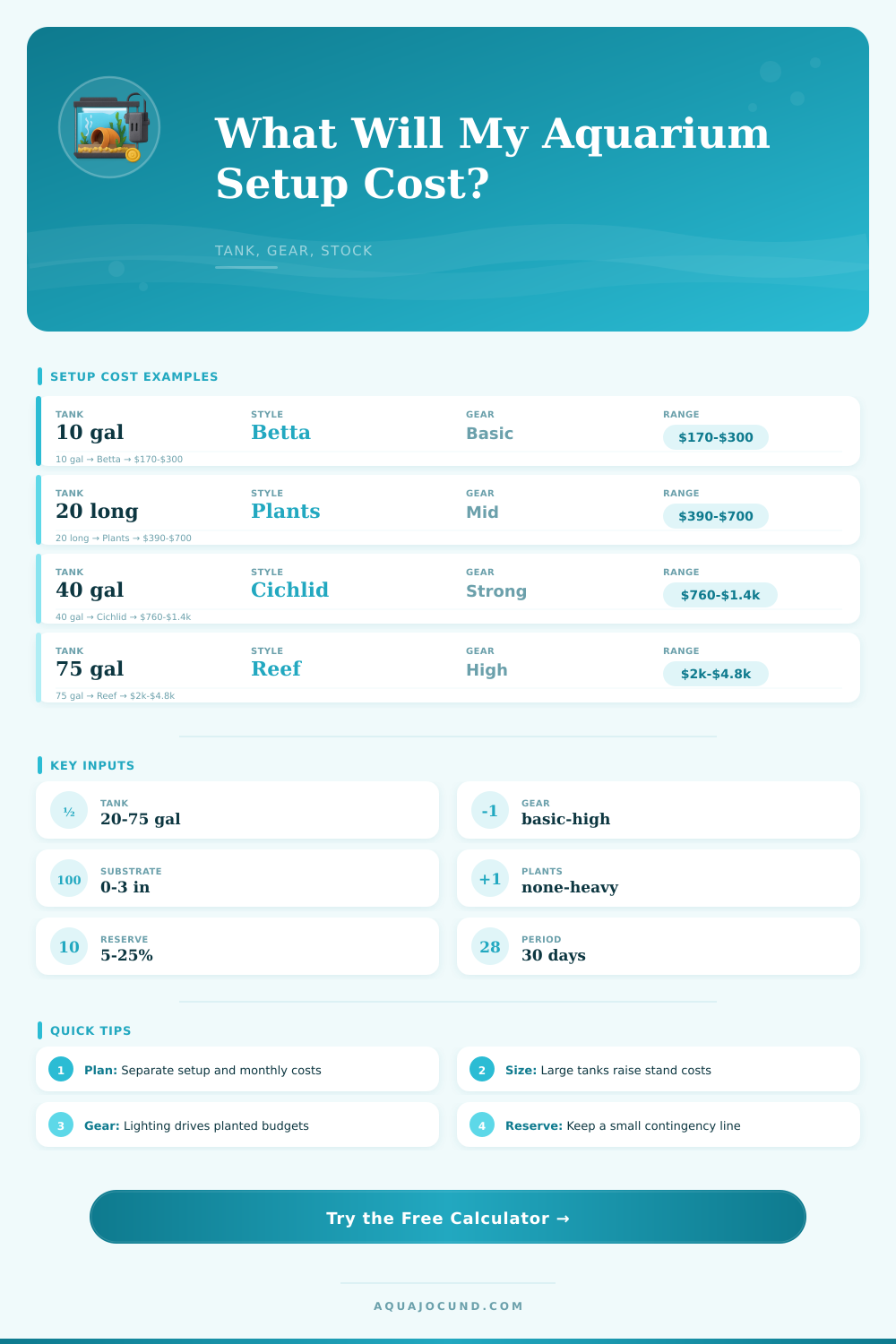
Estimate a complete aquarium setup from tank volume, stand choice, filtration, lighting, heating, substrate, aquascape materials, livestock, supplies, and contingency.
📏Tank size and setup profile
⚙Equipment and aquascape inputs
Use average visible depth after slopes, caves, and open areas.
Add permits, delivery, extra lids, replacement media, quarantine tub, or local service fees without changing the preset logic.
Cost Breakdown
🧾Equipment category comparison
📊Reference tables
| Setup style | Typical cost drivers | Starter range per gallon | Notes |
|---|---|---|---|
| Basic freshwater | Tank, filter, heater, gravel, test kit | $10 to $22 | Costs stay lower when light and decor are simple. |
| Low-tech planted | Plant light, substrate, plants, fertilizer | $18 to $38 | Plant density affects the final number more than tank glass. |
| High-tech planted | CO2 allowance, stronger light, nutrient tools | $35 to $80 | Smaller tanks can have a high cost per gallon. |
| Cichlid or goldfish | Oversized filtration, rock, robust support | $18 to $45 | Waste load and hardscape weight drive equipment choices. |
| Marine fish-only | Salt mix, rock, stronger flow, test supplies | $45 to $95 | Saltwater consumables add early setup cost. |
| Mixed reef | Lighting, flow, rock, salt, tests, livestock | $75 to $180 | Coral and reef lighting widen the range quickly. |
| Equipment category | Low estimate | Mid estimate | High estimate |
|---|---|---|---|
| Tank, lid, and stand | $4 to $9 per gal | $9 to $18 per gal | $18 to $45 per gal |
| Filtration and circulation | $3 to $8 per gal | $8 to $18 per gal | $18 to $45 per gal |
| Lighting | $2 to $6 per gal | $6 to $15 per gal | $15 to $55 per gal |
| Substrate and hardscape | $2 to $8 per gal | $8 to $20 per gal | $20 to $70 per gal |
| Tests and startup supplies | $35 to $85 total | $85 to $180 total | $180 to $450 total |
| Common aquarium size | Dimensions | Freshwater setup | Planted or marine setup |
|---|---|---|---|
| 10 gallon | 20 x 10 x 12 in / 51 x 25 x 30 cm | $150 to $320 | $260 to $900 |
| 20 long | 30 x 12 x 12 in / 76 x 30 x 30 cm | $280 to $620 | $450 to $1,400 |
| 29 gallon | 30 x 12 x 18 in / 76 x 30 x 46 cm | $390 to $850 | $650 to $1,900 |
| 40 breeder | 36 x 18 x 16 in / 91 x 46 x 41 cm | $560 to $1,200 | $900 to $2,600 |
| 55 gallon | 48 x 13 x 21 in / 122 x 33 x 53 cm | $720 to $1,700 | $1,200 to $3,600 |
| 75 gallon | 48 x 18 x 21 in / 122 x 46 x 53 cm | $1,000 to $2,500 | $1,900 to $5,400 |
| Recurring item | Freshwater | Planted | Marine or reef |
|---|---|---|---|
| Electricity | $2 to $8 per month | $4 to $18 per month | $10 to $45 per month |
| Food and conditioner | $3 to $12 per month | $5 to $18 per month | $8 to $35 per month |
| Filter media | $2 to $10 per month | $4 to $15 per month | $8 to $35 per month |
| Salt, dosing, or fertilizer | $0 to $5 per month | $4 to $25 per month | $20 to $90 per month |
| Replacement allowance | $2 to $10 per month | $5 to $20 per month | $15 to $75 per month |
💡Cost planning tips
It begins when you look at the dazzling images of sparkling fish in clear water and end up tearing out your hair over a receipt. Whether you’re a beginner who bought your initial betta bowl or a seasoned fish keeper who upgraded to a one-hundred gallon reef tank, this have happened to all of us. Most novices trip over the chasm between perceived cost of having an aquarium vs. Actual cost.
Glass is only the start. You also need to factor in water weight which is about sixty-two pounds per cubic foot. That means a forty gallon tank are more than a bucket. It’s a structural design problem requiring appropriate support before you even THINK of putting any rocks/gravel or anything else into it. But here’s where the calculator comes in, it forces you to confront your hidden expenses early on.
How to Budget for Your Aquarium
When most newbies think about buying a tank, all they considers is the cost of the glass box itself. Until they’re standing at the checkout line balancing their cart, they don’t even think about things like substrate, decor, filtration, lighting, and heating. This calculator breaks these costs down into logical categories. It separates the one-time investment required to set up the system from the recurring monthly expenses paid after it is running. The distinction between these two types of expense is important when it comes to budgeting, since the consumables and electricity adds up quietley over time.
Nearly all of the other choices depend on the tank size. For example, a 10 gallon betta tank may look like it won’t cost very much. It doesn’t require many fancy filter. Just a simple one. It doesn’t require a high end heater. Just a simple one. You might only need a few plastic plant. But if you want to step up to something bigger, things don’t proportion out evenly. Nope. In fact, they increase exponentially!
This is especially true with lighting. A basic LED bar is just fine for live bearers or goldfish. If you’re a planted aquarium enthusiast, you’ll need more intense lights. Those will cost considerably more then a basic LED bar. For those into reef keeping, you’ll need pro level fixtures that rival the price of a used motorcycle. The calculator takes all of this into consideration so you can get an idea how your design preferences affect the budget.
Another big factor is substrate and hardscape. A bare bottom tank is economical because it saves on light, but it also looks sterile. Gravel is useful, and not very expensive. Soil additives will make plants grow better but has to be maintained with care. And then there’s the rock. For marine systems, live rock can be costly because of its weight when shipped and how long it takes to cure.
With this tool, you can play around with these variables independently. You can switch from a premium tier of equipment to an economy one. It’ll help you know what to skimp out on and what to spend more money on. If you keep cichlids or other heavy waste producers, maybe a fancy filtration system make sense. Most community tanks can get by with basic hang-on-back filter.
For example, livestock costs can range dramatically based off species. Neon tetras are cheap (a school of them). Specialized corals or rare discus aren’t. The calculator allows for startup stock. You don’t want to be surprised with that cost when you’re at the fish store!
It also accounts for startup supplies and testing kits. If you’re a marine hobbyist, you’ll know what I’m talking about here. Alkalinity and specific gravity must be tightly maintained in saltwater tanks. This leads to purchasing test kits, salt mixes, and sometimes an additional tank just for mixing. Freshwater setups don’t need as much. However, you still need basic water tests and dechlorinator to keep your water stable while waiting for the nitrogen cycle to establish itself.
Never forget the contingency line item. Retailer markup, availability, and location impact prices. A small buffer will save you from last minute surprises and upgrades. It is better to overestimate slightly then to run out of funds mid project. The built-in reference tables also help set expectations with realistic cost ranges for typical setups. You’ll see that a high tech reef environment costs more, but a basic freshwater environment costs less. Treat these as guidelines, not ironclad rules… Every market is different!
It’s all about planning. Don’t make expensive mistakes when rushing into things. You’ll end up stressed out with crappy equipment that doesn’t work well for your new fish. Relax, take your time. Know the needs of your desired livestock. What will they cost? What will they require of you? Budget to match.
It really isn’t rocket science if you know what to find. The hard part is self-control. Shop within your means. Resist the temptation to buy whatever looks good at the local pet shop. Pretty doesn’t mean stability or health.
If you’re new to the hobby, start small. You don’t learn by having tanks, you learn by doing. A properly maintained 20 gallon tank will teach you far more about water chemistry than a poorly maintained 100 gallons ever will. Once you’ve learned some things, you can increase the size of your tank as well. For now, use the numbers to help make your decisions.
Remember that it’s not only the up-front cost but the overall cost that you should watch. This is what helps you create a hobby that lasts for years rather than weeks.