Aquarium Tank Price Per Gallon Calculator
Normalize tank price by rated volume, measured water volume, tank format, condition adjustment, included equipment credit, delivery fees, and sales tax.
📏Tank volume basis
Use the normal operating water line, below rim, trim, overflow teeth, or lid gap.
💵Cost inputs
Enter a separate value for stand, lid, light, filter, sump, or other included items.
Full cost breakdown
🧮Tank format value comparison grid
📊Reference tables
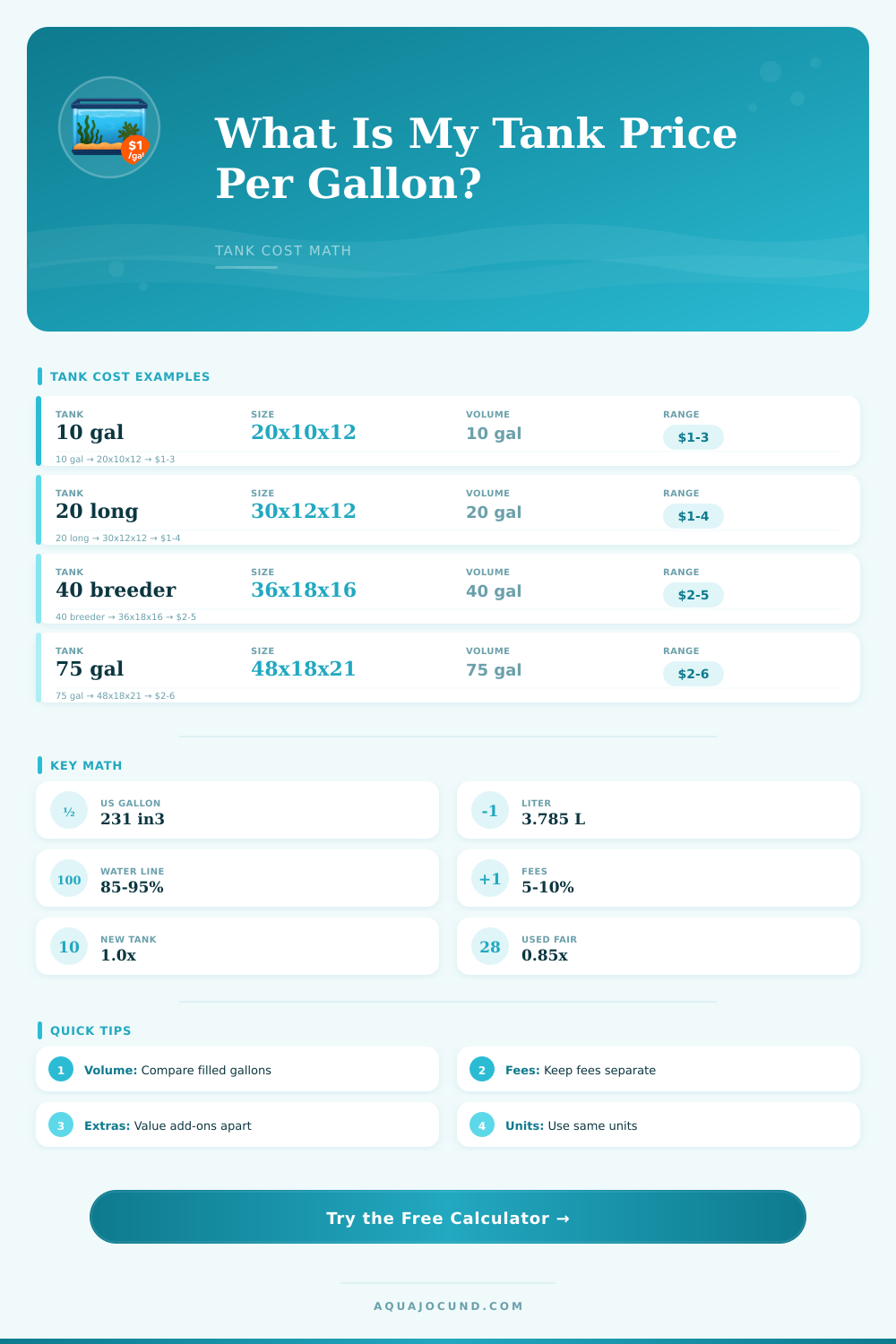
| Common tank | Typical dimensions | Rated volume | Reference dollars per gallon |
|---|---|---|---|
| 5.5 gallon rectangular | 16 x 8 x 10 in / 41 x 20 x 25 cm | 5.5 gal / 20.8 L | $2 to $6 tank-only |
| 10 gallon rectangular | 20 x 10 x 12 in / 51 x 25 x 30 cm | 10 gal / 37.9 L | $1 to $3 tank-only |
| 20 gallon long | 30 x 12 x 12 in / 76 x 30 x 30 cm | 20 gal / 75.7 L | $1 to $4 tank-only |
| 29 gallon tall | 30 x 12 x 18 in / 76 x 30 x 46 cm | 29 gal / 109.8 L | $1.50 to $4.50 tank-only |
| 40 gallon breeder | 36 x 18 x 16 in / 91 x 46 x 41 cm | 40 gal / 151.4 L | $2 to $5 tank-only |
| 55 gallon rectangular | 48 x 13 x 21 in / 122 x 33 x 53 cm | 55 gal / 208.2 L | $1.50 to $4.50 tank-only |
| 75 gallon rectangular | 48 x 18 x 21 in / 122 x 46 x 53 cm | 75 gal / 283.9 L | $2 to $6 tank-only |
| 125 gallon long | 72 x 18 x 21 in / 183 x 46 x 53 cm | 125 gal / 473.2 L | $2 to $7 tank-only |
| Format | Normalization factor | Typical comparison use | Cost math note |
|---|---|---|---|
| Standard framed glass | 1.00x | Baseline tank-only comparison | Divide by rated and usable gallons directly. |
| Rimless low-iron glass | 1.45x | Premium display comparison | Calculator can normalize premium format back to baseline. |
| Acrylic aquarium | 1.35x | Large or unusual shape comparison | Use included scratch condition separately from format. |
| Bow front display | 1.18x | Curved-front volume comparison | Bow volume is estimated from flat box plus curved segment. |
| Cube aquarium | 1.15x | Compact display comparison | Footprint and glass thickness can raise per-gallon figures. |
| Reef-ready tank | 1.25x | Drilled overflow comparison | Overflow format is separate from sump or plumbing credit. |
| Custom built tank | 1.70x | Special size comparison | Use direct volume when wall thickness or bracing is unusual. |
| Included item | How to enter it | Why it is separated | Example credit |
|---|---|---|---|
| Stand or cabinet | Add to equipment credit | Keeps tank-only price per gallon clean | $25 to $300 depending size |
| Glass lid or canopy | Add only if usable | Cracked lids should not inflate tank value | $10 to $80 |
| Light fixture | Use working replacement value | Light value varies more than glass volume | $15 to $250 |
| Filter, sump, or plumbing | Credit separately | Equipment is not gallon capacity | $20 to $500 |
| Substrate or decor | Credit conservatively | Weight and cleanup can distort tank math | $0 to $100 |
| Adjustment | Calculator field | Typical range | Effect on result |
|---|---|---|---|
| Fill level | Usable fill level | 85% to 95% | Lower fill raises usable water price per gallon. |
| Sales tax | Tax or marketplace fee | 0% to 12% | Adds to total acquisition cost before per-gallon math. |
| Delivery or freight | Fees field | $0 to $500+ | Large tanks can shift sharply when freight is included. |
| Condition | Condition adjustment | 0.60x to 1.08x | Used or repair factors create a normalized comparison number. |
| Measurement confidence | Confidence field | 0.86x to 0.97x | Rounded listings reduce confidence-adjusted usable volume. |
💡Cost comparison tips
When we’re talking about aquariums, you look at the tag and it says “X” gallons. But that’s not exactly X gallons of water you can use. It’s a made-up number, a marketing construction.
What does matter is: What are you realy getting for your money? How many gallon of live water do you get with this purchase? Is your tank purchase being used as an excuse for something else (like a fancy stand or extra equipment), or are you getting what you realy want, more gallons of live water? This is why using usable volume to normalize cost is so important.
Why Usable Volume Matters More Than Label Size
Because if two tanks appear comparable in cost but one holds less water than the other, there’s a wild difference between them. The reason has nothing to do with the size of the tank and everything to do with how those tanks was built. You might see two tanks: a 10 gallon and a 40 gallon breeder. On the surface, these two tanks seems like a fair comparison. But after accounting for frame type, wall thickness, etc., you discover that the 40 is only a couple inches bigger in diameter but costs twice as much, and it has half the amount of usable water!
Using the gallons of usable water measurement lets you strip out all the confusion and make apples-to-apples comparisons. You enter your costs and dimensions into the calculator (above). It do the math so you don’t have to guess at coefficients and hidden fees.
Rated volume is also an idealized maximum. Most hobbyists neglect the fact that they don’t load their tank to its max. No one keeps 100% of the available headspace for substrate, filter media, livestock, and a safety margin if something goes splat. The input for usable fill level takes this fact into account. If you lower that percentage to ninety-two or even eighty-five percent, then you’re estimating the cost of what’s left over for actual use… Not the theoretical maximum capacity stamped onto a cardboard box. For smaller tanks, this becomes a big deal since headspace and surface area play an increasingly larger role in the value proposition.
Another part of the pricing equation has to do with glass quality and framing. Thick edges around the frame conceal the seam and eat up space inside the tank. This reduces the interior volume but creates nice clean lines. Low iron glass also cost more because it’s harder to make but looks really cool rimless. So this calculator will account for those formatting variations and help you determine if that fancy new tank is actualy worth an additional buck a gallon or not.
The same applies to acrylic. Custom shapes is possible and they’re lighter. However, they are prone to scratches and typically carry a higher price tag. That premium could be for functionality/durability, or aesthetic reasons. So the calculator will help you see if it fits your long term plans.
There are also some really big caveats when it comes to deals in the secondary market. What seems like a dirty tank with mild mineral deposits may actualy be structurally fine, but someone who hasn’t seen many tanks won’t know that. The condition adjustment allows you to level out this pricing. Now you can fairly compare a brand new, sealed tank to a used tank with minor imperfections. This helps you determine if the used tank offer better value for your budget than the new one.
This will come into play particularly when you’re shopping for bigger tanks on the second hand market because shipping eats up any money saved by purchasing something a little cheaper up front pretty fast. Remember; the tank and its extra equipment are not the same thing as just the tank. Some listings will include an old filter, a hood, or even a stand. They’re trying to inflate the overall cost but if you don’t want them, they distract from the tank itself. Take the estimate of what those pieces would be worth and subtract it from the overall cost. That will tell you exactly how much the tank alone cost per gallon. That way, you’re not underestimating your real entry fee when all this stuff comes bundled together… or overpaying on equipment you don’t want.
The hidden budget buster for any aquarium hobbyist is delivery costs. You can find an awesome deal on a 75g, but then you add shipping costs to it and suddenly that cheap tank becomes much more expensive once those delivery fees are included. That adds up really quick. It will tell you if you should of just buy local, even if it’s more expensive, since you won’t have to worry about the extra weight of moving it or getting it banged up during shipping.
That’s where the reference tables on the page come in. They has typical price ranges listed for popular size tanks so you can see at a glance what’s normal and what’s not. So if you find one well below average, make sure to look it over carefully because you may discover that it has some hairline fractures or leaking silicone. Likewise, if it’s way above market rate, then it probably has something special going for it like custom sizing or higher quality materials.
Bottom line. Buying a tank comes down to cost, volume, and footprint. The math help you get the right amount of space within your budget, room, and the number and type of fish you plan to keep. You will have no surprise bills down the road. Just clarity. That’s what good planning ought to give you.