Aquarium Aspect Ratio Calculator
Compare tank length, width, height, footprint, swim lane clearance, surface area, aquascape density, and fish movement style in one proportion check.
📏Tank dimensions and viewing layout
Estimate the percentage of tank length that remains clear for straight swimming.
Include large wood, rock piles, reef bommies, plant walls, equipment, and caves.
This adjusts usable water height for substrate, air gap, rim, and hardscape height loss.
Calculation Breakdown
📊Proportion snapshot
🧭Aquascape and swim-space comparison
📘Reference tables
| Tank proportion | Typical ratio | Strong use case | Watch point |
|---|---|---|---|
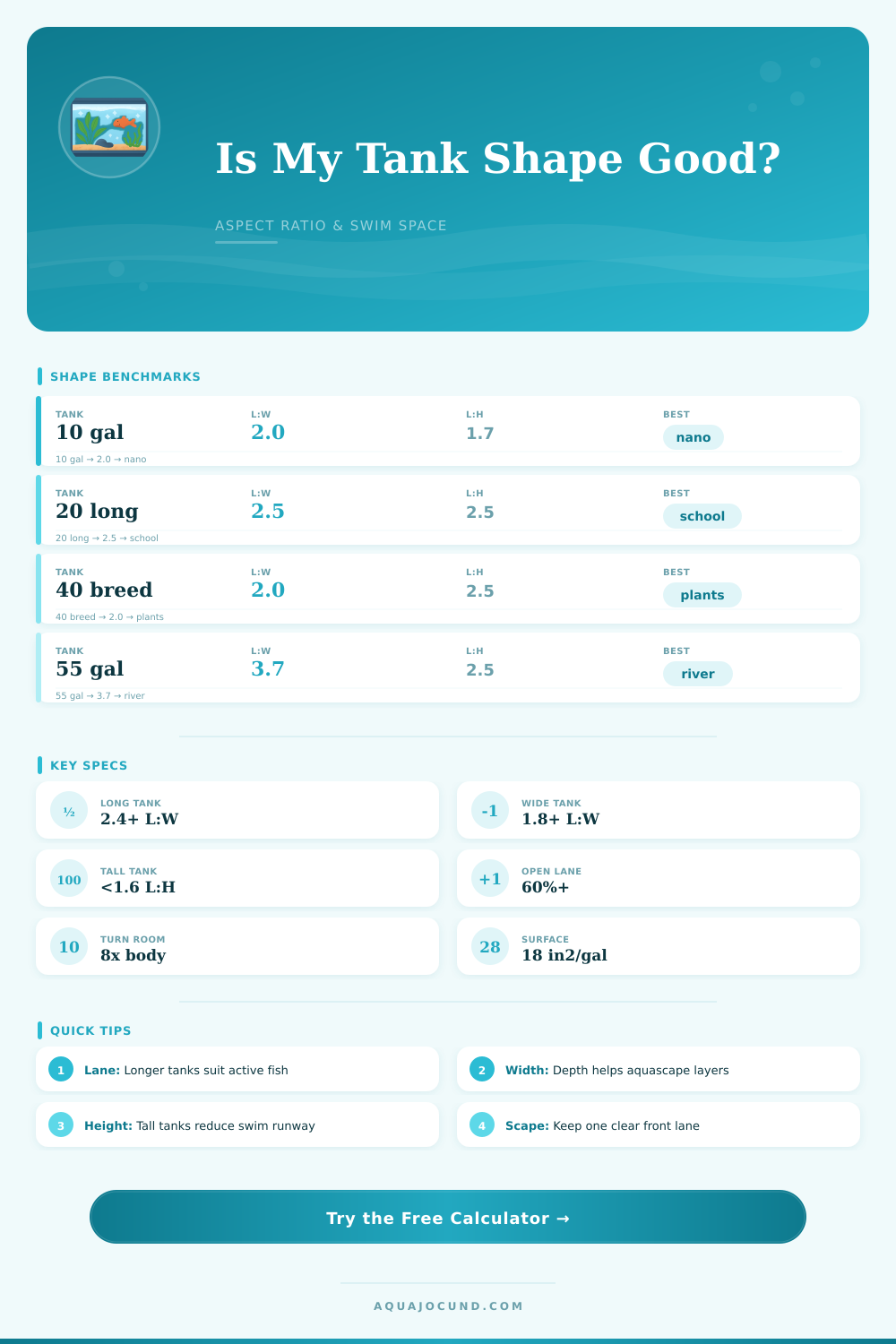
| Long or breeder-style | Length:width 2.0 to 2.8 | Schooling fish, planted layouts, cichlid territories | Leave a full-length corridor along the front or back |
| Standard rectangle | Length:width 2.8 to 3.8 | Community aquariums and general displays | Narrow width can flatten aquascape depth |
| Tall show tank | Length:height below 1.8 | Angelfish-style vertical displays and tall plants | Less horizontal runway for active fish |
| Cube or near-cube | Length:width below 1.5 | Reef bommies, shrimp colonies, top-down scapes | Limited straight swimming lane |
| Peninsula | Length:width 2.2 to 4.0 | Room divider with two long viewing sides | Hardscape should not block both long lanes |
| Fish or layout profile | Preferred length | Preferred width | Aspect note |
|---|---|---|---|
| Betta and gourami types | Moderate length | Gentle access to surface | Avoid very tall tanks without resting points |
| Shrimp and micro grazers | Any stable footprint | More surface and cover helps | Dense scapes matter more than runway |
| Active schooling fish | Long front lane | Enough width to turn as a group | Length:width near 2.4+ is helpful |
| Fast river swimmers | Very long runway | Open flow path | Minimize decor that breaks the lane |
| Territorial cichlids | Long enough for zones | Wide enough for rock islands | Width creates retreat paths and line-of-sight breaks |
| Reef fish with coral | Moderate to long | Wide aquascape shelf | Rock clearance and flow around islands matter |
| Common tank | Dimensions | Ratio profile | Typical aspect fit |
|---|---|---|---|
| 5.5 gallon | 16 x 8 x 10 in / 41 x 20 x 25 cm | 2.0 L:W, 1.6 L:H | Nano, betta, shrimp, low-flow scape |
| 10 gallon | 20 x 10 x 12 in / 51 x 25 x 30 cm | 2.0 L:W, 1.7 L:H | Nano community with careful stocking |
| 20 long | 30 x 12 x 12 in / 76 x 30 x 30 cm | 2.5 L:W, 2.5 L:H | Excellent small schooling footprint |
| 29 gallon | 30 x 12 x 18 in / 76 x 30 x 46 cm | 2.5 L:W, 1.7 L:H | More height than runway improvement |
| 40 breeder | 36 x 18 x 16 in / 91 x 46 x 41 cm | 2.0 L:W, 2.3 L:H | Strong width for aquascapes and territories |
| 55 gallon | 48 x 13 x 21 in / 122 x 33 x 53 cm | 3.7 L:W, 2.3 L:H | Long lane, narrow aquascape depth |
| 75 gallon | 48 x 18 x 21 in / 122 x 46 x 53 cm | 2.7 L:W, 2.3 L:H | Balanced community and cichlid footprint |
| 125 gallon | 72 x 18 x 21 in / 183 x 46 x 53 cm | 4.0 L:W, 3.4 L:H | Excellent runway with moderate width |
| Aquascape density | Footprint loss | Best matching shape | Planning note |
|---|---|---|---|
| Open sand or low plants | 5% to 15% | Long or standard rectangle | Runway is preserved, but add shade or cover for shy fish |
| Light planted edge | 15% to 25% | Standard rectangle or breeder | Keep tall plants behind or beside the swim lane |
| Moderate mixed scape | 25% to 40% | Breeder or wider display | Use islands so fish can loop around structure |
| Dense jungle growth | 40% to 60% | Wide shallow or species tank | Trim lanes before growth closes the front corridor |
| Rock wall or reef bommie | 35% to 55% | Wide or cube footprint | Leave side gaps for turning and circulation |
💡Aspect ratio tips
The shape of your tank is what you own; the size of your tank is what you paid for. Almost all novice hobbyists falls into this trap the first time they walk into a big box store. They see a tank rated at 30 gallons and think they bought themselves 30 gallons of water to swim in. What they actualy purchased was a particular geometrically constrained three dimensional volume. That’s why aspect ratio matters.
Aspect ratio isn’t some jargon for talking about dimension. It defines if the tank will act as a parking lot or a highway. This page do the calculation for you after entering your interior dimensions so you don’t have to guess at conversions or coefficients.
Why Tank Shape Matters More Than Size
The reason most folks take their measurements from outside rim (where the label happens to be located) is because they aren’t thinking right. You want the dimensions of water on the inside. Your substrate layers and glass thickness subtracts inches off the top and bottom. Your fish cannot access those inches of vertical swimming space. Forget these elements and your aspect ratio calculation won’t be accurate.
Active swimmers don’t care about width as much than length. For example, if you have a community of rasboras or a school of tetras, they will all be swimming along in a line, patrolling some kind of horizontal lane. Give them a long and narrow tank (a runway). In contrast, give them a short and wide tank that requires constant turning, that is stressful and it burns energy.
The open swim lane percentage can accommodate your decor. It’s a tool. Want a lot of plants? The percentage goes down. Think you’ve got space? No, you don’t. Wood looks larger. Plants grow. The effective runway decrease.
The other variable is height. Yes, tall tanks are dramatic. They’re also great to show off those tall stem plant (or angelfish). But height doesn’t do anything for oxygen exchange. Instead, surface area do. If you have a wide, shallow tank (of the same volume), there’s more surface contact with the air compared than a tall, narrow tank. That will matter for stocking capacity and gas exchange.
The calculator breaks this down in terms of how much surface area per gallon you have so you know whether your layout allows for heavy respiration or not, i.e., whether it’s too deep and stagnant.
The other key is turn radius. You can’t treat fish like a car. They don’t have a reverse gear, either. To turn comfortabley in a tight area, they require room to move around. Eight times their own length is a popular guideline. If you have a narrow tank (e.g., just a dozen inches), then keep the fish size down or make them really snail-like.
The tool helps here by using the chosen species profile to check how much space there is to turn back (which the tool calls “clearance”). It’s one way to avoid making error of housing big cichlids in a narrow tank that has no room for the fish to stretch out.
Everything changes when you start aquascaping. A bare tank full of just sand feels empty, but it is the simplest form to work with as there is no wasted space; every inch can be used. Now add some driftwood and rocks and suddenly you’ve got islands. Islands break up lines of sight. This is good if you’re trying to hide shy fish. It is bad if you’re trying to make an aggressive fish dominant by letting it see everything from one view.
It’s a balancing act between open spaces and cover, the results will tell you if your plan focuses more on hiding or swimming. Neither is right or wrong; they just serve different purposes. This is easy to see if you look at the reference table on the page for common tank sizes. Why is a five gallon betta bowl bad? Why does a twenty gallon long become legendary for schooling fish? It is because of the shape.
You can’t change the geometry, though you could of influence its behavior through lighting and filtration. But what goes into the tank will always flow across the glass that same way. The light will always strike the corner at that same angle. Take the grown-in state into account. On day one, the tank looks big. By month three after you’ve added moss and crypts that grow in, it seems cluttered.
Trim early and often. Clear that front corridor if you want active fish. Let ’em move around. They’ll reward you with swimming rather than hovering nervously next to the heater. Aspect ratio isn’t just about getting it into the room; it’s about fitting the life inside.