Aquarium Tank Footprint Calculator
Calculate the base area, required stand top, floor loading, service clearance, and support style for rectangular, cube, cylinder, bow front, and custom tanks.
📏Tank base dimensions
Measure the outside trim or panel edge that touches the stand.
Use the extra front curve beyond the straight back-to-front width.
🛠Stand, clearance, and floor inputs
Calculation breakdown
📊Footprint, stand, and material comparison
📘Reference tables
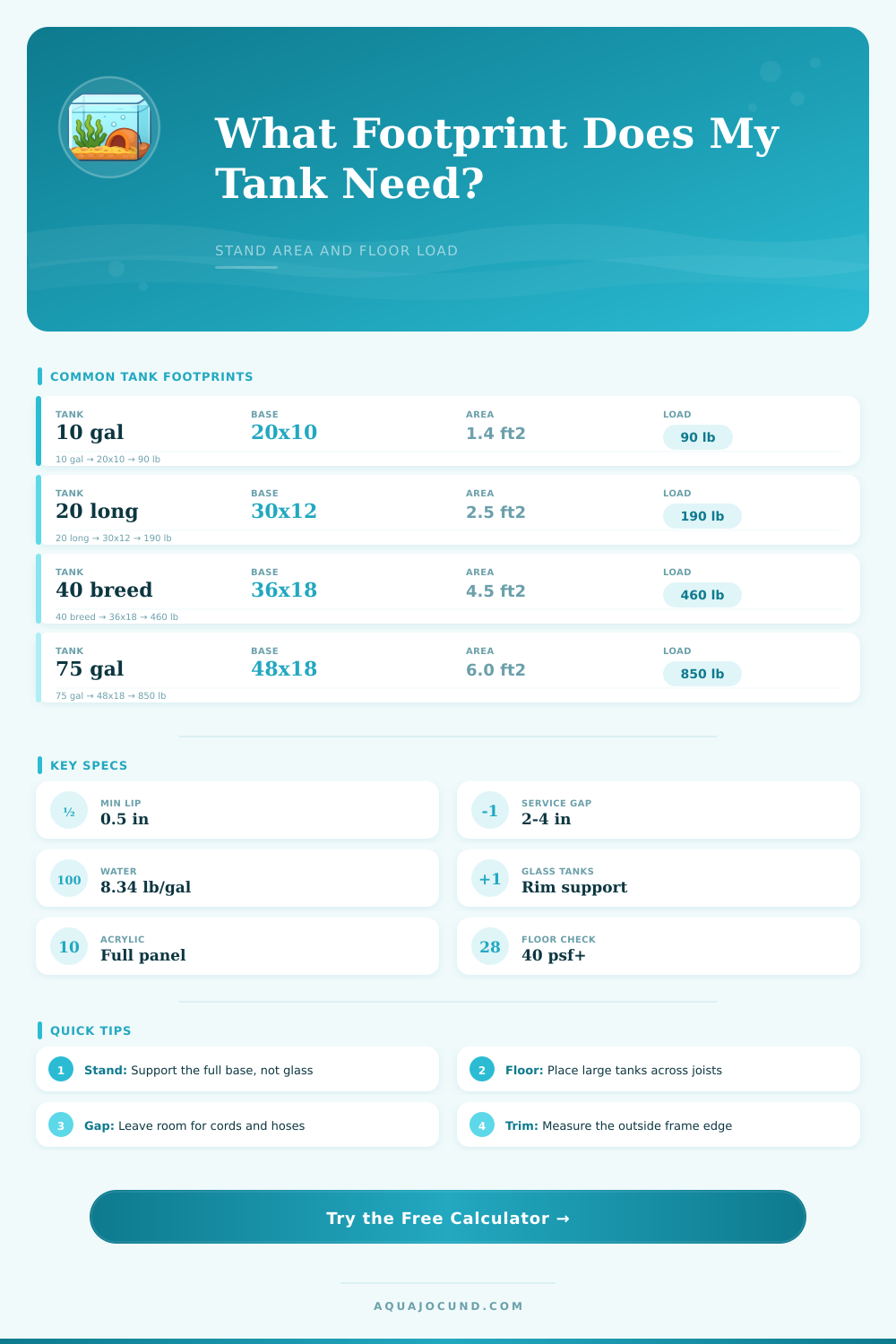
| Common tank | Outside footprint | Footprint area | Approx loaded weight |
|---|---|---|---|
| 5.5 gallon desktop | 16 x 8 in / 41 x 20 cm | 0.9 sq ft / 0.08 m² | 55 to 70 lb / 25 to 32 kg |
| 10 gallon standard | 20 x 10 in / 51 x 25 cm | 1.4 sq ft / 0.13 m² | 90 to 115 lb / 41 to 52 kg |
| 20 gallon long | 30 x 12 in / 76 x 30 cm | 2.5 sq ft / 0.23 m² | 180 to 230 lb / 82 to 104 kg |
| 29 gallon standard | 30 x 12 in / 76 x 30 cm | 2.5 sq ft / 0.23 m² | 280 to 340 lb / 127 to 154 kg |
| 40 gallon breeder | 36 x 18 in / 91 x 46 cm | 4.5 sq ft / 0.42 m² | 430 to 520 lb / 195 to 236 kg |
| 55 gallon standard | 48 x 13 in / 122 x 33 cm | 4.3 sq ft / 0.40 m² | 570 to 700 lb / 259 to 318 kg |
| 75 gallon standard | 48 x 18 in / 122 x 46 cm | 6.0 sq ft / 0.56 m² | 780 to 950 lb / 354 to 431 kg |
| 125 gallon standard | 72 x 18 in / 183 x 46 cm | 9.0 sq ft / 0.84 m² | 1300 to 1600 lb / 590 to 726 kg |
| Support surface | Best tank match | Footprint rule | Leveling note |
|---|---|---|---|
| Open perimeter frame | Rimmed glass | Frame must sit fully on rails | Shim stand, not tank corners |
| Sealed plywood top | Rimless glass or acrylic | Panel covers entire bottom | Check for crown or twist |
| Foam mat on flat top | Rimless and acrylic | Mat equals or exceeds base | Use only when maker allows it |
| Steel stand frame | Large display tanks | Rails align under bearing edges | Verify weld plane is flat |
| Rack beam stand | Breeder rows | Each tank has direct rail contact | Do not rely on shelf sag |
| Floor placement | Planning range | Footprint effect | Action |
|---|---|---|---|
| Concrete slab | Best for heavy systems | Pressure spreads through stand feet | Check level and moisture barrier |
| Across joists | Good for medium tanks | Load crosses several members | Prefer near a bearing wall |
| Parallel to joists | More sensitive | Load may sit on fewer members | Use wider stand or review framing |
| Unknown framing | Needs caution | Calculator becomes screening only | Inspect framing before filling |
| Upper floor display | Depends on structure | Large tanks need load path review | Ask a qualified pro for big loads |
| Shape | Footprint formula | Stand top estimate | Support detail |
|---|---|---|---|
| Rectangle | Length × width | Add lip to all sides | Match the outside trim |
| Cube | Side × side | Add equal lip all around | Check front-to-back level |
| Cylinder | π × radius² | Use diameter plus lip | Base ring must be fully supported |
| Bow front | Rectangle plus curve allowance | Use full curved depth | Do not leave front curve unsupported |
| Hex or corner | About 0.65 of box area | Stand follows widest points | Support all bearing edges |
💡Footprint planning tips
The problem is most aquarium mishaps begin not with an algae bloom or a sick fish but rather with a water-logged hardwood floor after a tank slips off its stand.
People make mistake by thinking about gallons. Gallons are a measure of volume. What they should of be thinking about is the actual space their tank takes up. How many square inches it occupy? That’s something that can wreck your house structure and your furnitures.
How to Prevent Aquarium Accidents
The calculator does all the math for you. All you need to do is input your measurements, then you’ll know if that gorgeous seventy-five gallon display tank is going to work on your second-floor bedroom floor.
Above all, know that labeled size of your tank is largely fictional marketing. What does it mean if the “twenty” gallon long has a base measuring thirty by twelve inches? And what about the “twenty” gallon high… That one may be entirely different than the rest. You want real-world outside dimensions of the tank’s acrylic/glass panel touching the stand. Measure inside of the water column and you’ll construct a stand that is too small.
Weight resides in the rim of your glass tank. It are not in the center of the bottom pane. It is not in the middle section. That would be the plastic frame surrounding the rim. Acrylic tanks is different. They require full-panel support to avoid bowing with time. The tool accounts for this so you do not place a rimless glass cube onto an open frame stand that contacts only its edges.
And then we come to the stand itself. For starters, the stand top must project beyond the bottom of the tank (typically no less than 1/2″ on all sides). This give you a bit of breathing room in case someone bumps your tank. It also adds a visual buffer. Plus, it spreads the weight out more evenly throughout the cabinetry structure.
The top should be sealed appropriately if made from plywood, otherwise water can actualy wick through the wood and begin rotting it from the inside-out. It is a slow disaster, but one that will ruin everything once it begins to show its ugly head (years later!).
The true engineering occurs with floor load. Water alone weighs eight and a third pounds per gallon, yet with substrate, rock, and heavy equipment such as canister filters, the weight increase greatly. A fifty-five-gallon tank might seem reasonable, but it may weigh nearly seven hundred pounds once fully loaded. Depending on how much of that load you plan for, the calculator will estimate the loaded weight using your selected fill level and decor allowance. This is something you should knows prior to purchasing a custom cabinet or rack.
And if you’re planning on putting a large tank on an upper floor, knowing the joist direction is very important. Generally speaking, loads perpendicular to joists are considered safer than loads parallel to the joists, as they distribute weight over additional structural members.
The other thing people forget about until it’s too late is clearance. There has to be space around and behind the tank for filter intake tubes, power cords, and hoses. Two to four inches of service gap isn’t just convenient. It allows you to maintain the system without having to pull everything apart every time you want to change the water. Wrestling with plumbing if your stand is flush against the wall won’t end well.
However, I like to have a quick sanity check for common sizes, which is why the tool includes reference tables. These allow you to see the relationship between footprint area and approximate loaded weight, so you can visualize what’s the difference between a large reef display and a desktop betta tank. Keep in mind these are estimates. The real world has variables such as equipment complexity and substrate density.
All of this goes back to respecting the laws of physics. How much you love your cichlids doesn’t matter; gravity does not care. It only cares about the load distribution and the pressure per square inch. Measure correctly. If you’re doing something big, check under your floors for the framing. And don’t assume because something looks strong it is strong. Flood prevention takes a little bit of thought. Once water gets on the drywall, no amount of fish keeping experience can fix it.