Bean Animal Overflow Calculator
Size the full siphon, open channel, emergency drain, weir length, standpipe heights, and operating safety margin.
Overflow sizing results
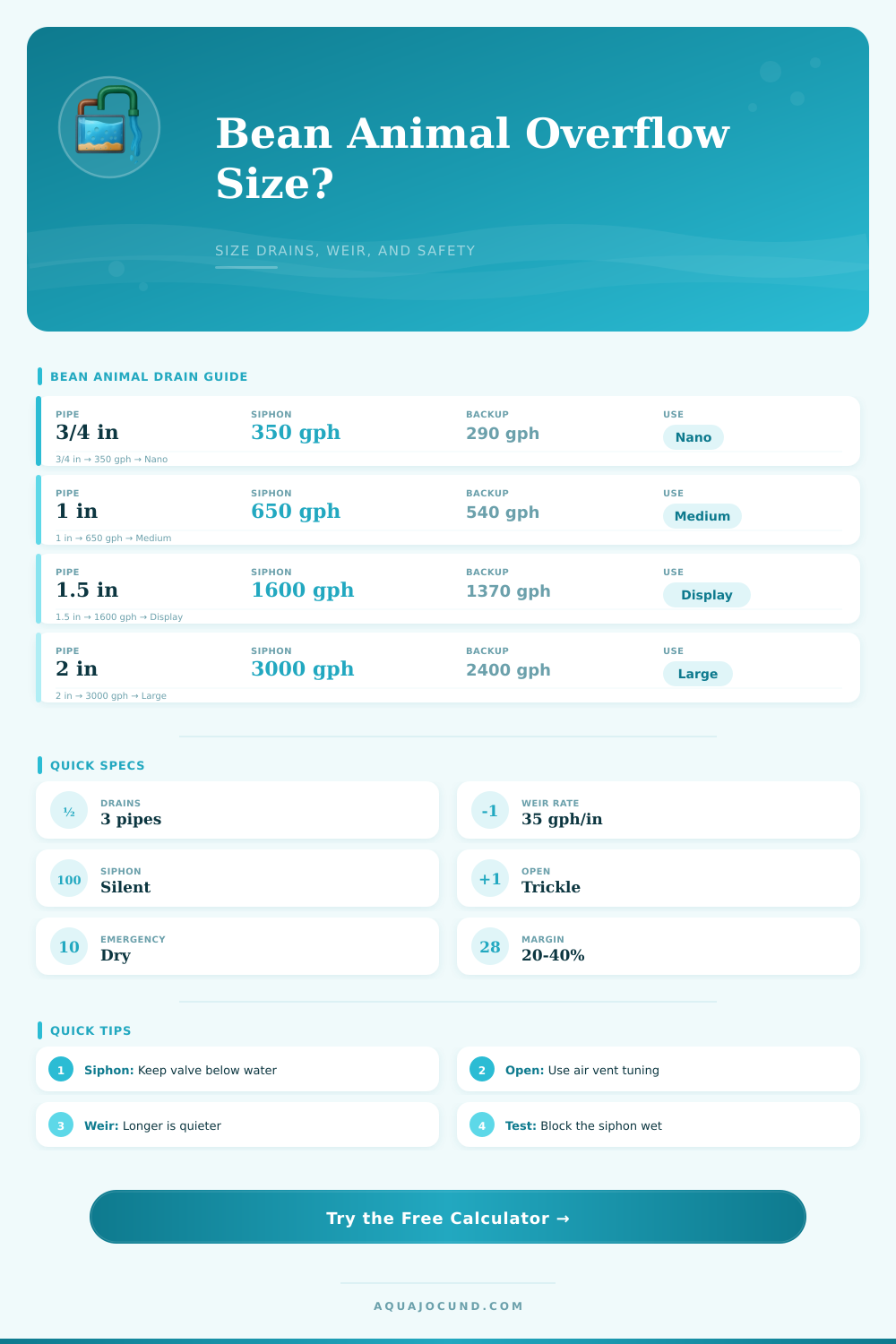
| Nominal pipe | Typical full siphon | Open channel range | Best use |
|---|---|---|---|
| 3/4 in | 250-450 gph | 80-160 gph | Nano and low return flow systems |
| 1 in | 500-800 gph | 150-300 gph | Most 40-90 gallon displays |
| 1 1/4 in | 850-1,250 gph | 260-450 gph | Medium reefs with headroom |
| 1 1/2 in | 1,250-1,900 gph | 400-700 gph | Large displays and frag systems |
| 2 in | 2,400-3,500 gph | 750-1,200 gph | Large tanks and long plumbing runs |
| Return flow | Smooth quiet weir | Toothed comb at 75% | Typical overflow style |
|---|---|---|---|
| 200 gph | 6 in minimum | 8 in minimum | Nano rear box |
| 500 gph | 15 in minimum | 20 in minimum | Internal box |
| 800 gph | 23 in minimum | 31 in minimum | External ghost box |
| 1,200 gph | 35 in minimum | 46 in minimum | Coast-to-coast section |
| 2,000 gph | 58 in minimum | 77 in minimum | Long coast-to-coast |
| Tank | Common flow target | Suggested pipe set | Quiet weir target |
|---|---|---|---|
| 20 long reef | 120-220 gph | 3/4 in Bean Animal | 6-9 in |
| 40 breeder reef | 300-500 gph | 1 in Bean Animal | 12-18 in |
| 75 gallon reef | 500-800 gph | 1 in Bean Animal | 18-28 in |
| 125 gallon display | 800-1,200 gph | 1 1/4 or 1 1/2 in | 28-40 in |
| 180 gallon SPS | 1,200-1,800 gph | 1 1/2 in Bean Animal | 40-58 in |
| Pipe | Normal role | Relative inlet height | Check during test |
|---|---|---|---|
| Full siphon | Carries return flow silently | About 1.5-2.5 in below box water line | Restarts after power cycle |
| Open channel | Small trickle and air vent | About 0.5 in below box water line | No flushing or gulping |
| Emergency | Normally dry backup drain | About 0.5 in above box water line | Handles flow with siphon blocked |
| Weir crest | Sets display water level | Slightly above overflow box water line | Even sheet of water across teeth |
A quiet, well plumbed fish tank isn’t luck. It’s because of a balanced hydraulic system, one that moves water silentley. That said, how do we get that silence? The answer is three separate pipes for three different tasks.
Sounds easy enough right? But every piece of pipe have a specific length, and every elbow or vertical run change the math. The math shifts depending on your tank dimensions and setup. Every tank are different, so the math shifts accordingly.
How to Design a Quiet Fish Tank System
If your drain sizing is off, there is only two ways it can go wrong. Either your siphon will be loud and gurgly because it’s starving for water, or your overflow box will flood floor when the power goes out. You want something that stay quiet, steady, and has a backup if your equipment fail.
Don’t just push buttons; it is important to know what each entry mean. How much water does the system require passing through per hour? That’s the target return flow.
Remember there is head loss to consider. Most pumps won’t push as hard as they are rated for, especially if pushing water uphill (against gravity) or a long distance through plumbing. Input your actual measured flow rather than the peak spec on the pump.
Gravity assists in this case; how high above the sump is the source water? The higher the difference in elevation, the faster the water moves. This help overcome friction caused by fittings and elbows. Using fewer bends and a larger pipe result in the same throughput if you have little drop into a low-profile stand.
The pipe material and profile settings adjusts to compensate for different diameter sizes and surface roughness inside the tube. Flow restriction occurs because standard Schedule 40 PVC has a looser bore than Schedule 80 PVC, which has a tighter bore and thicker wall. Flexible tubing is also convenient but has a lot of drag when it sags or has sharp kinks in the line.
The calculator accounts for real world constraints and adjusts capacity estimates to match them; do not rely on perfect lab conditions. Fittings Add Up Fast, Most folks greatly underestimate the impact of fittings. Depending on the radius of the turn, five 90 degree elbows alone could easily drop your effective flow rate by twenty percent or more
The second key one that’s frequently ignored is Weir length. That’s the part of the edge that water spills over from the tank into the overflow box. Longer weirs spread the water over a larger area, which lowers it speed and noise when it enters. However, if you’re on a narrow tank with a lot of return flow, there may simply be insufficient physical room to create a long smooth weir.
Using a toothed comb design will help add more spill points while maintaining the same footprint so that effective weir is longer. This way you can tell whether or not your existing set up has sufficient surface area to accommodate your water volume without creating a turbulent sheet of water that splashes back into the display.
Properly installed standpipes also need the correct height. Generally, this means full length of the siphon pipe needs to be below water, typically one or two inches below the waterline. The open channel should be right at water level so there is a slight amount of air exchange but still a trickle through when not in use. The emergency drain needs to be above normal water level as well so it’s out of the way and dry while running normally.
Too tall a standpipe and you could overflow before the backup comes on. Too short and you may activate the back up when it isn’t needed. The only way to test is to manually block the primary siphon and see if the emergency route handles the whole load without trouble.
There are safety margins for a purpose. You want to add 20 to 40 percent additional capacity so you can handle any fluctuation of the pump and/or build up of debris without going over the edge. It is better to be safe than sorry. Oversize your pipe instead of risking an overflow during a power surge or storm.
Your actual plumbing configuration will determine how well it performs, but the tables referenced with the calculator will give you some ballpark figures based off typical tank size. If you plan well enough, everything fits together nicely and operates silently in the background. Your fish will live happily in a stable environment while you look at a nice tank.
It’s all well planned out to help you manage potential failure modes. Your reward for going the extra mile on the design/planning side of things is that quiet confidence.