Aquarium Overflow GPH Calculator
Size overflow flow from weir length, water head, drain size, drain count, desired turnover, safety factor, fittings, and noise target.
📏Tank volume and turnover target
Use display-to-sump turnover, not total in-tank circulation.
🌊Weir, drain, and noise limits
Use only the wetted crest length that water actually spills across.
More drop helps siphons, but it does not make an undersized emergency drain safe.
Use 100 when a separate emergency drain should be able to pass the full return flow by itself.
Overflow Sizing Breakdown
⚙Overflow style comparison
📊Drain capacity reference
| Drain size | Quiet open channel | Typical open channel | Tuned siphon |
|---|---|---|---|
| 3/4 in or 20 mm | 90 gph | 150 gph | 300 gph |
| 1 in or 25 mm | 180 gph | 300 gph | 600 gph |
| 1 1/4 in or 32 mm | 300 gph | 500 gph | 950 gph |
| 1 1/2 in or 40 mm | 420 gph | 700 gph | 1300 gph |
| 2 in or 50 mm | 720 gph | 1200 gph | 2200 gph |
| 2 1/2 in or 63 mm | 1050 gph | 1750 gph | 3200 gph |
| Noise target | Weir loading | Typical sound | Best use |
|---|---|---|---|
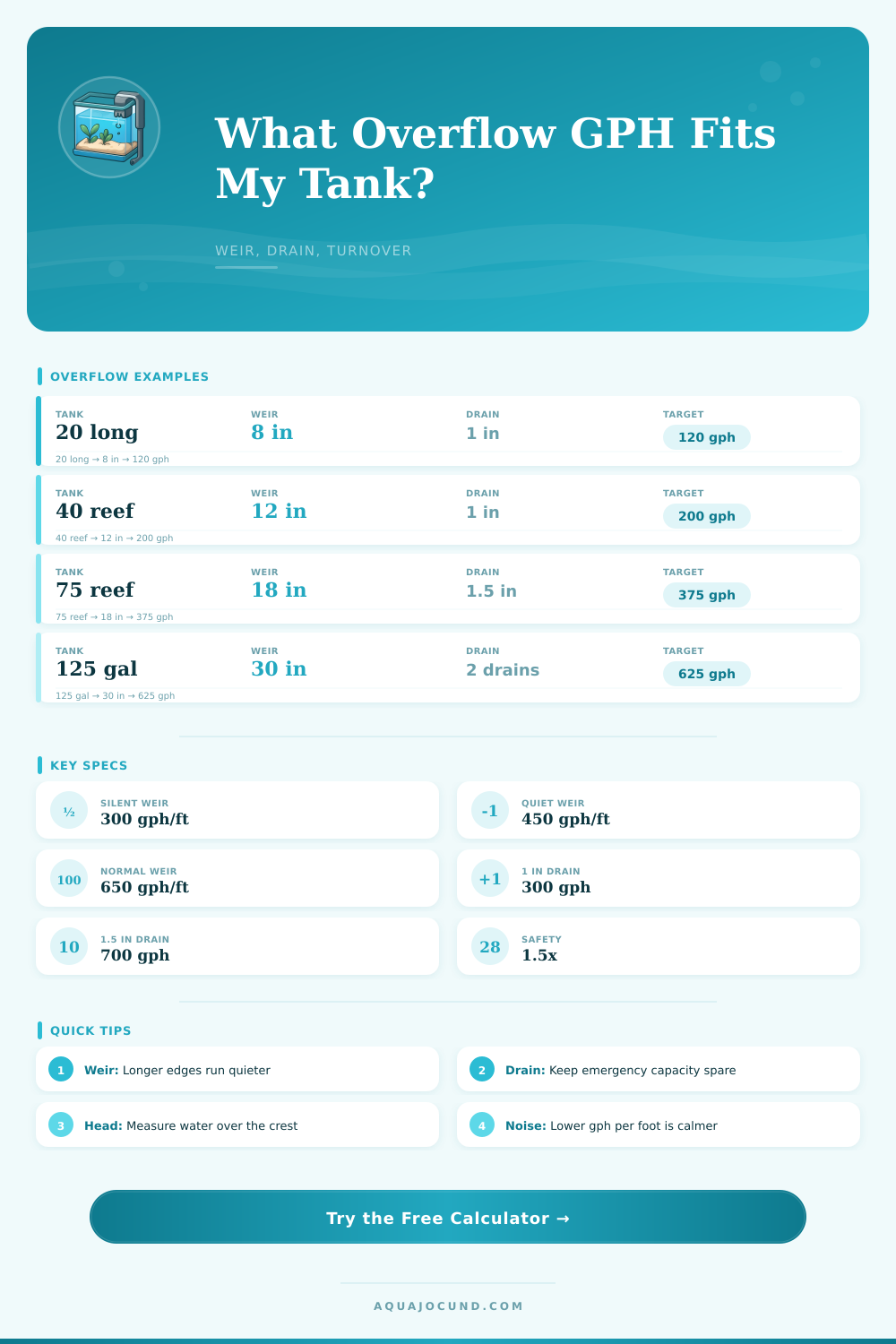
| Silent room | Up to 300 gph/ft | Thin sheet | Bedroom tanks |
| Quiet living room | Up to 450 gph/ft | Soft trickle | Most display reefs |
| Normal aquarium hum | Up to 650 gph/ft | Audible water | Fish rooms nearby |
| Utility room flow | Up to 900 gph/ft | Noticeable | Basement sump runs |
| Tank size | Dimensions | 5x turnover | Quiet weir length |
|---|---|---|---|
| 20 long | 30 x 12 x 12 in / 76 x 30 x 30 cm | 100 gph / 379 L/h | 4 to 8 in |
| 40 breeder | 36 x 18 x 16 in / 91 x 46 x 41 cm | 200 gph / 757 L/h | 8 to 12 in |
| 75 gallon | 48 x 18 x 21 in / 122 x 46 x 53 cm | 375 gph / 1420 L/h | 12 to 18 in |
| 120 gallon | 48 x 24 x 24 in / 122 x 61 x 61 cm | 600 gph / 2271 L/h | 18 to 30 in |
| 180 gallon | 72 x 24 x 24 in / 183 x 61 x 61 cm | 900 gph / 3407 L/h | 24 to 36 in |
| Overflow layout | Active drains | Emergency reserve | Noise note |
|---|---|---|---|
| Single Durso | 1 open channel | Low unless oversized | Air mix can gurgle |
| Herbie | 1 siphon plus 1 emergency | High if emergency is dry | Very quiet when tuned |
| BeanAnimal | Siphon, open, emergency | Very high | Quiet and redundant |
| Dual towers | 2 open channels | Moderate | Split flow lowers noise |
| Coast-to-coast | Varies | Depends on drains | Lowest weir loading |
💡Overflow sizing tips
Every hobbyist remembers his first time he heard that distinctive sound that meant trouble in his reef tank. It wasn’t the soft gurgle of the siphon or return pump hum. No, that was the sound of water crashing to the floor as some part of his overflow flow out quicker then he could unplug it. If you have ever seen a wall-mounted display and wondered if your plumbing could handle it, that scene plays out in the back of your mind.
Most system failures occurs when there is too much water flowing over the edge and not enough coming out of tank. To size this properly, you need to consider all three: head height, drain capacity, and weir length. That’s why we put one above to run those numbers for you so you don’t have to spend big bucks making an educated guess.
How to Stop Your Reef Tank From Flooding
People also get confused on one key variable: Effective weir length. Your thirty-six inch tank may have a full foot of overflow surface…but when you include all the teeth and algae guards and screens, how much of that surface actualy spills? Even if water flows across an eight-inch span, the physics still treat it like an eight-inch tank no matter how large the glass tank is on the outside. So the calculator asks for the wetted crest length (i.e. Not simply the outer size of the box), which is the correct measurement to account for this.
Why does it matter? Because a shorter effective weir means more velocity and more sound…it can turn a whisper into a roar with hardly any additional water flow.
Capacity of drains is also problematic because pipe size isn’t the entire picture. Even a one inch drain will transport much less water than an open channel than a tuned siphon such as a Durso or Herbie overflow set up. Vacuum pressure allow for pulling more volume through equal sized pipes, like a siphon. However, this creates more potential points of failure and adds complexity. As we see from the reference tables above, quiet open channels fall miles behind their tuned counterparts in terms of straight-throughput volume. So if your focus is quietness with an open drain, you’ll be looking at significantly bigger pipe sizes or multiple drains to achieve the equivalent flow of a single siphon based system.
A 1.5x safety factor is not something builders use as padding for an optimistically generous design. It’s insurance against failure of their equipment, growth of algae and detritus, or other mishaps. If your normal operating flow is x gallons per hour, then with a 1.5x safety factor, your emergency drain must be able to accommodate half again as much (50%) in case the main drain becomes blocked. If it doesn’t have that reserve, even a partial blockage will send the water rushing up towards top of the tank quickly. The reserve is there because things can, and will. Go wrong, and you want them to not result in a flood in your livig room.
Measuring water flow and determining what constitutes too much is not so cut-and-dry. Flow speed matter, as does the amount of water passing over each foot of the weir’s crest in gallons per minute. In most cases, below 400 gph/ft should be nothing more than a soft trickle (suitable for bedrooms or quieter spaces). Above that, it gets loud enough to be noticed, which relaxes some people but distracts others from their activities. You can use this tool to calculate the actual weir loading and see whether or not you need to compromise between your desired turnover rate and your limit for tolerating noise.
In the end, there’s no cheating fluid dynamics and gravity when creating a safe overflow. The math doesn’t care if you’ve created a complex custom siphon array or simply used some furnitures. Determine where the actual spill edge is, size your drains to handle the worst case scenario, and then provide lots of wiggle room for error. Get those variables correct and all you’ll hear is the peaceful hum of a healthy tank doing what it was made to do.