🦫 Live Food Culture Ratio Calculator
Size starter, feed, split, and harvest ratios for infusoria, daphnia, microworms, vinegar eels, and brine shrimp cultures.
Live Food Culture Ratio Estimate
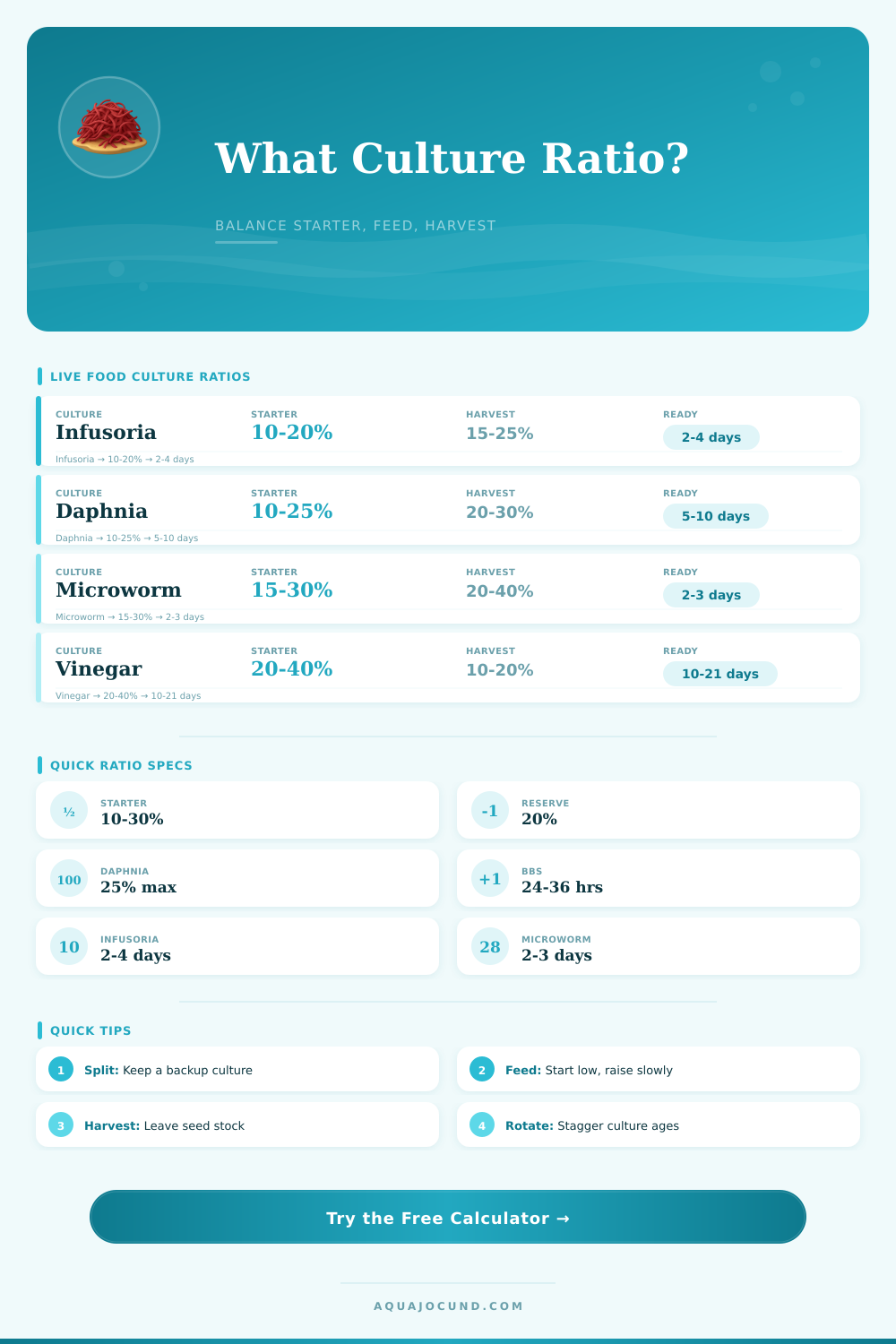
| Culture type | Starter ratio | Feed reference | Safe harvest | First harvest |
|---|---|---|---|---|
| Infusoria / green water | 10-20% liquid starter | 0.35 ml plant tea per L | 15-25% | 2-4 days |
| Paramecium jar | 15-25% active culture | 0.20 ml grain infusion per L | 10-20% | 4-7 days |
| Daphnia / moina | 10-25% stock water | 0.12 ml yeast slurry per L | 20-30% | 5-10 days |
| Microworm medium | 15-30% seeded medium | 18 g cereal medium per L | 20-40% | 2-3 days |
| Vinegar eels | 20-40% live vinegar | 0.08 apple slice units per L | 10-20% | 10-21 days |
| Brine shrimp hatch | Eggs, not starter culture | 1.5 g cysts per L brine | 80-95% | 24-36 hours |
| Vessel | Working volume | Good culture fit | Starter at 20% | Harvest at 25% |
|---|---|---|---|---|
| 1 quart jar | 0.25 gal / 0.95 L | Infusoria, paramecium | 190 ml | 240 ml |
| Half gallon jar | 0.5 gal / 1.9 L | Vinegar eels, infusoria | 380 ml | 475 ml |
| 1 gallon jar | 1 gal / 3.8 L | Paramecium, small daphnia | 0.76 L | 0.95 L |
| 5 gallon pail | 5 gal / 18.9 L | Daphnia, green water | 3.8 L | 4.7 L |
| 20 gallon tub | 20 gal / 75.7 L | Daphnia grow-out | 15.1 L | 18.9 L |
| Culture | Useful range | Fast zone | Slow signal | Overfeed signal |
|---|---|---|---|---|
| Infusoria | 68-82°F / 20-28°C | 75-80°F | Clear water | Rotten odor |
| Daphnia | 60-78°F / 16-26°C | 66-72°F | Few juveniles | Milky water |
| Microworms | 68-80°F / 20-27°C | 72-78°F | Dry surface | Sour collapse |
| Vinegar eels | 65-78°F / 18-26°C | 70-75°F | Thin harvest | Fruit decay |
| Brine shrimp | 74-84°F / 23-29°C | 80-82°F | Late hatch | Foul hatch |
| Feeding need | Culture count | Split rhythm | Harvest rhythm | Reserve rule |
|---|---|---|---|---|
| Small fry batch | 2 cultures | Weekly backup | Light daily pull | Keep 25% |
| Daily livebearer fry | 3 cultures | Every 5-7 days | Alternate cultures | Keep 30% |
| Cichlid spawn | 4 cultures | Every 3-5 days | Harvest strongest | Keep 25% |
| Daphnia production | 3 tubs | Every 7-10 days | 20-30% pulls | Keep 40% |
| Brine shrimp hatch | 2 cones | Start daily | Full hatch pull | Keep dry cysts |
Maintaining live food cultures is an exercise in learning the difference between gardening vs managing a biological engine. When your live foods crash, you has lost your system. Yes, it’s true (you lost dinner but more importantly), you’ve also learned that maintaining live foods mean operating a biological engine. Biological engines require fuel, accurate limits on what you can harvest while simultaneously maintaining consistent temperatures. Overfeeding + Panic + Guessing = Hobbyist 101.
Differing tolerances and appetites is specific to each organism. While microworms do not like dry air and grow slowly, infusoria grows fast but crashes hard if ignored. Daphnia requires regular yeast and clean water; vinegar eels love acidic conditions which will kill all other. Trying to remember all these food variables while also managing your aquarium water changes is a recipe for disaster.
Stop Guessing and Use Numbers
The calculator turns your decision making (usually based off gut feelings). Into hard facts: what amount of certain species can be harvested? How much should I feed it? What is the minimum volume required for my starters? The numbers take away all guessing, forcing you to consider things in percent instead of vague ideas.
While it seems logical to many to think “more starter = faster growth,” this isn’t quite right. Feeding an excess amount of starter to a new vessel will quickly overwhelm existing food sources. You’ll get an instant population boom and then everybody starve and dies. The app calculates the proper ratio for you. This is usually between fifteen and twenty percent for things like paramecium or other liquid cultures like infusoria. This will ensure adequate biological activity to get things going while still leaving some room for original colony to survive.
With paste-based cultures such as microworms, there’s a little different thinking involved since you’re adding it to a medium rather than a vessel, but the same idea applies, don’t overdo it. The main way people lose all their cultures is at harvesting time. You take as much as you can scoop out and bring home to feed your fish, which seems like most sensible thing to do. You’re taking away what you expect to be your food supply.
Yet live food cultures are self-reproducing… They require some seed stock to replenish themselves. Take off ninety percent? That leaves insufficient organisms to continue building a population by the next time you come back to feed. That’s why the calculator calculates a safety margin according to whatever fraction of culture you want to keep back. Yes, leaving twenty-five percent or more is not wasteful; it’s an investment in tomorrows harvest.
This idea of rotation planning is key. If you’ve got several jars going, space them out so one peaks when another one is still recovering. The reference table show how various cultures might fit into a week’s plan. And then there’s temperature. Warmer water speeds up metabolism for everything, including both the live food and whatever they leave behind. This means faster growth, but also quicker spoilage if you overfeed. If your culture runs at eighty degrees F, it’ll burn through its food supply twice as fast than a culture that runs at sixty-five degrees, which dramatically narrows the margin for error. The tool includes this, adjusting the timing estimates according to whatever temperature you enter. That matters when you are trying to time a harvest for a particular feeding event.
The secret to successful live food culture management boils down to respect for biological limits plus consistency. Don’t try to beat nature; instead adjust your own behavior so that it fits with her rhythms. Settle on reasonable ratios for both harvests and feeds. Avoid reacting to crashes. Start preventing them instead.
Food is more than just what’s available right now. It’s a cycle; create a sustainable system based off those predictable cycles. Stop thinking about every single jar as an isolated experiment and begin viewing it as one link in a chain of useful links. Feed accordingly. Harvest within reason. Your fry will keep thriving from the constant supply of nutrition that live food alone can provide. Stress dissapears.