Incubation Time Temperature Fish Calculator
Estimate fish egg hatch timing from species, average temperature, degree-days, egg type, aeration, stability, and current incubation progress.
🐟Species Presets
🌡Incubation Inputs
Incubation Estimate
📊Incubator and Species Comparison Grid
🐟Species Thermal Reference
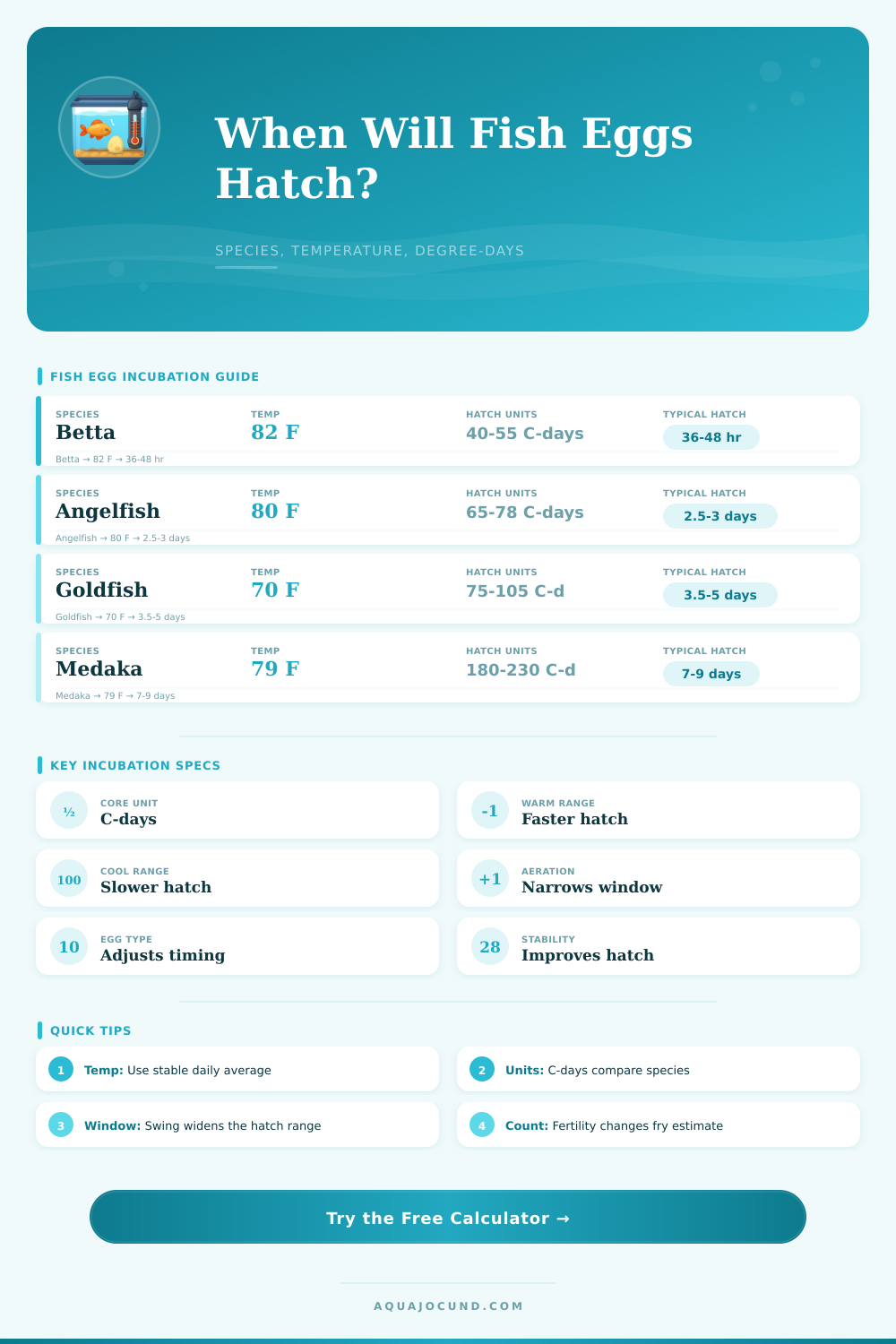
| Species profile | Useful incubation range | Hatch thermal units | Typical hatch note |
|---|---|---|---|
| Betta splendens | 78-84°F / 26-29°C | 40-55 C-days | About 36-48 hours in warm water |
| Freshwater angelfish | 78-82°F / 26-28°C | 65-78 C-days | About 2.5-3 days to hatch |
| Goldfish | 64-74°F / 18-23°C | 75-105 C-days | Often 3.5-5 days in spring temperatures |
| Koi carp | 68-77°F / 20-25°C | 90-125 C-days | Usually 4-6 days in warm vats |
| Corydoras catfish | 74-80°F / 23-27°C | 85-115 C-days | Commonly 3.5-5 days |
| Zebrafish | 80-84°F / 27-29°C | 70-88 C-days | Rapid hatch at 28-29°C |
| Discus | 82-86°F / 28-30°C | 70-92 C-days | Warm cichlid clutch timing |
| Medaka / ricefish | 75-82°F / 24-28°C | 180-230 C-days | Often about 7-9 days |
| Rainbow trout | 45-55°F / 7-13°C | 300-370 C-days | Coldwater eggs take several weeks |
🌡Temperature Effect Examples
| Thermal target | At 20°C / 68°F | At 25°C / 77°F | At 28°C / 82°F |
|---|---|---|---|
| 50 C-days | 2.5 days | 2.0 days | 1.8 days |
| 80 C-days | 4.0 days | 3.2 days | 2.9 days |
| 110 C-days | 5.5 days | 4.4 days | 3.9 days |
| 220 C-days | 11.0 days | 8.8 days | 7.9 days |
| 340 C-days | 17.0 days | 13.6 days | 12.1 days |
🥚Egg Type and Aeration Factors
| Condition | Timing effect | Window effect | Best calculator use |
|---|---|---|---|
| Bubble nest eggs | Slightly faster | Narrow if stable | Betta and gourami style clutches |
| Adhesive mop eggs | Near baseline | Moderate | Goldfish, medaka, many killifish |
| Guarded substrate eggs | Near baseline | Narrow with parent fanning | Cichlid cone, cave, or leaf spawns |
| Egg tumbler flow | Slightly faster oxygen exchange | Narrows scattered hatch | Cichlid, catfish, and non-adhesive eggs |
| Low movement | Slightly slower | Wider | Use only when eggs are not oxygen limited |
📐Common Incubation Scenarios
| Scenario | Typical inputs | Watch in result | Useful output |
|---|---|---|---|
| Fresh angelfish spawn | 80°F, guarded substrate, parent fanning | Eggs turning white after day 1 | 2-3 day hatch window |
| Goldfish spawning mop | 70°F, adhesive eggs, light bubbling | Wide temperature swing outdoors | Daily check timing |
| Medaka egg cup | 79°F, adhesive eggs, steady aeration | Longer thermal target | Week-scale hatch estimate |
| Coldwater trout tray | 50°F, coldwater eggs, steady flow | Logged degree-days | Several-week planning window |
Embryos don’t care about human calendars. They care only about amount of energy you provide as it relates to their growth rate. The physics of egg development are a combination of thermodynamics and waiting patiently.
You observe small balls stuck to a leaf on a plant or suspended in a bubble nest. Your mind leaps ahead to the instant they’re released into the world. While humans see time as a straight line, biological processes like embryo development builds on themselves over time. A day isn’t a day; one at 80 degrees doesn’t equate to one at 70.
Why Degree-Days Matter More Than Calendar Days
This is why aquarium keepers who breed fish uses degree-days instead of calendar days to follow along. It sounds technical but is simple enough. Regardless of the speed at which you give heat, what matters is how much heat is needed to achieve a particular milestone. So, what’s the catch? How do I know how much to adjust?
You don’t need to do all the conversion and coefficient math yourself…that’s why there’s this calculator. Plug in your average temperature (not the current number from your thermometer) and your species, and the calculator do the math for you.
The important thing is not so much the thermometer reading at any given time as it is the consistent average temperature throughout entire duration of incubation. Heaters cycle on and off which creates a false reading. These highs and lows throw embryo for a loop rather than helping it along. It doesn’t matter if you’ve got an eighties heater dial because what matters is the average temperature the eggs actualy see over the course of a day.
Maybe your tank water is eighty degrees with a two degree drop overnight due to cooling room air. Your real average could end up being only seventy-eight degrees. This one or two degree change can shift your hatch window by hours, and when you’re hoping to feed fry moments after their heads pop above water, those few hours make a big difference.
These estimates rely on species profiles, since various fish has varied development baselines. An egg of a rainbow trout requires many more cumulative heat units than an embryo of a betta. The reference table spells it all out. Coldwater species require upwards of three hundred degrees-days, while warm water species such as cichlids hatches in less than eighty.
And so you can’t just assume that what happens in your tank will happen elsewhere, as if you’re making the same assumption about timing across tanks. While a clutch of eggs for some species may be ready in five days at 70 degrees Fahrenheit (e.g., goldfish spawning in spring), another species such as zebrafish eggs might hatch in half that time at the same temperature. Their seasonal reality is set differently; their biological clock runs on different time.
The other variables are air and egg type (which control growth of fungus and affect available oxygen). Eggs laid stickily (such as on a spawning mop); tend to clump. Particularly without good water movement, they become a mess that reduces local dissolved O2 and traps waste. Constant gentle aeration prevents this and provides each embryo with sufficient oxygen for efficient metabolism of the heat it generates. Choosing your egg type in the tool basically instructs the algorithm how much margin to set aside for physical constraints.
Fanned eggs like mouthbrooders or guarded substrate eggs benefits from parental care to regulate flow, whereas bubble nest eggs depends on the male maintaining the structure. Lack of flow means a wider hatch window as some eggs will be just a little less oxygenated than others, falling out of step with their siblings. This produces a staggered fry emergence instead of a simultaneous blast-off.
A huge number of hobbyists fall into the trap of checking for hatch at specific times determined by ideal conditions that they’ve read in a book. In reality, your tank is an ecosystem, and most real tanks are fairly messed up. Water quality vary. Temperature fluctuates.
The calculator takes this into account by giving you a range rather than a time and date. Because faster temps accelerate development and slower temps slow it down, it expands the predicted window accordingly. Rather than one hour, it gives you a window, way more realistic considering biological variability!
Another thing to consider is fertility rates. Not all clear eggs will turn into fries. Some are unfertilized from the outset while others will get infected with bacteria/fungus and die off before reaching the eyed stage. If you keep track of your historical fertility rate, you can adjust your expectations for how many mouths you’ll realy have to feed.
You can know when it’s going to happen, but knowing when it happens is only half the battle. The real question is how do I have live food ready just as the first few fry start swimming? This should of happened before their yolk sacs run out. Otherwise they die. Feed them too soon and you’re wasting money and fouling up your tank.
Timing connects what you expect with what you do. It stops you from guessing and starts you preparing instead, based off data not hope.
“Incubation isn’t so much about making nature conform as it is about understanding nature’s signals. If you’re paying attention, the thermal units builds up in the background, and the eggs will tell you what to do when they reach their readiness. From the rate of development to stress level, getting that average temperature correct matters. When you can rely on the degree-days’ count, there’s no need to watch the tank every hour; instead, you can just wait for the right window of opportunity. You are moving from anxiety to strategy, and that is the difference between sporadic luck and an ongoing practice.