Egg Hatch Time Temperature Calculator
Estimate fish egg hatch timing from species, water temperature, degree-days, oxygen, egg age, antifungal care, aeration, and expected survival.
🥚Egg Hatch Presets
🌡Species and Incubation Conditions
Estimated Hatch Plan
🐟Egg Species Comparison Grid
📊Species Hatch Reference
| Species | Typical Temp | Model Degree-Days | Common Hatch Window | Incubation Note |
|---|---|---|---|---|
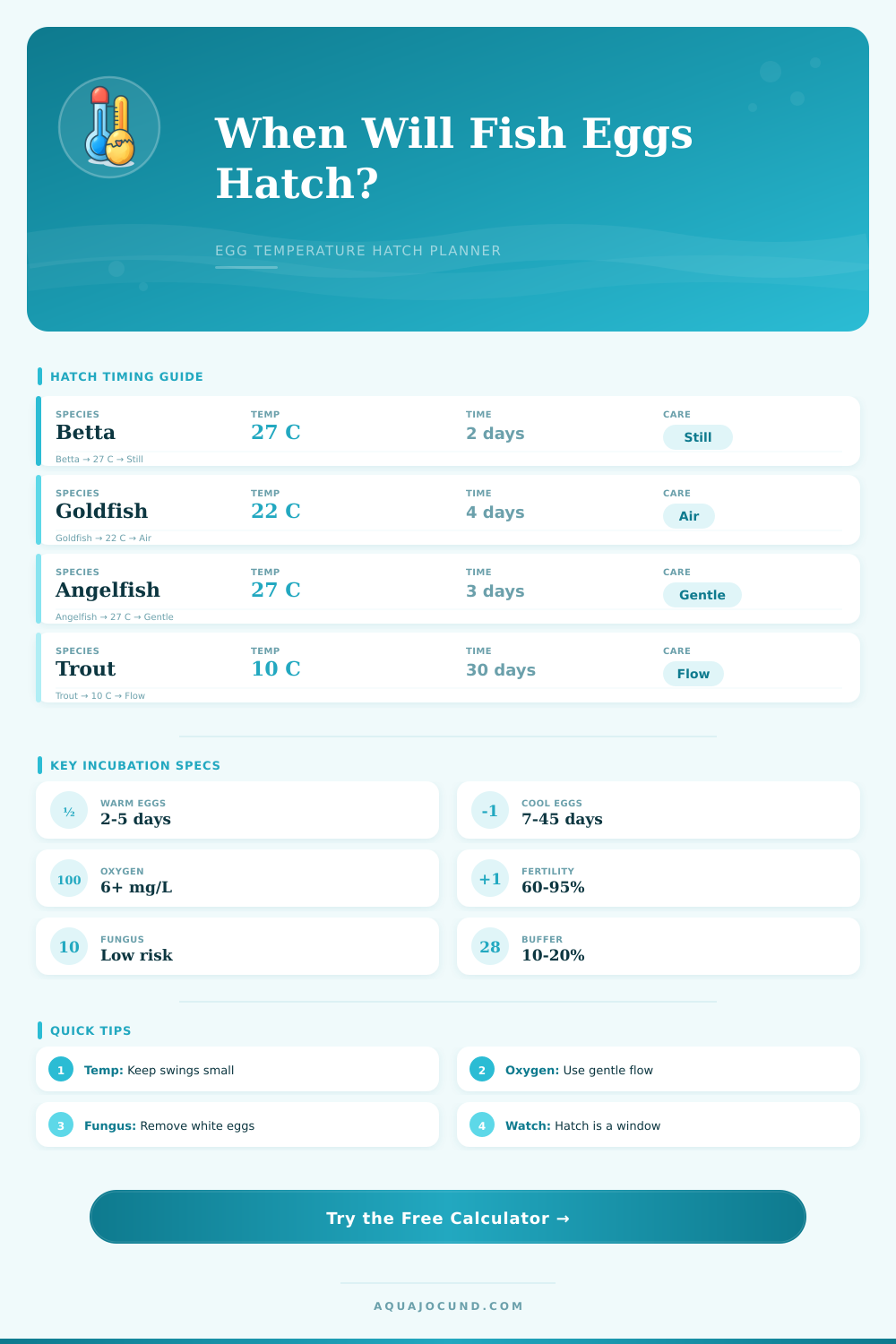
| Betta splendens | 26-28°C / 79-82°F | 52 above 1°C | 36-54 hours | Bubble-nest eggs need humid air and low turbulence. |
| Goldfish | 20-23°C / 68-73°F | 82 above 1°C | 3-5 days | Adhesive eggs fungus quickly if unfertilized eggs remain. |
| Koi carp | 20-24°C / 68-75°F | 92 above 1°C | 3.5-5 days | Pond spawns need steady oxygen through dense egg ropes. |
| Angelfish | 26-28°C / 79-82°F | 70 above 1°C | 54-72 hours | Parent fanning can substitute for a very gentle air stream. |
| Corydoras | 23-25°C / 73-77°F | 88 above 1°C | 3.5-5 days | Eggs on glass or mops benefit from daily white-egg removal. |
| Zebrafish | 28-29°C / 82-84°F | 78 above 1°C | 2.5-3 days | Warm, stable incubators produce a narrow hatch window. |
| Medaka | 25-27°C / 77-81°F | 166 above 1°C | 6-8 days | Embryos often remain visible in small, clear eggs. |
| Rainbow trout | 8-12°C / 46-54°F | 315 above 0°C | 28-45 days | Cold water must stay oxygen-rich and free of silt. |
⚙Care Factor Table
| Factor | Good Range | Warning Range | Effect in Calculator | Care Action |
|---|---|---|---|---|
| Dissolved oxygen | 6-9 mg/L | Below 5.5 mg/L | Reduces survival estimate | Add gentle aeration or flow past eggs. |
| Temperature swing | 0-1°C daily | Above 2°C daily | Widens hatch window | Use heater guard, lid, or stable room. |
| Fertility | 75-95% | Below 50% | Limits expected fry | Remove infertile eggs before fungus spreads. |
| Aeration | Gentle flow | Still or blasting | Adjusts survival score | Keep eggs moving only if the species tolerates it. |
| Fungus control | Clean and checked | White eggs left in place | Adjusts fungus risk | Use species-safe hygiene and daily inspection. |
🧪Degree-Day Calculation Notes
| Term | Meaning | Formula Used | Why It Matters |
|---|---|---|---|
| Thermal units | Heat available for embryo development | (Temp - threshold) x days | Warmer safe water usually shortens time. |
| Lower threshold | Temperature where development nearly stops | Species value or custom entry | Cold-water and warm-water eggs differ strongly. |
| Remaining hours | Time left after egg age credit | Remaining degree-days / daily gain | Prevents restarting the clock for older eggs. |
| Hatch window | Expected spread from variation | Core time plus stress spread | Eggs hatch over a range, not at one minute. |
📝Temperature Band Guide
| Band | Warm Species | Cool Species | Likely Result | Calculator Response |
|---|---|---|---|---|
| Below minimum | Under 22°C | Under 6°C | Slow or stalled hatch | Flags cold stress and adds risk. |
| Preferred | 25-28°C | 8-12°C | Predictable development | Uses normal degree-day timing. |
| Warm edge | 29-30°C | 13-14°C | Fast but less forgiving | Adds temperature risk and wider window. |
| Too warm | Above 31°C | Above 16°C | Deformity or mortality risk | Marks high stress and reduces survival. |
Think of egg incubation as a biology-based process that is driven by heat accumulation, not necessarily a set-in-stone calendar date. Embryo development are based off the total heat they absorb. This makes understanding degree-day model more important than using intuition when trying to coordinate fry feedings or timing breeding schedules.
After plugging in your water temperature and species, the calculator above eliminates guesswork on conversions and coefficients. Once it knows your species and water temp, it convert raw heat into embryo development progress. It does this by taking your water temperature minus a lower threshold, the point where no biological activity occurs, and multiplying that difference by number of days.
Why Egg Incubation Is Not Just About Time
If you’re in a tropical warm-water climate such as for Angelfish or Bettas, the floor is low, almost anything above comfortabley room temp will help eggs hatch. Trout are much more different and has a slower metabolism (longer development cycle). They also benefit from constant flow of cool water to avoid fungal outbreaks. So that’s another calculation.
Hobbyists tend to focus solely on when the eggs will hatch and forget about how they’re being kept alive prior to hatching from there shell. In reality, oxygen is quiet assassin of any egg clutch. Even though there may be plenty of dissolved oxygen throughout most of the water column (as indicated by your tank test kit), dense clusters of corydoras or goldfish egg can draw all the oxygen right out of immediate area around them. This can result in small dead zones within your tank, which are accounted for in the tool via aeration adjustment.
You’ll typically find the sweet spot between gentle current and no current at all because you don’t want water movement strong enough to blast the embryos off a leaf or spawning mop but weak enough to provide fresh oxygen to each egg as well as remove waste products. Still water promote fungus growth; violent water current stresses emerging larvae. It’s a fine balance and one that takes observation rather than simply plugging in an air stone and walking away.
Finally, fungal control is just as important and poorly understood. Nonviable eggs contain either white eggs (dead tissue or unfertilized) which won’t ever hatch, they’ll rot instead. These will quickly become a source of fungus if left with the clutch, spreading fast into viable embryo. If you intend to remove daily (a lot of work) or treat chemically (e.g., with methylene blue), the calculator incorporate your choice into its estimate of survival.
Chemical treatment must be done carefully, checking species compatibility and correct dosage; removing each day is very effective but also lots more work. It’s a tradeoff: less work, higher risk… or more work, lower risk. The reference table on page shows how different levels of hygiene change total fry counts for many species.
Surprisingly, water temperature stability also impacts hatch quality. Normal small day-to-day variation is nothing to worry about. But big variations will cause a large widening of your hatch window. Embryos don’t all develop at the same rate, and instead of a timed burst where they all fry out at once, you’ll experience a staggered trickle over multiple days. That means more difficulty managing those initial few meals of vulnerable fry. It fragments the feed schedule, too. Stable temperatures prevents that dispersion. Degree-days add up at a predictable rate.
So what’s it all mean? Hatch time is a matter of setting your expectations. It’s not a question of making baby fish come faster, too much heat will kill them, cause deformities and just generaly mess things up. Your objective is to set ’em up right and let biology take over. Waiting requires patience but ultimately results in better, more consistant fry that swim and feed immediately. So get your oxygen levels checked first; then check the clock.