🐟 Fry Growth Rate Calculator
Project fry length and weight gain from species, age, temperature, feeding, density, and water changes.
Projected Growth Estimate
| Profile | Example fry | Base length gain | Weight model | Calculator note |
|---|---|---|---|---|
| Livebearer fry | Guppy, molly, platy | 0.40 mm/day | Medium body | Usually strong feeders soon after birth |
| Tiny egg-layer fry | Danio, tetra, rasbora | 0.26 mm/day | Light body | Small first foods slow early visible gain |
| Cichlid fry | Angel, apisto, mbuna | 0.48 mm/day | Deep body | Responds strongly to live food and clean water |
| Cory / catfish fry | Corydoras, small catfish | 0.34 mm/day | Bottom grazer | Density matters because food settles low |
| Labyrinth fry | Betta, gourami | 0.28 mm/day | Light body | Early growth can pause during transition stages |
| Goldfish / pond fry | Goldfish, medaka tub | 0.62 mm/day | Heavy body | Needs more volume as biomass rises |
| Rainbowfish fry | Rainbowfish | 0.31 mm/day | Slender body | Frequent small live foods improve consistency |
| Large-bodied fry | Discus, large cichlids | 0.44 mm/day | Heavy body | High water quality has a large effect |
| Condition | Multiplier | Typical use | Growth effect | Watch point |
|---|---|---|---|---|
| Cool for profile | 0.70-0.90 | Lower temperature grow-out | Slower length and weight gain | Do not overfeed cold fry |
| Near optimum | 0.95-1.08 | Stable species range | Most reliable projection | Keep daily swings small |
| Warm but safe | 1.08-1.22 | Fast grow-out windows | Higher appetite and waste load | Oxygen demand rises |
| Frequent feeding | 1.00-1.16 | 4-6 meals per day | Better small-fry conversion | Uneaten food must be removed |
| Heavy growth push | 1.18 | Rich food plan | Fast weight gain | Needs stronger water changes |
| Active density | Daily water change | Growth pressure | Score cue | Calculator response |
|---|---|---|---|---|
| Under 5 fry/gal | 10-20% | Low | Open grow-out space | Little density penalty |
| 5-10 fry/gal | 15-30% | Moderate | Normal nursery range | Small penalty unless changes are low |
| 10-18 fry/gal | 25-45% | High | Fast fouling possible | Growth is reduced without clean water |
| 18+ fry/gal | 40%+ | Very high | Move or split soon | Density penalty becomes strong |
| Setup | Volume | Fry count range | Good projection window | Typical use |
|---|---|---|---|---|
| Small breeder box | 0.5-1 gal (1.9-3.8 L) | 5-20 tiny fry | 2-5 days | Short observation only |
| 5.5 gal nursery | 5.5 gal (20.8 L) | 20-60 fry | 7-14 days | First grow-out stage |
| 10 gal fry tank | 10 gal (37.9 L) | 40-120 fry | 7-21 days | Livebearer and small cichlid fry |
| 20 gal long | 20 gal (75.7 L) | 80-220 fry | 14-30 days | Better surface and feeding room |
| 40 breeder | 40 gal (151 L) | 150-450 fry | 21-45 days | Batch grow-out before sorting |
Once the fry hatch, focus on fishkeeping transitions from observing them to managing them. The tank is no longer just an aquarium but also a place of high stakes, water quality that fluctuates by the hour; action driven by feeding. What’s happening? Are they thriving? Growing? To answer these questions, we need to measure them, since what we don’t measure, we can’t control. Measuring fry growth rates removes guesswork.
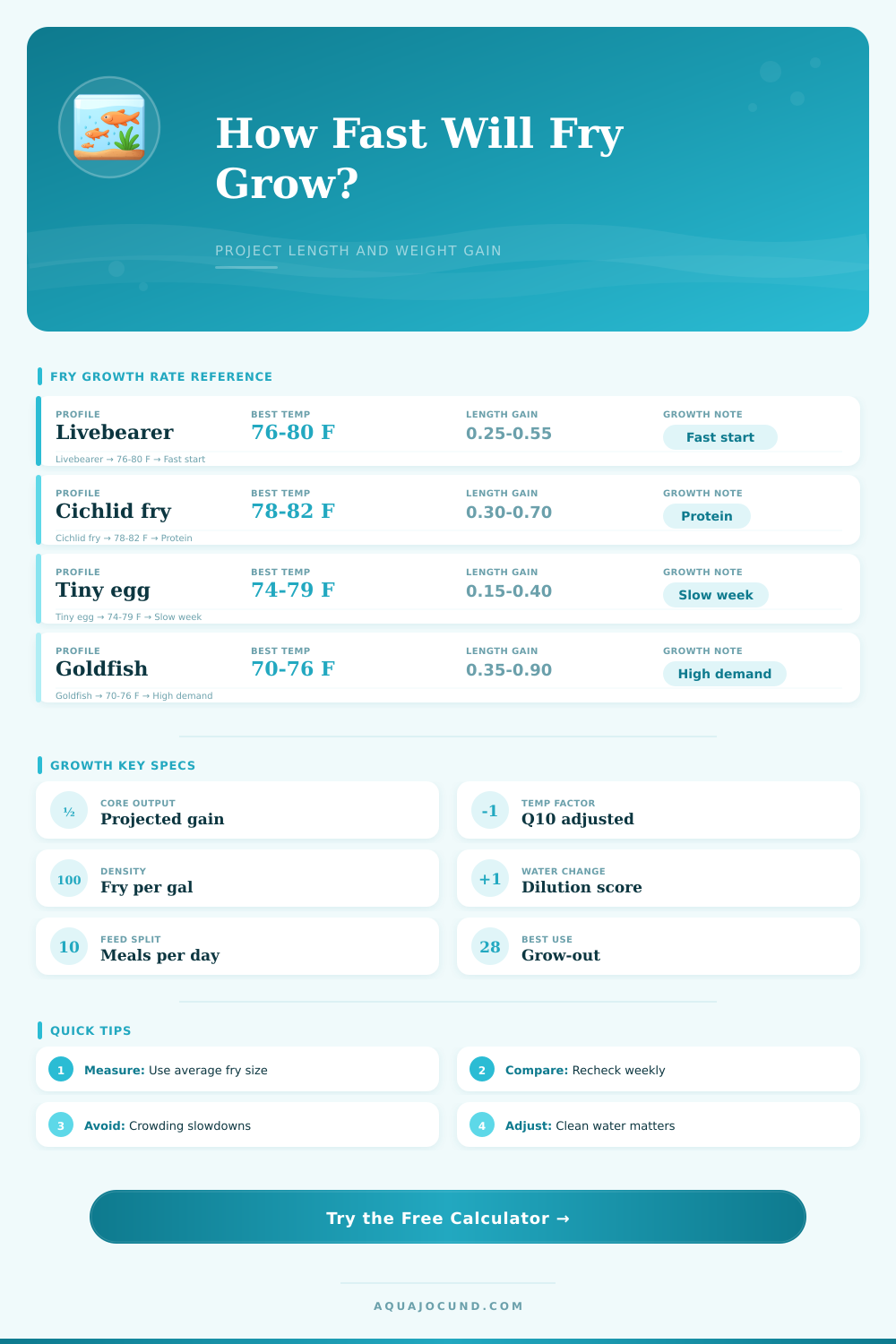
Growth rate change based off the environment and does not follow a straight line. Within a couple of weeks, a guppy raised in warm water with live food will be larger then a betta raised in cool, stagnant water. The online fry growth rate calculator (above) takes care of math, translating density, temperature, etc. It translates these factors into predicted length and weight gains.
How to Measure Fry Growth
The initial thing many people will do to increase rate of growth is change tank temperature. Faster metabolisms means faster digestion of food and conversion into tissue at warmer temperatures. But warmer water also takes more oxygen out of the water AND the fish need more too. If you raise the heater without compensating by adding more filtration or surface agitation, you risk suffocating your fish.
The tool includes that with the understanding that expectations should of be adjusted according to your tank temperature, as long as it remains in an acceptable range. The other area that is frequently not well understood is feeding strategy. Beginners usually think the more you feed, the bigger your fish will grow. But this isn’t true. Rotting uneaten food causes elevated ammonia which kills off more fish and stunts their growth.
Appropriateness and frequency are more important than amount fed. If you feed enough little bits 4-6x/day then fry stay satiated but don’t foul up the water. Regular feeding like this result in regular daily gains. Sporadic big meals cause erratic growth and weak immune system.
Density is another factor affecting long term success. Great filtration allow you to pack a tank with fish; however, higher density mean higher waste generation and more competition for food. To address this, the calculator looks at density based on both fry numbers (relative to tank volume) combined with the frequency of water changes. For example, keeping 50 small tetra fry in a five gallon bucket with infrequent water changes will result in lower growth score (not a penalty per se, but a flag that environment is deteriorating even though there’s enough food).
Note: While this section applies primarily to community tanks, it also has implications for species-only tanks. The final bottleneck in your fry’s growth potential is the water quality. Even if you have the ideal temperature and feeding conditions, the fry will stop growing the moment they encounter toxic levels of ammonia or nitrite. Because their organs aren’t fully developed yet, fry are much more susceptible to bad water than adults.
Frequent (daily) water changes dilute toxicity of ammonia/nitrite while replacing lost minerals. Tedious task? Yes. Gives you biological stability that allows for sustained growth spurts? Yes.
Measuring success requires time and data. Don’t just assess the health of your stock based off the quickest fish. That fish is the exception to the rule, the fast fish will skew how you think the rest of the population is doing. Check the average of the mid-pack. Use this to get a good idea of where you’re at and what to expect next when you want to sort or upgrade in the future.
It could be that your egg-laying smallies haven’t grown much but your livebearer family has more than doubled in size within only a couple weeks. You can expect this, given the biology of each species. Fry raising is as much art as it is science. How do I get more from less? While inputs affect outputs, you want to balance them so as not to break the system.
This isn’t about pushing fish to grow, rather it’s about eliminating things that will stop them growing naturaly. If you pay attention to all the variables they turn your crazy ass nursery into a well-controlled production line. You’re not raising survivors, you’re raising strong, healthy fish who should thrive wherever they end up. Starting with some hope and a bucket full of eggs, you end up with data driven confidence behind each decision you make.