Shipping Box Insulation Calculator
Estimate insulated live fish, coral, shrimp, or aquatic plant shipping performance from box size, insulation thickness, ambient temperature, water mass, transit duration, and heat or cold pack energy.
📦Shipping Scenario Presets
📏Box and Insulation
🌡Water, Route, and Livestock Range
🧊Pack Planning
Shipping Box Estimate
🧱Insulation Material Comparison
📊Box Size Reference
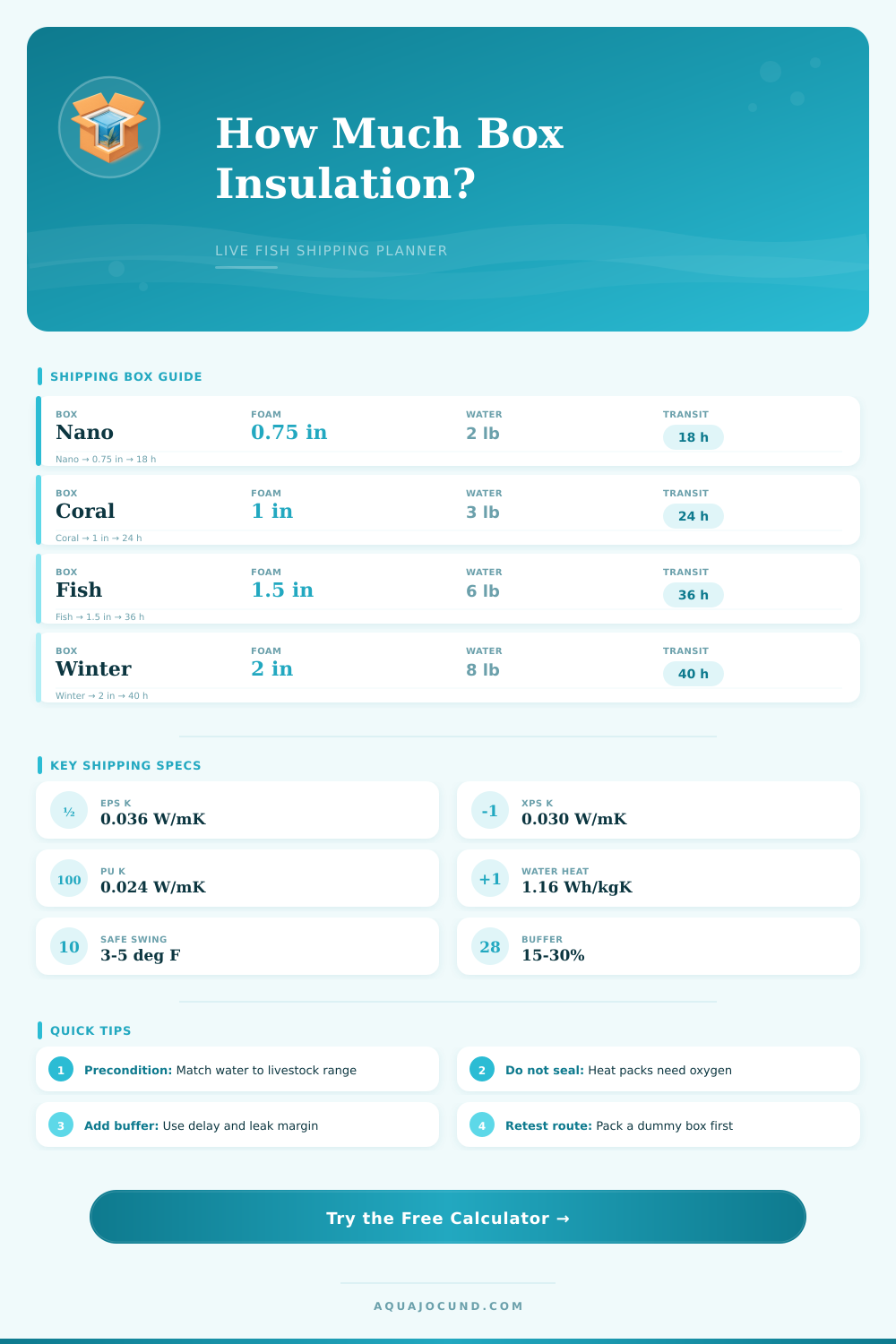
| Use Case | Outside Size | Common Foam | Typical Water | Planning Note |
|---|---|---|---|---|
| Single betta or shrimp | 10 x 8 x 7 in | 0.75-1 in EPS | 1-2 lb | Small thermal mass changes quickly |
| Small community fish | 14 x 10 x 9 in | 1 in EPS | 3-5 lb | One heat pack often affects the full box |
| Coral frag shipment | 12 x 10 x 8 in | 1-1.5 in EPS | 2-4 lb | Avoid direct pack contact with cups or bags |
| Medium fish box | 16 x 12 x 10 in | 1.5 in EPS | 5-9 lb | Good balance for overnight routes |
| Large koi juvenile | 20 x 14 x 12 in | 1.5-2 in EPS | 10-18 lb | Water mass helps but box area is larger |
⚡Pack Energy Reference
| Pack Type | Usable Energy | Best Use | Main Limitation | Calculator Key |
|---|---|---|---|---|
| 20 hour heat pack | 70 Wh heat | Cool overnight tropical fish | Needs oxygen and spacing | heat20 |
| 40 hour heat pack | 110 Wh heat | Cold two-day routes | Can overheat small boxes | heat40 |
| 72 hour heat pack | 150 Wh heat | Delay-prone winter routes | Slow start, long tail | heat72 |
| Small frozen gel pack | 90 Wh cooling | Warm short routes | Condensation and cold spots | gelSmall |
| Large frozen gel pack | 180 Wh cooling | Hot longer routes | Too much for small bags | gelLarge |
| Phase change pack | 120 Wh buffer | Stable coral or reef shipping | Must be conditioned correctly | phase |
🌡Livestock Temperature Guide
| Profile | Planning Range | Ideal Start | Swing Caution | Pack Note |
|---|---|---|---|---|
| Tropical freshwater fish | 72-80 deg F | 76 deg F | Keep swing under 5 deg F | Heat below mild room temp |
| Dwarf shrimp and snails | 66-76 deg F | 70 deg F | Avoid fast hot spikes | Often prefer cooler routes |
| Warm discus or rams | 78-84 deg F | 82 deg F | Cold stress arrives quickly | Use strong winter margin |
| Goldfish or koi | 50-70 deg F | 62 deg F | Heat can be worse than cool | Cold packs for summer hubs |
| Reef coral and marine fish | 74-80 deg F | 77 deg F | Small water cups swing fast | Separate packs from cups |
🔬Calculation Assumptions
| Factor | Value Used | What It Means | When To Adjust |
|---|---|---|---|
| Water heat capacity | 4.186 kJ/kgK | Energy needed to move bag water temperature | Use actual water mass for accuracy |
| Surface film resistance | 0.17 m2K/W | Still air resistance inside and outside the liner | Windy docks reduce this benefit |
| Leakage factor | User entered | Extra heat transfer through lid and corners | Raise for loose lids or crushed boxes |
| Paper buffer factor | 0.90-1.18 | How internal packing slows direct heat exchange | Raise when bags are fully nested |
| Pack efficiency | User entered | How much pack energy reaches water | Lower when packs are heavily isolated |
The box should always be right for the route; the shipment dies more due to the box being wrong rather than due to fish themselves being weaklings. Expensive packaging and premium livestock won’t save you if your water bags fall outside the safe range before they arrive. This happens if insulation is too thin for the travel time and the outdoor temperature.
The math surrounding thermal drift is unforgiving. Hot runs towards cold. Hot doesn’t run backwards. Heat flow from hot to cold until equilibrium is reached. Your role as a shipper is to slow this flow just enough so you don’t freeze them solid nor suffocate them in the process.
Why Packing Matters More Than the Fish
It uses those complicated heat transfer equations so you don’t have to guess if your foam is too thin to last 48 hours in the winter time. It balances the thermal mass of the water you’re keeping with the surface area of the box it’s going into. It figures out how much that material you selected for insulation can slow the heat loss down. Then, it calculates by how many degrees the water temp will shift over a certain period of time.
So you may think more is better when it comes to thickness, but that really only accounts for part of the equation. The other half is volume. Half an inch of foam protecting your tiny little box of nano shrimp isn’t going to protect it like half an inch of foam doing the same job on a big koi box. Small packages do not have good surface-area-to-volume ratios. In short, it needs actual measurements to know how much thermal buffer you have between you and the fish. It also needs the weight of your water.
Material is the difference-maker. White styrofoam (expanded polystyrene) is the industry standard, for good reason; it’s cheap but sufficient for most overnight shipments when used properly. But what about shipping sensitive coral via a hot hub over the summer on a long haul? That same white foam might be letting in too much heat. With cross-linked polyurethane, there’s a higher level of insulation per inch than traditional white foam, allowing you to achieve better temperature stability using less bulk. The tool also includes reference tables that break down those conductivity values. These show why paying more for premium foam makes sense when the item being shipped is expensive and there is no room for error. Don’t select based solely off of appearance. Select based on your budget & risk tolerance and how well the material’s thermal resistance meets both.
A large amount of water is your first line of defense against temperature changes. You can think of water as having a really high specific heat capacity (i.e., a lot of energy must be used to change its temperature). That’s why I recommend conditioning livestock in shipping bags prior to plopping them into new tank water just before packaging. You want to prepare livestock to the optimal midpoint within the safe range (e.g., for tropicals, that would be around 76°). From there, you have an equal amount of room to go up or down without reaching stress thresholds.
The calculator finds this shift exactly. It assumes that during your expected travel time, the water temperature will fluctuate based on distance from the middle point, taking into account leaks along the sides and top of the package, where insulation is less effective due to corners. Even if walls are thick, those corners and gaps are what cause many packs to fall short.
Another factor that’s mishandled by most shippers: Heat packs emit energy until their oxygen supply is exhausted. Even then, they can quickly overheat to more than the safe max temp in a well-insulated, confined box. Therefore, separating the packs and allowing some airflow are crucial variables. Don’t cram ’em all together and seal them up tight; you want to leave space for the heat packs to exchange air and prevent any hot spot where packs might be cooking your livestock. The tool will help you calculate if you need just a single, 20-hour heatpack or require two (based on how effectively that heat transfers into the water bags). Buried under layers of cardboard and paper, less energy gets transferred into the water bags. Taped right to the bag, the heat transfer is too aggressive.
Seasonality also matters. Shipping a box full of bettas in May may have been fine but it could be deadly in July with rising ambient temps on the trucks. If you ship during the summer months, you need to add cooling elements or rethink your insulation plan. Winter shipments will have more insulation required (thicker boxes/liners) as well as a strong heating plan so they don’t get chilled too fast.
Last, never ship live stock until you’ve tested your route with dummies. Tape up a box, put in a water bag and thermometer and see what it does. How long did it take? What was the temp change? Nothing compares to real world data. It shows the model is right and increases confidence.
At its core shipping is about energy management. Insulation fights it. Water holds it. Packs modify it. Once you have those three aligned to the requirements of your livestock and your particular route, survival rates skyrocket. It isn’t about buying most expensive box; it’s about respecting the science of what happens inside it. You should of done the math, plan your packs with purpose, then let the science do the work while you attend to the care where it counts.