Sand Displacement Volume Calculator
Estimate aquarium sand bed volume, pore water, compaction, true water displacement, adjusted tank volume, and dosing correction.
Sand displacement results
| Sand type | Typical grain | Estimated porosity | Bulk density | Best fit |
|---|---|---|---|---|
| Sugar fine aragonite | 0.2-0.5 mm | 34% | 92 lb/ft³ | Reef sand beds, gobies |
| Fine silica sand | 0.5-1 mm | 36% | 95 lb/ft³ | Corydoras, soft-bottom fish |
| Washed play sand | 0.5-1.5 mm | 37% | 100 lb/ft³ | Budget freshwater beds |
| Medium aquarium sand | 1-2 mm | 39% | 98 lb/ft³ | Community and planted tanks |
| Coarse river sand | 2-4 mm | 43% | 105 lb/ft³ | Cichlid and high-flow tanks |
| Crushed coral sand | 1-3 mm | 41% | 82 lb/ft³ | Marine or hard-water aquariums |
| Black inert sand | 0.5-1.5 mm | 38% | 110 lb/ft³ | Display tanks, contrast layouts |
| Oolite reef sand | 0.1-1 mm | 35% | 88 lb/ft³ | Shallow reef aesthetics |
| Tank | Footprint | Display volume | Medium sand bed | True displacement |
|---|---|---|---|---|
| 5 gal | 16 x 8 in | 5 gal | 1.35 gal bed | 0.78 gal |
| 10 gal | 20 x 10 in | 10 gal | 2.07 gal bed | 1.19 gal |
| 20 long | 30 x 12 in | 20 gal | 3.72 gal bed | 2.13 gal |
| 29 gal | 30 x 12 in | 29 gal | 3.72 gal bed | 2.13 gal |
| 40 breeder | 36 x 18 in | 40 gal | 6.73 gal bed | 3.86 gal |
| 55 gal | 48 x 13 in | 55 gal | 6.49 gal bed | 3.72 gal |
| 75 gal | 48 x 18 in | 75 gal | 8.98 gal bed | 5.15 gal |
| 125 gal | 72 x 18 in | 125 gal | 13.47 gal bed | 7.72 gal |
| What changes | Used in formula | Typical effect | Dosing meaning |
|---|---|---|---|
| Higher sand depth | More bed volume | More displaced water | Lower corrected dose |
| Finer grain | Lower porosity | More solid fraction | More dose reduction |
| Coarser grain | Higher porosity | More pore water | Smaller dose reduction |
| Compaction | Reduced bed height | Slightly less bed volume | Use settled depth if known |
| Hardscape displacement | Subtracts directly | Can be large in reefs | Dose remaining water |
| Average depth | Use case | Displacement trend | Calculation note |
|---|---|---|---|
| 0.5-1 in | Cosmetic cover | Low | Small dose difference |
| 1-2 in | Cory or planted display | Moderate | Worth correcting in nano tanks |
| 2-3 in | Burrowing fish or reef sand | High | Correct volume before dosing |
| 4-6 in | Deep sand bed | Very high | Use settled depth and real fill height |
The bag of sand went in your tank because it was nice looking or complemented the décor, right? Now the tank’s full and the water level isn’t what you thought it would be. That’s when displacement stop being a physics lesson and becomes real problem.
If you know your tank size and type of sand, all you has to do is use the calculator provided above. You don’t have to wonder about the water volume left over once substrate is added.
Why Sand Changes Water Amount
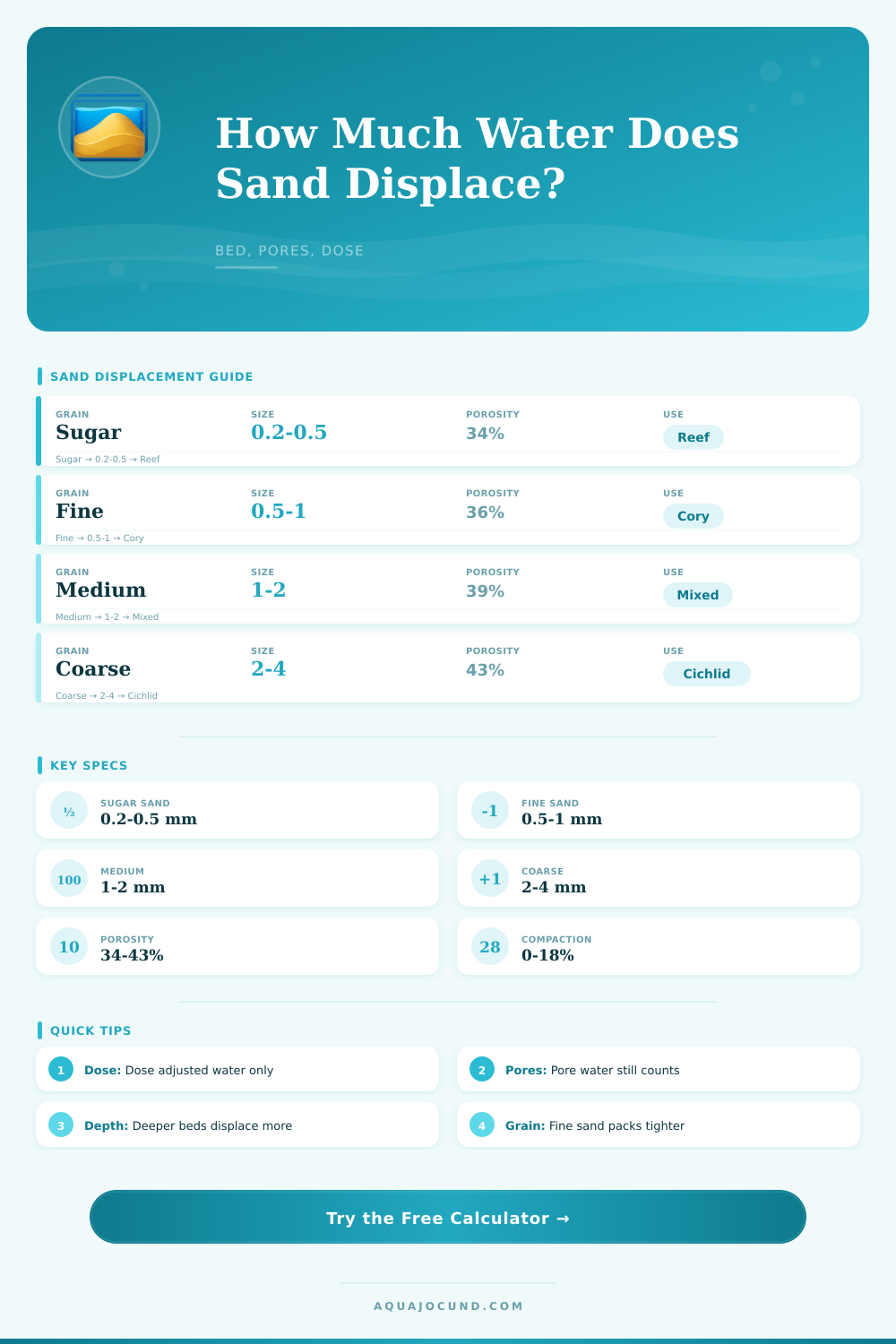
Sand does not remove as much water as its volume in your tank. That’s the mistake most people make. Why? Because when sand are full of water, there is no voids for water to occupy. The little holes between each grain is filled with water. The only thing that reduce your tank’s space is actual solid matter itself.
The tool displays this truth (true displacement vs. Pore water). Understanding this allow you to dose accurately.
For instance, take a twenty-gallon long tank with two inches of medium sand. Four gallons of this set-up are occupied by the bed. However, not all of that are solid stuff. In fact, there’s just two and a quarter gallon of solid stuff with the remainder being water in substrate. If you dose according to what instructions say for a tank completely filled with water, you’ll overdose. Chemicals will accumulates in the filter. They might also stick to plants.
With proper displacement figure, you know how much of actual liquid volume to treat. And this all depends on grain size. Smaller grains packs tighter with less “empty” space. Larger grains (coarser) has larger gaps, meaning more porosity. Aragonite is no different. You’ll notice that fine grades of aragonite are only about 34% porous whereas the coarse grades hit around 43%. For the purposes of aquarium sand, this mean that finer sand appears better for shrimp keeping but must be precisely dosed as it occupies more relative volume than coarser sand.
Another factor is depth. An inch deep doesn’t make much difference to your usable water. This is most important if you have small tank where every ounce really does count. If its for looks or you want lots of bacteria, deep sand beds do get taken up fast.
You also need to consider compaction. Rinsed sand will settle a bit once you start using it and water flow through it. The loose height makes it seem like it takes up more space then it actualy does. Once it settles, measure that depth and there’s your real number.
Adding rocks, driftwood and big pots makes it more complex. They also displace volume that is not occupied by sand. Enter their extra volume into calculator so you don’t count the lost volume twice. For example, if your layout have a lot of rock/many plants, they can displace as much water as your substrate. If you ignore them, you will have overdosing issues. That big piece of wood takes up gallons of space that could of otherwise hold water and bacteria.
Treat your tank like a puzzle (every item in the tank take up space), and you don’t have much! While most tanks will use substrate, you don’t need it. So how do you make sure everything fits? After adding all your items, you should be certain how much space is left. And if dosing, knowing the difference between solid vs. Liquid (or even pore water) will simplify dosing for you. You aren’t guessing anymore, but measuring what’s realy there. When you can see clearly, what used to be problems with chemicals become just regular maintenance.