Rock Displacement Volume Calculator
Estimate submerged rock volume, aquarium water loss, remaining treatment volume, and corrected dosing after hardscape goes into the tank.
⚖Unit System
📐Tank, Rock, And Dose Inputs
🪨Rock Density Comparison
📊Reference Tables
| Rock Type | Density | Typical Porosity | Best Calculator Basis |
|---|---|---|---|
| Seiryu / limestone | 155-170 lb/ft³ | 12-22% | Dry mass plus porosity |
| Dragon stone / ohko | 105-130 lb/ft³ | 28-42% | Mass or envelope check |
| Lava rock | 45-70 lb/ft³ | 40-60% | Envelope plus high porosity |
| Slate ledge | 165-180 lb/ft³ | 8-15% | Mass with low porosity |
| Dry reef rock | 60-90 lb/ft³ | 45-60% | Mass with high porosity |
| Common Tank | Inside Size | Nominal Volume | Rock Loss Watchpoint |
|---|---|---|---|
| 5 gallon nano | 16 x 8 x 10 in | 5 gal / 19 L | 1 gal loss is major |
| 20 long | 30 x 12 x 12 in | 20 gal / 76 L | Dense iwagumi groups add up |
| 40 breeder | 36 x 18 x 16 in | 40 gal / 151 L | Wide bases raise water evenly |
| 75 gallon | 48 x 18 x 21 in | 75 gal / 284 L | Cichlid stacks need correction |
| 125 gallon | 72 x 18 x 22 in | 125 gal / 473 L | Large rockwork can change dosing |
| Porosity Setting | Use For | Displacement Effect | Example Rock |
|---|---|---|---|
| 5-12% | Solid stone | Nearly full solid volume | Granite, slate |
| 15-25% | Grooved dense rock | Small to medium reduction | Seiryu |
| 30-45% | Pocketed aquascape rock | Medium reduction | Dragon stone |
| 45-60% | Open reef or lava rock | Large reduction | Lava, dry reef |
| Dosing Item | Volume To Use | Why It Matters | Check Again When |
|---|---|---|---|
| Water conditioner | New water volume | Rock does not need dechlorinator | After large water changes |
| Fertilizer | Usable tank water | Prevents high nutrient additions | After hardscape changes |
| Medication | Usable tank water | Reduces overdose risk | Before each treatment course |
| Buffer or mineral | Actual water volume | Concentration depends on water only | After substrate or rock changes |
✅Calculation Tips
Drop in the rock and fill the tank. At first glance you don’t notice much, the water level is up a little bit. But that little bit of water make all the difference. It is the difference between a well dosed system and one that is slightly under-conditioned or slightly over treated. We’re prone to treat the volume of aquarium as a static value marked on the glass, but that mark is for an empty box, not the ecosystem inside the box. Water gets displaced by hardscape and if you ignore that displacement, there are quiet mistakes made in maintenance.
So how does it work? It works primarily by letting us know exactly what it is telling us. Twenty gallons of capacity mean you bought twenty gallons of empty space. That number goes down when you start adding stone, plants, and substrate. The calculator above takes care of this for you. Simply plug in your tank dimensions and rock mass, and it will do the rest. No more guesswork about whether that big old Seiryu is displacing half a gallon or only two cups. Instead, it use porosity and density information to convert physical weight into fluid displacement, which would normally take a lab to get right.
Why Rocks Change Your Water Level
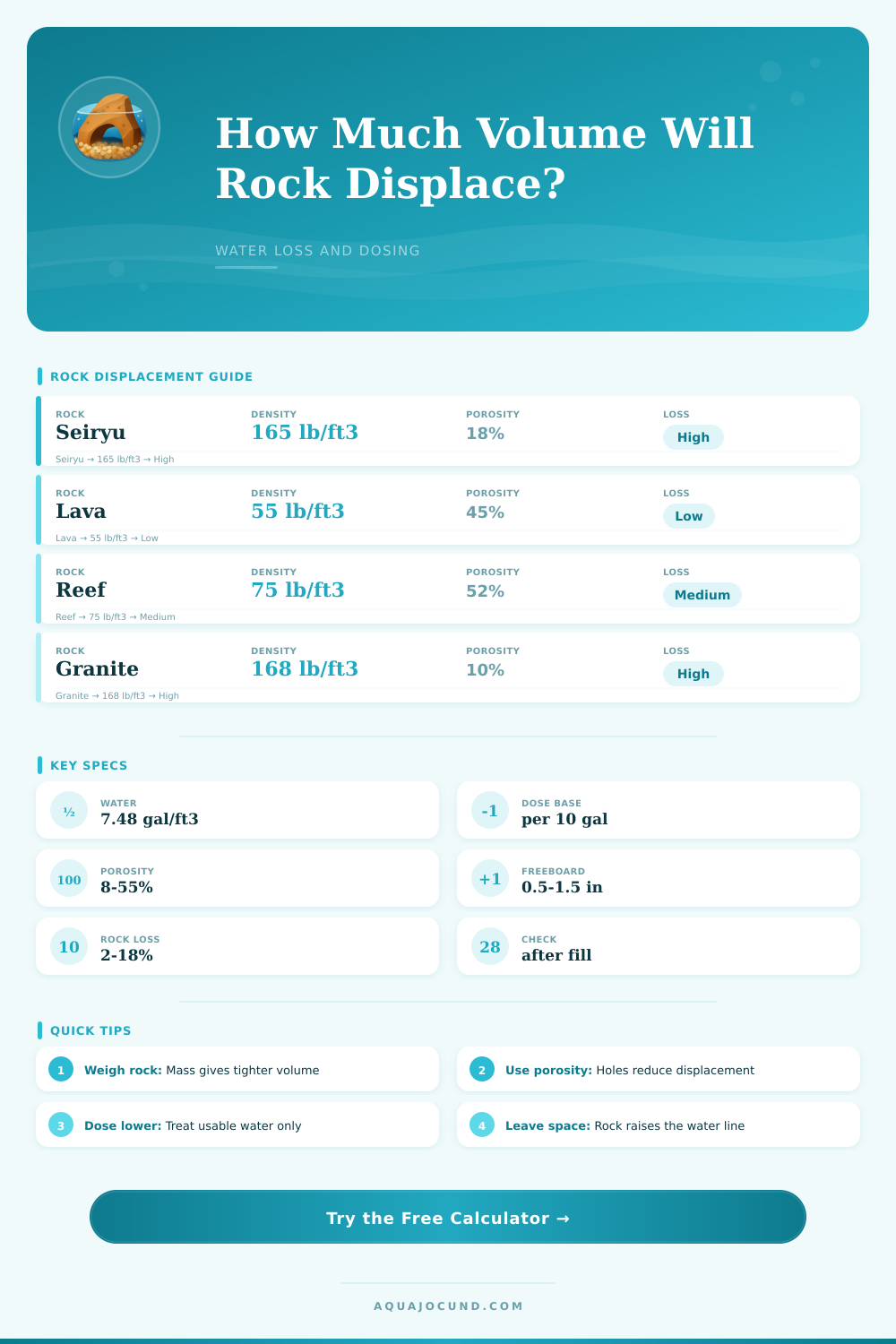
Most hobbyists makes their mistake in density. Yes, lava rock appears huge, but it’s loaded with air space. That means it displaces much less water then its apparent volume would lead you to believe. Conversely, slate and granite are solid and dense. A fistful of granite will remove way more water than that same amount of volcanic material will. The page have a table showing all of these in one place so you can compare quickly. You don’t have to memorize the numbers, only know which ones is heavy anchors (granite/slate) and which are light sponges (lava rock).
This knowledge would of changed how much water you have left. For dosing anything, whether it’s fertilizer or medication, this is most important. You have a twenty gallon tank (nominal), but since fifteen percent of that volume is taken up by rock, the actual liquid amount are less. So if the dosage calls for ten gallons, then the effective volume you’re treating has increased by about 15% to more like seventeen or eighteen gallons. That doesn’t sound like much, but when you’re attempting to cure ich, maintain balanced nutrients for finicky plants, etc., that dose makes all the difference.
What’s inside the glass matters because it changes how much water you actually have; what matters is the concentration of your water. Trapped air in the rock can’t be treated. In fact, it can hurt your livig livestock. The tool considers the internal makeup of the rock with its porosity settings. The higher the porosity, the greater the amount of non-displacing interior space. The lower the porosity, the more aggressively it push water out. Setting this slider properly will give you results based off how your hardscape is set up. Using a generic guess here could cause you to think you’ve lost two gallons while only losing one. From there, all of your dose calculations and water change amounts is wrong as well.
Another useful output is a rise in the waterline. If you’re stacking rocks like mad, it can move the water line dangerously near the rim. No one wants fish jumping out or evaporative loss when there’s insufficient “freeboard” (the gap between the water and rim). Simply plug in your tank footprint and amount of stone you plan to add, and the tool calculates the rise for you. This is a quick sanity test that will save you from an embarassing cleanup down the road.
Before you fill up, do you need to adjust your vision? Will your desired look fit into physical limits? Displacement is one element of the chemistry budget for your tank. Each gram of rock you put into your tank reduces the leeway for dosing errors. Weighing your rocks before adding them is the best way to get an estimate with the least error. However, even eyeballing your rocks with the envelope method will help establish a baseline rather than going in blind and assuming zero displacement. It may be small but it helps maintain balance within the system.
Life depends on the water, so understanding exactly how much of it you have should be foundational to good care. It is an empty box. You want to fill it with purpose, making each drop count where it matters most.