Stock Solution Concentration Calculator
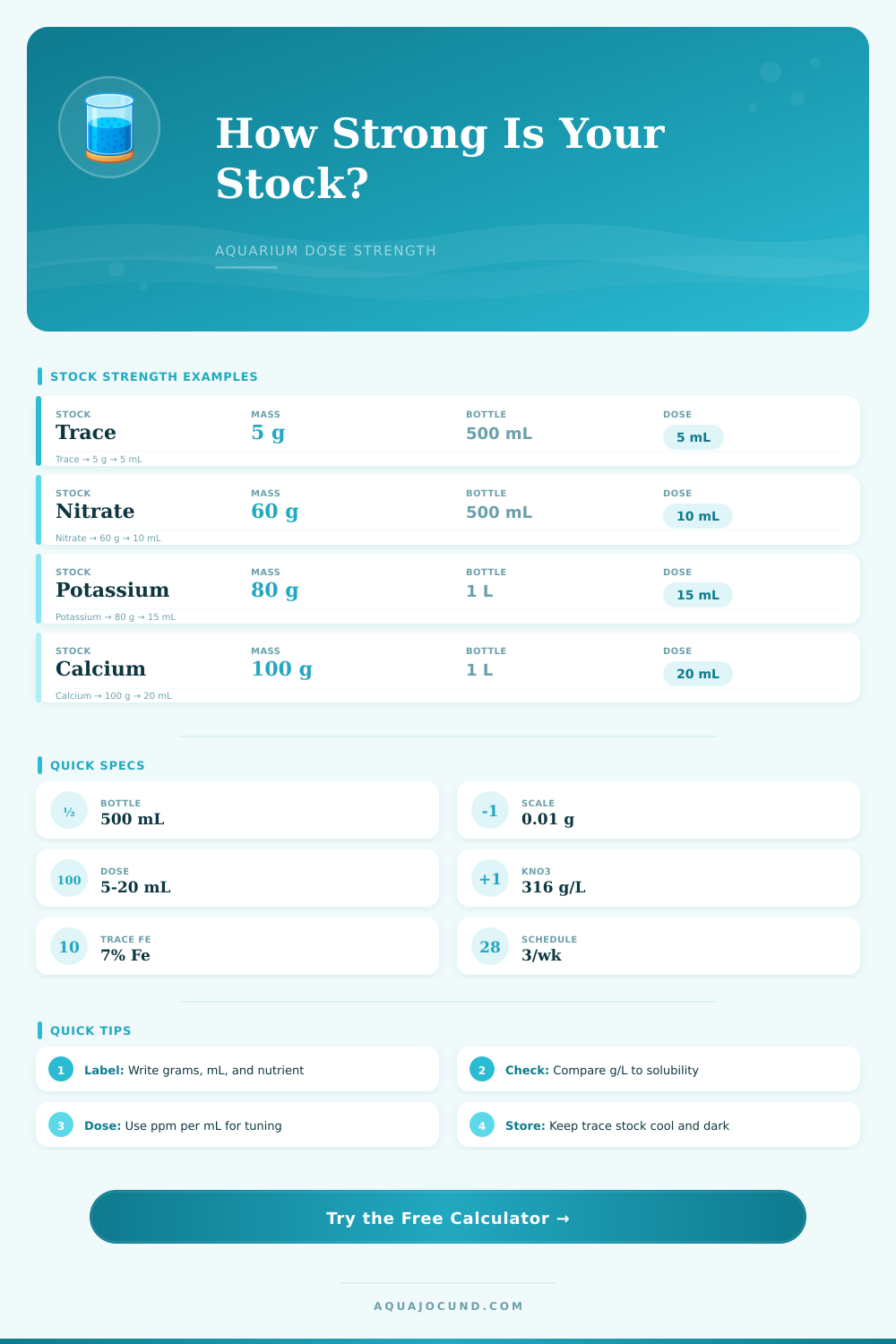
Convert solute grams and bottle volume into aquarium stock strength, nutrient mg per mL, ppm per mL, dose volume, weekly load, and storage concentration.
🧪Stock Concentration Presets
📐Tank Volume, Solute, and Dose
Stock Solution Concentration Result
⚗Stock Solution Comparison Grid
📊Common Solute Analysis
| Solute | Calculator basis | Approx solubility | Typical aquarium use |
|---|---|---|---|
| KNO3 | 61.3% NO3, 38.7% K | 316 g/L at 20°C | Nitrate macro stock |
| KH2PO4 | 69.8% PO4, 28.7% K | 220 g/L at 20°C | Phosphate macro stock |
| K2SO4 | 44.9% K | 111 g/L at 20°C | Potassium-only stock |
| MgSO4.7H2O | 9.9% Mg | 710 g/L at 20°C | Magnesium and GH stock |
| CaCl2.2H2O | 27.3% Ca | 745 g/L at 20°C | Calcium stock for reef or hard water |
| Trace mix | Label dependent, often Fe basis | Use label guidance | Micronutrient stock |
💧Common Tank Dose Ranges
| Tank size | Water volume | Usual stock dose | Good bottle range |
|---|---|---|---|
| 5 gallon nano | 19 L / 5 gal | 1 to 3 mL | 100 to 250 mL |
| 10 gallon planted | 38 L / 10 gal | 2 to 5 mL | 250 to 500 mL |
| 20 long planted | 76 L / 20 gal | 5 to 10 mL | 500 mL |
| 40 breeder | 151 L / 40 gal | 10 to 20 mL | 500 to 1000 mL |
| 75 gallon display | 284 L / 75 gal | 15 to 30 mL | 750 to 1500 mL |
| 125 gallon aquarium | 473 L / 125 gal | 25 to 60 mL | 1 to 2 L |
🌡Storage Strength Bands
| Storage load | Solubility share | What it means | Practical action |
|---|---|---|---|
| Easy stock | Under 35% | Usually dissolves readily | Good for small mL dosing |
| Routine stock | 35% to 60% | Balanced strength | Shake before dosing |
| Dense stock | 60% to 80% | May be slower to dissolve | Use warm water and headspace |
| Limit stock | Over 80% | Crystal risk increases | Dilute or raise dose volume |
📅Schedule Planning Guide
| Dosing goal | Nitrate per dose | Phosphate per dose | Trace Fe per dose |
|---|---|---|---|
| Lean shrimp tank | 1 to 3 ppm | 0.1 to 0.3 ppm | 0.02 to 0.05 ppm |
| Low tech plants | 3 to 6 ppm | 0.3 to 0.8 ppm | 0.03 to 0.08 ppm |
| EI split dosing | 5 to 10 ppm | 1 to 2 ppm | 0.05 to 0.15 ppm |
| High light CO2 | 7.5 to 15 ppm | 1.3 to 3 ppm | 0.08 to 0.2 ppm |
When starting to weigh powder from bulk bags instead of using premixed bottles, it can be easy to panic. It’s even worse at midnight when all you want to do is go to bed but aren’t sure whether the white stuff in your jar are undissolved failure or maybe calcium chloride. Making your own stock solution seems complicated because you have to remember chemistry math you hasn’t used in years. It’s no longer just feeding food. It’s engineering water chemistry with a measuring cylinder and a scale.
After you input your bottle size and solute amount, the calculator does all the complicatid math for you. It converts dry gram amounts to something meaningful based off your aquarium. That’s great! You don’t need to guess at conversions or coefficients. But, the reason your plants stays alive comes down to knowing why the conversion process matters.
Why This Calculator Helps You Dose Correctly
When starting out, most people only care about how much powder goes into their bottle. Thirty grams potassium nitrate? Cool! Thirty-grams of whatever. That’s the entire equation as far as they’re concerned. Unfortunately, that’s precisely when things go wrong, because water parameters aren’t changed by the bulk mass inside a bottle but rather by the active nutrient percentage.
This is about weight for weight. What’s important here is that potassium nitrate contains about sixty-one percent nitrates by weight. The other atoms present are all oxygen and potassium. That doesn’t impact what you’re looking at (ie. That does not change the nitrate or its amount. So if you take the full 30 grams and don’t account for the percentage, you’ll end up significantly under-dosing the tank. It’s a subtle point but makes all the difference.
Consequently, the tool asks for the nutrient percent so that you can get a sense of precisely how many milligrams of actual nitrate or phosphate is in each milliliter of solution. Nutrient/solute is key concept for DIY dosing. Another surprise is strength of storage. Some folks want to make a super concentrated stock in order to conserve some shelf space. However, salt water have physical limits as to how much it will hold without falling back out.
Temperature affects solubility. A solution may look like a clear solution on a warm day but then become sludge the next night after the room cool. Also, the reference table on the page shows safe ranges for storage load. Thirty-five and sixty percent of the solubility limit is plenty strong to be practical. This also provides a little buffer to prevent crystals from forming in neck of the bottle.
The amount of headroom you have for error depends on tank size. A five-gallon nano tank contains relatively little water. Even minor overdosing will quickly spike parameters, which in turn stresses livestock. By contrast, a seventy-five-gallon display tank absorbs changes far more easier.
Lastly, the calculator takes into account the dimensions you input and factors in shape difference (e.g., cylinder vs. Rectangle with a bow front) common causes of misestimating volume. Gravel displaces water and glass takes up space too so getting the actual volume of water right is half the battle.
Dosing is more about consistency than accuracy (in the long run). You do not need a laboratory-grade balance to dose effectively. All you really need is to have the same routine each week, on the same scale, using the same bottle. This allows you to see how much you’re putting into your tank over the course of the week and adjust your dosing based off what your tank consumes at different times of the week.
Sometimes pale plants aren’t necessarily a problem with too little food but perhaps a problem with when you feed them. Splitting the feeding up during the week often work better than dumping a bunch all at once on, say, Sunday. It’s not rocket science. It’s really about following a routine. It’s learning to tell the difference between the weight of the solute versus the actual amount of nutrients it contains, thereby removing the fear from the process.
It’s eliminating guess work and replacing it with measurement. It’s knowing that when the solution settles to the bottom of the bottle and shows you crystal clear water, you’ve got it right.