Auto Top Off Pump Rate Calculator
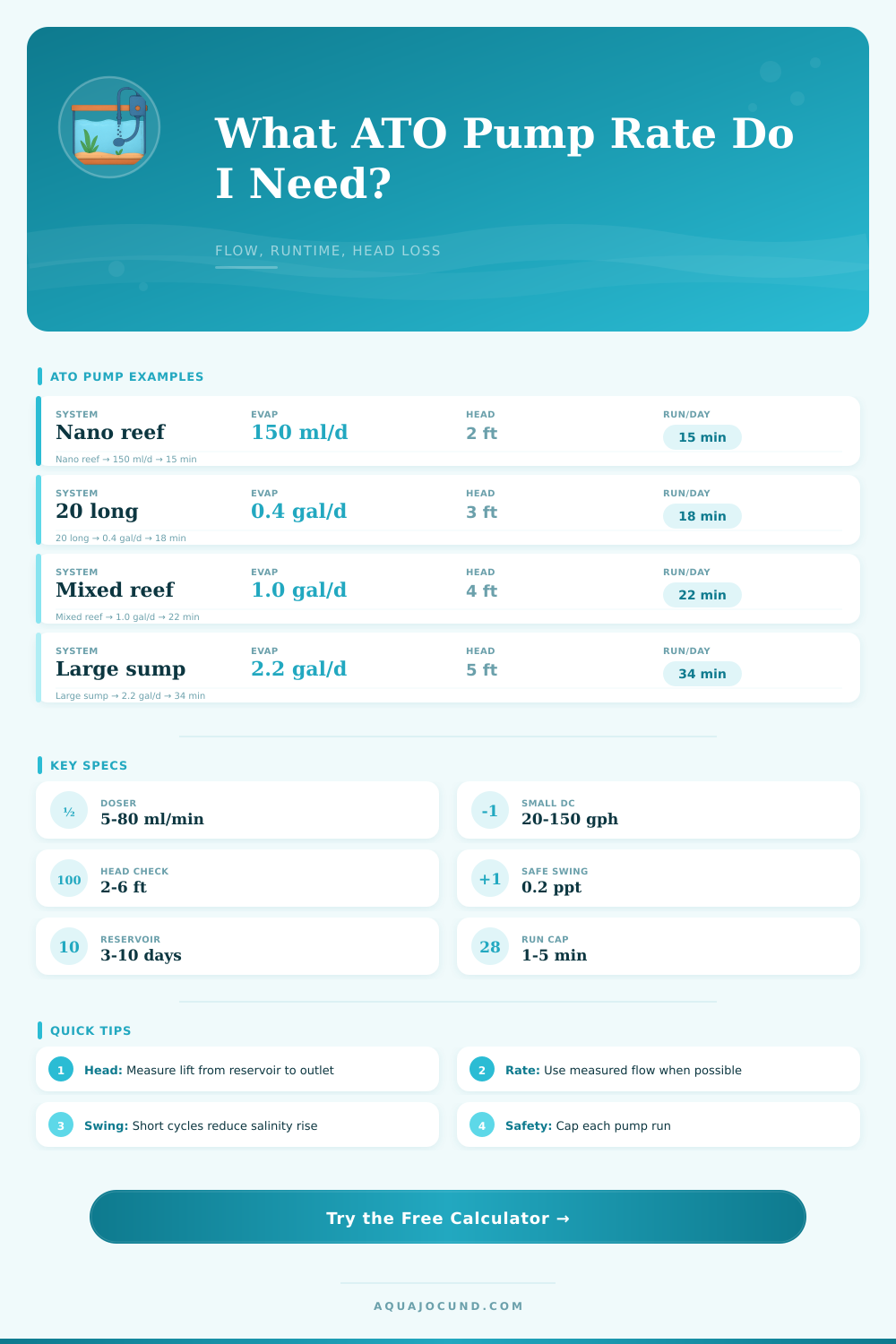
Estimate ATO pump flow after head loss, daily refill runtime, reservoir duration, maximum cycle count, and salinity swing if top-off is delayed.
📏System volume and evaporation
Use 24 for a daily evaporation estimate, or a shorter test period.
⚙Pump, head height, and safety limits
Measure from reservoir waterline to the outlet or anti-siphon break.
This limit helps stop a stuck-on ATO from dumping the reservoir.
This models salinity rise before the next ATO dose. Shorter delays make reef salinity steadier.
Detailed breakdown
🔌Pump type comparison grid
📊Reference tables
| ATO setup | Typical flow | Best use | Watch item |
|---|---|---|---|
| Peristaltic doser | 5 to 80 ml/min | Nano reefs and precise refill | Tubing wear |
| Diaphragm pump | 30 to 250 ml/min | Cabinet reservoirs | Pulse noise |
| Small DC pump | 20 to 150 gph | Large sumps with short lift | Overfill speed |
| Mini fountain pump | 40 to 200 gph | Simple freshwater tanks | Head loss |
| Gravity solenoid | 10 to 500 ml/min | Elevated reservoir feed | Siphon risk |
| System example | Evaporation | Suggested effective rate | Daily runtime |
|---|---|---|---|
| 5 gal covered betta | 50 to 120 ml/day | 5 to 20 ml/min | 3 to 12 min |
| 20 gal planted | 0.2 to 0.5 gal/day | 40 to 120 ml/min | 6 to 48 min |
| 40 breeder reef | 0.4 to 0.9 gal/day | 50 to 180 ml/min | 8 to 70 min |
| 75 gal mixed reef | 0.7 to 1.5 gal/day | 100 to 300 ml/min | 9 to 57 min |
| 125 gal open sump | 1.5 to 3.0 gal/day | 200 to 600 ml/min | 9 to 57 min |
| Head or tube condition | Low-flow doser | Utility pump | Planning note |
|---|---|---|---|
| 1 to 2 ft lift | Small loss | Small loss | Measure anyway |
| 3 to 4 ft lift | Moderate loss | Moderate to high loss | Use 10 to 20% buffer |
| 5 to 6 ft lift | Check pump curve | Often near limit | Prefer high-head pump |
| Narrow tubing | Higher friction | High friction | Keep runs short |
| Wide tubing | Stable flow | Better flow | Add anti-siphon |
| Salinity swing | Freshwater delay | Reef read | Action |
|---|---|---|---|
| 0.00 to 0.10 ppt | Very short | Excellent | Normal ATO cycle |
| 0.10 to 0.25 ppt | Short | Usually fine | Good reef target |
| 0.25 to 0.50 ppt | Moderate | Watch sensitive coral | Shorten delay |
| 0.50 to 1.00 ppt | Long | Stress possible | Increase cycle count |
| Over 1.00 ppt | Too long | Unsafe for reef | Fix ATO sizing |
💡Practical ATO tips
Evaporation is treated as an unseen force of nature. “On Monday I fill up the tank. On Friday it’s down. How much did it go down? How fast?” An auto top off system are exactly what you need to chase down that invisible loss.
The question isn’t simply replacing the evaporated water, its replacing it without overflowing your display, increasing your salinity while you’re gone, etc. The solution is a pump capable of moving sufficient volume to replace what evaporates during the day… but it can’t run continuously because then it will overflow.
How to Choose the Right Pump for Your Tank
Head loss is what complicates the math. For each foot of vertical lift and each 90 degree bend in the tubing it cuts into the flow rate as compared to a pump’s rated performance. Pumps is rated at their max flow rate when they’re flat with nothing impeding them. That’s hardly ever the case with your set-up. You’ve got tubing going to the rim of tanks. You have reservoirs underneath stands and perhaps even some kinks in the line. You enter your tubing size and lift height and the calculator will do this math for you. No more guesswork on how much capacity has been lost by the time water hits display.
Selecting the incorrect pump: Choosing the right pump type is where most people go wrong. For example, a peristaltic doser (which is accurate) are good for a nano tank where changing a little water makes a big difference in level. But this style of pump doesn’t do well with high vertical lift, as it works by squeezing tubing rather than generating pressure. If your reservoir is up off the ground or your stand is tall, then go with a small DC utility pump or a diaphragm pump. They can manages head pressure, but be careful to not dump more than a little bit at a time… which means you need to set them carefully to time out properly. The pump reference chart matches the best pumps with their limitations and suggested uses.
The other key variable, how long does it run? How frequently do you want the system running so that the salinity remains stable? On average, a 0.2 parts per thousand swing in salinity will stress sensitive corals in a reef tank. So if you have lots of water evaporating and your pump only runs for ten seconds every six hours, you’ll get temporary salt spikes as it catches up. More frequent and shorter cycles helps make it stable.
Actualy measuring how much water evaporates over twenty-four hours is important since eyeballing it will lead to undersizing. And that means your smaller sized system won’t be able to keep up with hot/humid days. Not only is it theoretical; safety buffers makes sense practically too. Pumps get old, tubing deteriorates, and filters clog up. While a brand-new pump may produce fifty milliliter per minute, one that has been through six months of duty with hardening tubing might drop to forty without warning. Adding a twenty percent safety margin ensures that your system will function safely during equipment aging. Better to have excess capacity than an empty reservoir on Sunday afternoon.
An auto top off system depends on balance. It’s about replacement without interruption of what nature takes away. It’s about maintenance that goes unnoticed, the water level stays steady. Salinity doesn’t change. And you don’t think about it…except to realize weeks might have elapsed since you manually filled up. Understanding how much you evaporate at any given time gives you that peace of mind because you know what to set your limits to; you can choose a pump based off the head height and protect the tank. First measure what you’re losing and match your equipment to replace it gentle.