Reef Iodine Consumption Calculator
Estimate iodine drop, target correction, soft coral and macroalgae demand, water change offset, and interval dosing from your reef's actual water volume.
🧪Reef Iodine Presets
📐Tank, Target, Demand, Water Change, and Stock
Reef Iodine Consumption Result
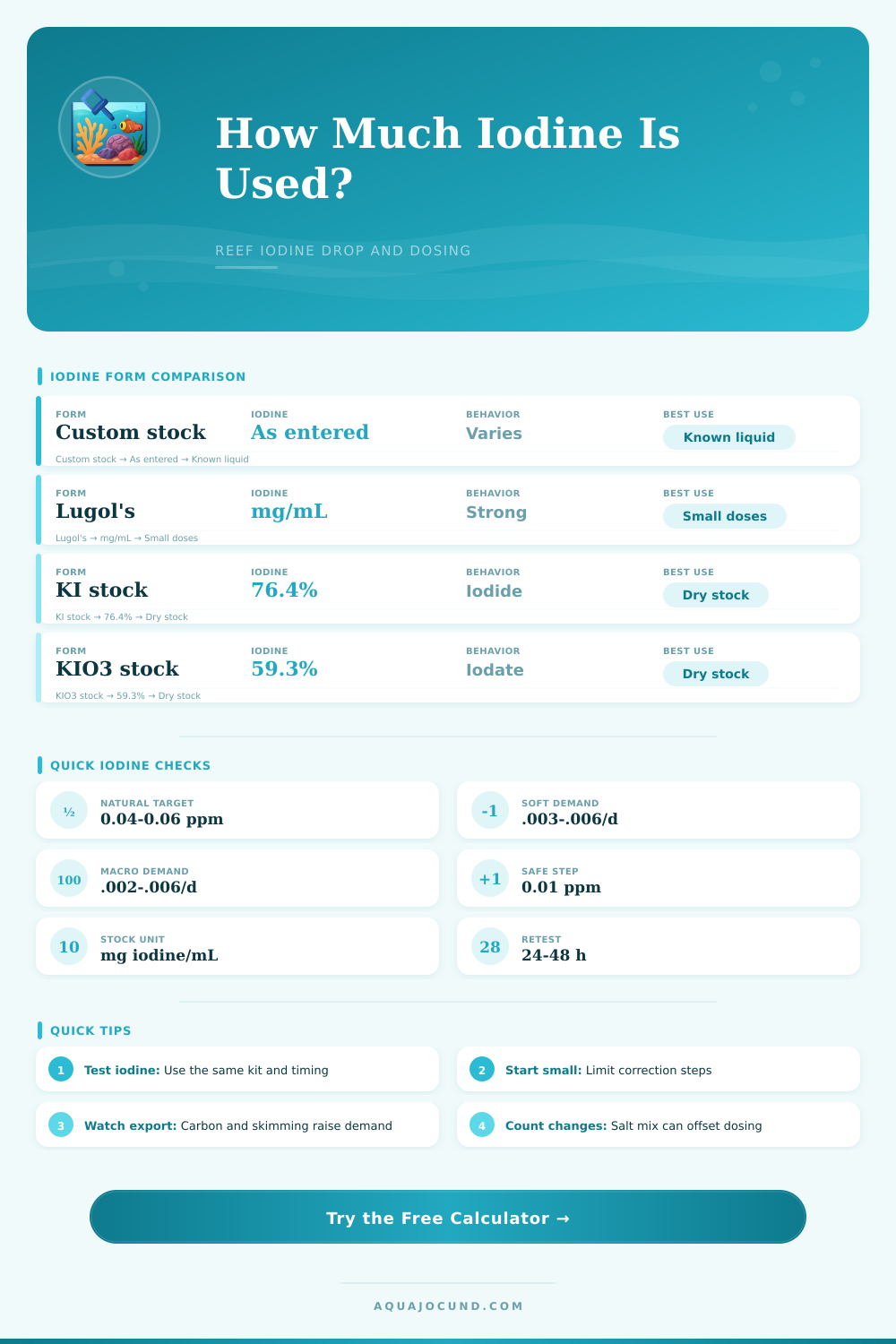
⚖Iodine Form Comparison Grid
📊Iodine Stock Source Reference
| Source | Input basis | Iodine fraction | Calculator use |
|---|---|---|---|
| Custom liquid stock | mg/L as iodine | 100% as entered | Known commercial or DIY liquid |
| Lugol's 5% nominal | mg iodine per mL | User-entered strength | Very small measured additions |
| Potassium iodide | g/L KI dry salt | 76.4% iodine | Iodide-focused DIY stock |
| Sodium iodide | g/L NaI dry salt | 84.7% iodine | Iodide without potassium addition |
| Potassium iodate | g/L KIO3 dry salt | 59.3% iodine | Iodate-focused DIY stock |
| Iodide and iodate blend | mg/L as iodine | 100% as entered | Mixed form supplement |
| Trace iodine supplement | mg/L as iodine | 100% as entered | Dilute daily dosing liquid |
🔬Target Range and Demand Guide
| Reef condition | Target range | Typical drop | Calculator note |
|---|---|---|---|
| Low demand mixed reef | 0.03 to 0.05 ppm | 0.001 to 0.002 ppm/day | Water changes may cover most demand |
| Natural seawater target | 0.04 to 0.06 ppm | 0.002 to 0.004 ppm/day | Good default for measured dosing |
| Soft coral dominant | 0.05 to 0.07 ppm | 0.003 to 0.006 ppm/day | Retest after leather or xenia growth spurts |
| Macroalgae heavy refugium | 0.06 to 0.09 ppm | 0.004 to 0.008 ppm/day | Demand varies with harvest and lighting |
📏Common Reef Size Planning
| System size | Net water estimate | 0.01 ppm iodine mass | 1000 mg/L stock dose |
|---|---|---|---|
| 20 gal nano | 60 to 70 L | 0.60 to 0.70 mg iodine | 0.60 to 0.70 mL |
| 40 breeder reef | 120 to 145 L | 1.20 to 1.45 mg iodine | 1.20 to 1.45 mL |
| 75 gal mixed reef | 240 to 285 L | 2.40 to 2.85 mg iodine | 2.40 to 2.85 mL |
| 125 gal system | 400 to 475 L | 4.00 to 4.75 mg iodine | 4.00 to 4.75 mL |
| 180 gal large reef | 580 to 680 L | 5.80 to 6.80 mg iodine | 5.80 to 6.80 mL |
🔄Water Change Offset Reference
| Water change pattern | New water iodine | Target iodine | Daily offset behavior |
|---|---|---|---|
| 10% weekly | 0.055 ppm | 0.050 ppm | Adds about 0.00007 ppm/day |
| 15% weekly | 0.065 ppm | 0.050 ppm | Adds about 0.00032 ppm/day |
| 10% biweekly | 0.040 ppm | 0.055 ppm | Removes about 0.00011 ppm/day |
| 25% monthly | 0.060 ppm | 0.050 ppm | Adds about 0.00008 ppm/day |
Dosing isn’t the issue most of the time. You can spend hours tinkering with water flow and lighting. However, iodine is an invisible variable that throws off your tank.
While iodine occurs naturaly, it doesn’t linger long in reef tanks. Unless you’re paying attention to the way macroalgae growth halt and soft coral appearance become dull, most aquarists don’t realize their iodine level have dropped.
Why Iodine Is Different and How to Use a Calculator
So, what’s the deal? You dose, right? Sure…but do you know how much your particular set-up burns through? But here’s the catch: Theoretical requirements does not always align with real-world demands.
For example, a big Chaeto refugium might pull more iodide out of water than an SPS garden running only chemical filtration. Consider both physical export and biological uptake. Ozone and/or activated carbon will change chemistry and how iodine is cycled. Your skimmer will pull down organics. New colonies and livestock grows every day, changing your tank.
This changing environment doesn’t lend itself to a static spreadsheet. That’s where the calculator comes in, it fills space between arbitrary and precise.
First, provide net water volume (the calculator subtracts the volume occupied by your sand and live rock). Overdosing is very easy if you dose based off the rated tank size from manufacturer.
Second, precisely identify your desired range. Most keepers desires somewhere above natural seawater (~0.05 ppm), with soft coral keepers wanting more and those with extensive macroalgae bed wanting even more. Based on those ranges, the calculator calculates how far off you currently are vs. It also shows how much was used over long term.
I think the water change offset gets overlooked. Different brands of fresh saltwater mixes has different trace elements, but most have some baseline level of iodine which will naturally replenish your tank with each water change. Thus, if you don’t account for this, you may end up dosing above what’s being lost, replacing whatever’s in new water. This offsets the impact of how often you change water and what iodine content your mix contains.
It also separates the immediate “correct” dose from the ongoing “maintain” dose necessary to maintain a stable concentration. The choice of reagents also depends on how much is used. Potassium iodate, Lugol’s solution, and potassium iodide are all iodine sources, but each behaves different chemically and delivers iodine with different efficiency.
Dry salts require careful dissolving and give different fractions of usable iodine; Lugol’s is concentrated and suitable for measuring small amounts. The reference tables on the page explains these nuances so that you can dial in your inputs accordingly. Running a 50% solution through a calculator designed for 100% standard will mess up every calculation by a factor of two. Accuracy avoids chronic deficiency or accidental toxicity.
The last part of the puzzle is consistency in testing. Kits will vary as they get older. Your technique varies, and sometimes time of day that you pull the sample can affect the iodine test. Test at the same time each week for best results and compare them to one another. It’s better to make small adjustments versus drastic correction swings.
You might not notice a change of 0.01 ppm on a coral over time, but it’s safe to do right now. It will stress the system less then a large swing caused by the deficiency.
The bottom line is that managing iodine really isn’t as much a “chemistry” thing but more of a “logic + observations” thing. I mean that in a good way. It’s like taking an educated SWAG then checking your results and making adjustments from there. A practical variable provides a practical starting place for you to use instead of some average off the internet.
After getting a handle on the starting point, it’s all about adjusting up or down until things makes sense. That’s what the numbers do… They tell you exactly where you’re at. Your corals will let you know if you’re close. But the numbers let you know exactly how close. Balancing this stuff makes a dying tank into a living breathing ecosystem.