Carbon Dose Ramp Calculator Reef
Estimate a cautious vodka, vinegar, or NOPOX-style carbon dosing ramp from reef volume, nitrate reduction target, phosphate level, skimmer strength, and weekly dose increments.
🧪Carbon Dosing Presets
⚙System and Carbon Source
🌊Nutrient Targets and Export
⏱Ramp Pace and Safety Limits
Reef Carbon Dose Ramp Estimate
🧬Carbon Source Comparison Grid
📊Carbon Source Reference
| Carbon source | Estimated carbon | Relative mL | Ramp behavior |
|---|---|---|---|
| Vodka 40% ethanol | About 165 mg C/mL | 1.0x | Potent, use small accurate dose changes |
| White vinegar 5% | About 20 mg C/mL | 8.2x vodka mL | Dilute and easy to measure, larger daily volume |
| NOPOX-style mixed carbon | About 90 mg C/mL | 1.8x vodka mL | Moderate strength, label caps should still rule |
| Vodka-vinegar blend | About 70 mg C/mL | 2.4x vodka mL | Gentler than vodka with less vinegar volume |
| Diluted ethanol 20% | About 82 mg C/mL | 2.0x vodka mL | Useful when tiny vodka doses are hard to measure |
| Sodium acetate solution | About 95 mg C/mL | 1.7x vodka mL | Use only when strength is known and mixed evenly |
| Sugar solution | About 110 mg C/mL | 1.5x vodka mL | Can cloud quickly, ramp more conservatively |
| Custom strength | User entered | Calculated | Best for measured DIY or labeled products |
🚦Nutrient Guardrails
| Condition | Nitrate | Phosphate | Carbon dosing response |
|---|---|---|---|
| Near-zero phosphate | Any NO3 | Under guardrail | Cut the calculated target sharply and correct PO4 first |
| Low nutrient reef | 0-2 ppm | 0.02-0.04 ppm | Use a maintenance or hold dose, not an aggressive ramp |
| Balanced reduction | 5-25 ppm | 0.04-0.15 ppm | Standard slow ramp with frequent testing |
| High nitrate load | 25+ ppm | 0.05+ ppm | Limit weekly NO3 drop and keep skimming wet |
| Cloudy water signal | Any NO3 | Any PO4 | Pause increases, aerate strongly, and retest |
📅Ramp Pace Reference
| Ramp style | Start point | Weekly increase | Best fit |
|---|---|---|---|
| First-time cautious | 5-15% target | 5-8% | Nano reefs, low PO4, no carbon history |
| Standard reef ramp | 15-25% target | 10-15% | Stable mixed reef with a reliable skimmer |
| Restart after pause | 25-50% target | 10-15% | Previously tolerated dose with recent tests |
| Monitored high export | 30-60% target | 15-20% | Experienced SPS systems with wet skimming |
📐Common Reef Volume Examples
| System | Planning volume | Vodka start range | Vinegar start range |
|---|---|---|---|
| 13 gal nano reef | 49 L | 0.02-0.06 mL/day | 0.2-0.5 mL/day |
| 40 breeder reef | 151 L | 0.07-0.20 mL/day | 0.6-1.6 mL/day |
| 75 gal display | 284 L | 0.14-0.38 mL/day | 1.1-3.1 mL/day |
| 120 gal with sump | 454 L | 0.23-0.60 mL/day | 1.8-4.9 mL/day |
| 180 gal reef | 681 L | 0.34-0.90 mL/day | 2.8-7.4 mL/day |
Most conventional aquarists react with surprise when they hears someone pour vodka into their reef tank because to them, water changes is the way to go. It’s counterintuitive unless you realize it’s not a chemical trick but a biological management practice for dosing carbon. You’re growing bacteria which eat nitrate and phosphate and then you remove the bacteria from the system through skimming.
It’s not so much that you watch the numbers in your test kits goes down; it’s that you know what you’ve exported and are measuring. Instead of having to guess amount of ethanol or acetate your bio-load can handle, simply plug your nutrient levels and water volume into the calculator (above) and it do the work for you.
The Right Way to Dose Carbon in Your Tank
Most folks believe that their total system volume is equivalent to their display tank’s volume. The truth is that your plumbing (sumps), sand, and rock displaces A LOT of water. If you underestimate the water displacement, then you will overdose because you are creating a greater concentration in the water column different than what you intended. This is important if you are dosing with powerful carbon sources that may be able to cause rapid depletion of oxygen or drop your pH.
Though both vodka and vinegar are organic compounds, they is different. Vodka is about 16 times more concentrated in terms of its carbon content (per mL), which means you can’t swap their dosage volumes blindly. You’ll overdose if you change liquids without recalibrating the math. The tool considers concentration difference, sparing you from having to do elaborate mental calculations about molecular weights. By entering your nutrient-removal target, it convert it into a volume of liquid that’s equivalent to the bottle you’re using.
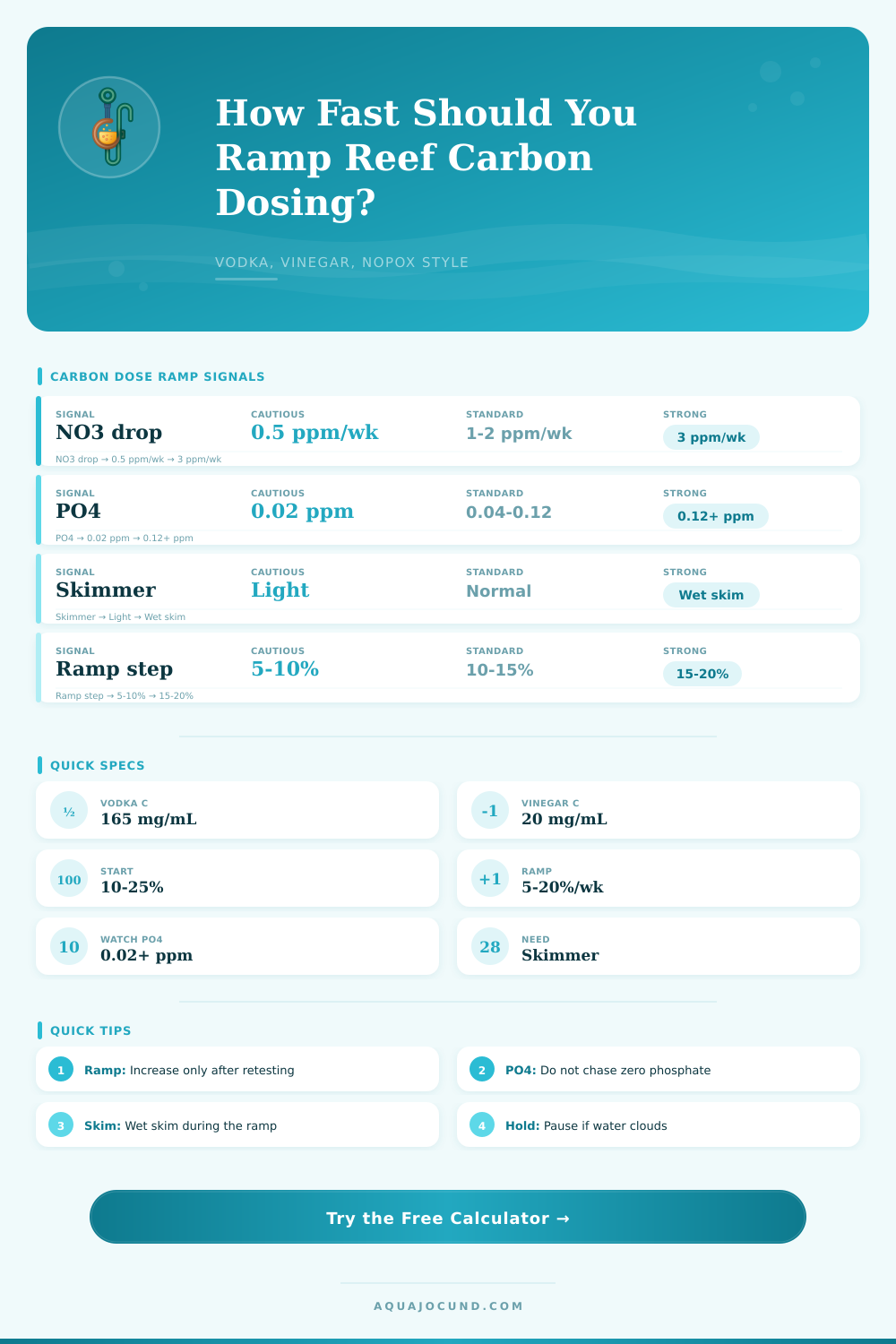
This is where most newbies go wrong: They want instant gratification, so they ramp up the dose fast. That means forcing bacteria to grow at a pace beyond what your skimmer can export as waste. If you drop nitrate three ppm overnight, you’re likely going to end up with clouded water, slime-coated substrate, and stressed-out livestock (because they lack oxygen).
Raising the dose carefully… In small increments weekly; permits the biofilm to adjust while guaranteeing that each additional molecule of carbon gets used and expelled. You want a gradual decrease more then a sudden plunge. I’ve posted the reference table from the page below that shows the effects of varying ramp paces on skimmer output and phosphate levels.
You’ll notice that when phosphate is near zero, you won’t be able to dose aggressively because what’s left over will get consumed by bacteria which starve your corals. That’s why phosphate is a type of guard rail. As long as it doesn’t drop too low, you can continue adding more nutrients, even though your nitrate might still be high. It is better to have a little bit of elevated nitrate. You risk a phosphate crash that can make SPS corals go black and brittle overnight.
How quickly you can raise the dose depends on how well the fish tank is being skimmed on the ramp. The denser the foam (from wet skimming), the more particles it’ll collect including any bacterial colonies being fed by the carbon. In other words, if you have a light frothy skim or are even running dry on your skimmer, you’ve got limited export capacity. You need to reduce the target dose to match. A weak skimmer can not be out dosed. Instead, the bacteria will overgrow in the tank, use up the oxygen, and eventually die in-tank instead of exiting with the waste foam.
But there’s another factor which is lurking behind the scenes, their diet. Feeding more often or more heavily adds extra nutrients that compete with the doses you provide. A heavily fed tank will require far more carbon (e.g., ethanol or acetate) to achieve and sustain low nitrate compared to one which is lightly fed. This input load is factored into calculation. Instead of assuming zero external nutrient contribution, it allows for a more real-world starting point.
Feeding bacteria means starving out nuisance algae; carbon dosing is therefore a balancing act. More so than accurate numbers, it’s about observing, being patient, and feeling the rhythm of your system. Notice what happens when you turn on the pump. What comes out the skimmer cup? Check the phosphate guardrail, let that tell you how far you can increase. Don’t push too hard too fast; let the testing control the ramp.
Want a stable, self-cleaning ecosystem where bacteria work quietly in the background? That takes a steady approach that turns a reaction into a manageable routine.
You should of seen this earlier. Actualy, most people dont realize how much it matters.