Biopellet Quantity Calculator Reef
Estimate reef biopellet media in milliliters and grams, then plan reactor flow, startup ramp stages, nitrate-load adjustments, and maintenance top-ups.
🧫Biopellet Reactor Presets
📐Tank Volume
⚙Nitrate Load and Media Choice
🌊Reactor Flow, Ramp, and Maintenance
Reef Biopellet Quantity Estimate
🧪Pellet and Reactor Comparison Grid
📊Biopellet Media Type Reference
| Media type | Bulk density | Base mL / 100 L | Reactor behavior |
|---|---|---|---|
| Standard PHA pellets | 0.62 g/mL | 80 | Balanced tumble and predictable ramp |
| Dense slow-release pellets | 0.70 g/mL | 70 | Needs stronger flow, slower bacterial response |
| Soft fast-start pellets | 0.55 g/mL | 90 | Starts quickly, inspect for clumping |
| Nitrate/phosphate blend pellets | 0.60 g/mL | 75 | Use cautiously when phosphate is already low |
| Pellet plus mineral blend | 0.68 g/mL | 65 | Lower volume charge, rinse fines well |
| Small reactor micro pellets | 0.58 g/mL | 85 | Good for compact reactors with gentle flow |
| Large bead low-dust pellets | 0.66 g/mL | 78 | Needs room for a broad rolling bed |
| Mixed polymer pellets | 0.63 g/mL | 82 | General-purpose option for mixed reefs |
🚦Nitrate Load Guide
| Condition | NO3 gap | Pellet sizing | Ramp advice |
|---|---|---|---|
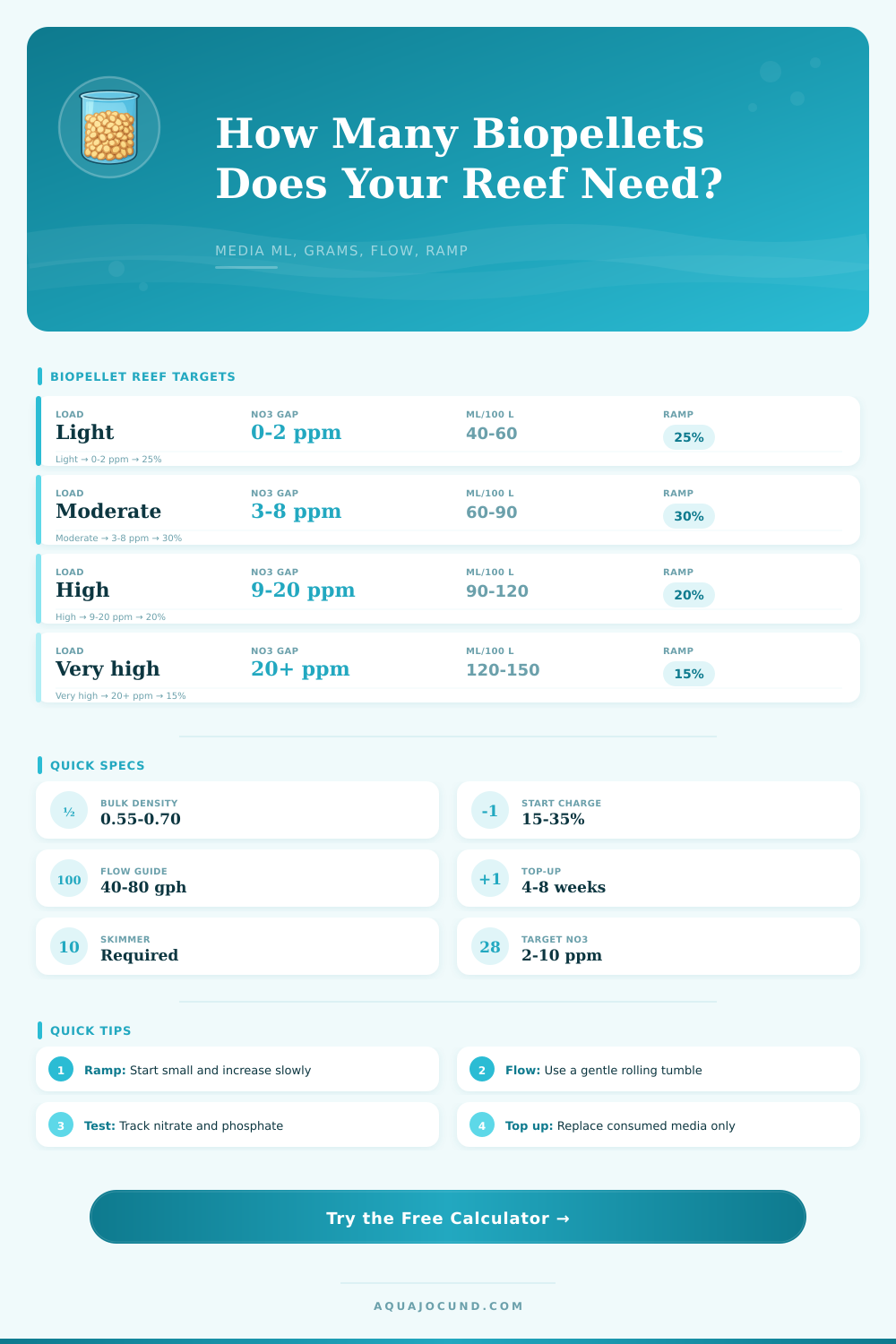
| Maintenance only | 0-2 ppm | 40-60 mL per 100 L | Keep the bed small and stable |
| Moderate reduction | 3-8 ppm | 60-90 mL per 100 L | Increase every 1-2 weeks |
| High nitrate | 9-20 ppm | 90-120 mL per 100 L | Use a smaller first charge and test often |
| Very high nitrate | 20+ ppm | 120-150 mL per 100 L | Correct feeding/export before full media load |
| Phosphate limited | Any NO3 | Cap media lower | Avoid stripping phosphate to zero |
📘Common Reef Tank Examples
| System | Planning volume | Moderate target | Start charge |
|---|---|---|---|
| 20 gal nano with rear chamber | 76 L | 45-65 mL | 10-20 mL |
| 40 breeder mixed reef | 150 L | 90-135 mL | 25-40 mL |
| 75 gal reef with sump | 285 L | 170-255 mL | 45-75 mL |
| 120 gal SPS display | 455 L | 275-410 mL | 70-120 mL |
| 180 gal heavy fish reef | 680 L | 410-610 mL | 100-180 mL |
🔄Ramp Stage Reference
| Stage | Typical media bed | Timing | Checkpoint |
|---|---|---|---|
| Startup | 15-35% of target | Week 0 | Gentle tumble, skimmer stable |
| First increase | 40-55% of target | Weeks 2-3 | NO3 falling slowly, PO4 measurable |
| Second increase | 65-80% of target | Weeks 4-6 | No bacterial haze or oxygen stress |
| Target bed | 90-100% of target | Weeks 6-10 | Nitrate trend matches goal |
🌊Reactor Flow Reference
| Bed size | Gentle tumble | Standard tumble | Vigorous tumble |
|---|---|---|---|
| 50 mL | 20-30 gph | 30-40 gph | 40-55 gph |
| 100 mL | 40-55 gph | 55-70 gph | 70-90 gph |
| 250 mL | 100-140 gph | 140-180 gph | 180-225 gph |
| 500 mL | 200-280 gph | 280-360 gph | 360-450 gph |
So you have a test result with something other than 0 for nitrates. There is a handful of healthy coral and some fish in a tank that’s still relatively new, and it look crystal clear! And then fear strikes, there will be more algae growth if there’s elevated nitrogen and you panic and try to do something about it. But you end up over-doing it (e.g., throwing in too many biopellets) and now you’re either running out of phosphate (crash!) or you’ve got an imbalance of bacteria (stressful for your inhabitant).
The goal isn’t just to remove the nutrient, but to do so slowly so you don’t throw the whole system into a tailspin. To do the math for you, it use those parameters (nitrate gap & tank dimensions) and converts them to a certain amount of media required. The good part: it takes into consideration displacement (ie. Live rock and substrate displace water. That’s important because if you oversize your pellet bed, you’re realy only increasing the volume of “water” in your tank. This is a common error.
How to Use Biopellets Safely
The other good part: it doesn’t guess at how much you’ll need just based off tank size. You plug in your existing nitrate and target levels to give you the real answer: how much reduction power do you realy need?
Biopellets are essentially food for a colony of heterotrophic bacteria that feed on organics and produce nitrate as a byproduct. When provided with proper conditions, these bacteria multiplies quickly. Hence, the size of the media bed should of match your bioload. Obviously, a heavily populated fish tank will require significantly more media compared to a lightly populated nano reef, there’s simply greater organic waste produced to process.
Also factored into the tool is the protein skimmer capacity because the skimmer remove the excess bacterial mass produced once the pellets have consumed all available waste. If no skimmer exists, then this bacteria merely decays and returns nutrients to the aquarium.
The single biggest key to success here is ramping up the media. Don’t put a full charge into the reactor from day one. It will overwhelm the existing bacteria with a sudden surge that use up oxygen. This leads to low oxygen levels in parts of the reactor chamber or causes changes in parameters across the whole tank. The table below on the page explain this, basically don’t start with a big charge but rather small ones so that the bacteria have time to get going before you give them more.
Better to underdose initially and increase slowly than to overshoot and crash your system. Reactor performance is also dependent on the flow dynamics. Pellets need gentle tumbling action, otherwise, they’ll compact into a tight bed and the bacteria will suffocate, or at least won’t have any exposure to the surface. The suggested flow rate in the calculator takes your media volume into account so you’re assured all pellets recieve enough agitation.
Not enough and you’ll have dead zones and waste the media. Too much and the pellets may be eroded away, or no bacteria can colonize them at all. Efficiency requires finding that happy medium between the two while avoiding premature pump wear.
Don’t neglect it; maintain it. Monitoring regularly is part of maintenance. If carbon sources (e.g., pellets) is added faster than the bacteria can consume them, phosphate will rapidy decline and may drop below safe levels. This causes coral bleaching and reef retraction. Monitor phosphate levels so you’re aware of when to add more media or how often to perform a water change (to correct nutrient imbalances).
When you set a maintenance routine, it also calculates how often you need to top up. This is because pellets break down and lose surface area for bacteria to attach to. The tool reminds you that Most reefers treat nitrate control like a numbers game, focusing only on the ppm reading. But what’s important is not so much the absolute number but its stability.
Careful ramping allows you to obtain a slow, steady decline in nitrates which maintains the delicate balance between algae, corals, and bacteria. You turn an out-of-control chemical reaction into a controlled biological process, one that sustains instead of stressing your reef. It’s not about a sterile tank; it’s about a balanced tank with efficient nutrient cycling.
The numbers above are only estimates, use them to get started and adjust according to the results from your own water tests. Your corals will be happy and well-fed. You will have cleaner water thanks to the soothing tumble in the reactor. There will also be no more drama caused by drastic changes in parameters.