Amino Acid Dosing Calculator Reef
Estimate reef amino acid dosing from water volume, coral biomass, nutrient readings, skimmer export, feeding load, product strength, and a staged ramp schedule.
🧪Reef Amino Presets
⚙System and Coral Load
🌊Nutrients and Export
⏱Ramp Schedule and Limits
Reef Amino Dosing Estimate
🧬Reef Amino Dosing Comparison Grid
📊Amino Supplement Strength Reference
| Supplement style | Base mL / 100 L / day | Relative strength | Best use |
|---|---|---|---|
| Standard balanced amino blend | 0.35 | 1.00x | Mixed reefs with measurable nutrients |
| Concentrated amino concentrate | 0.22 | 1.55x | Large systems where small doses are preferred |
| Dilute nano-friendly amino | 0.55 | 0.65x | Nano reefs and cautious ramping |
| SPS amino with light carbon source | 0.28 | 1.25x | SPS systems with strong export |
| Amino plus particulate food | 0.30 | 1.15x | LPS and mixed feeding response |
| Amino vitamin blend | 0.40 | 0.90x | General color and polyp extension support |
| Amino trace blend | 0.32 | 1.05x | Low trace overlap and moderate biomass |
| Custom label strength | 0.35 adjusted | User multiplier | Use when your product label differs |
🚦Nutrient Guardrails
| Nutrient condition | NO3 | PO4 | Dosing response |
|---|---|---|---|
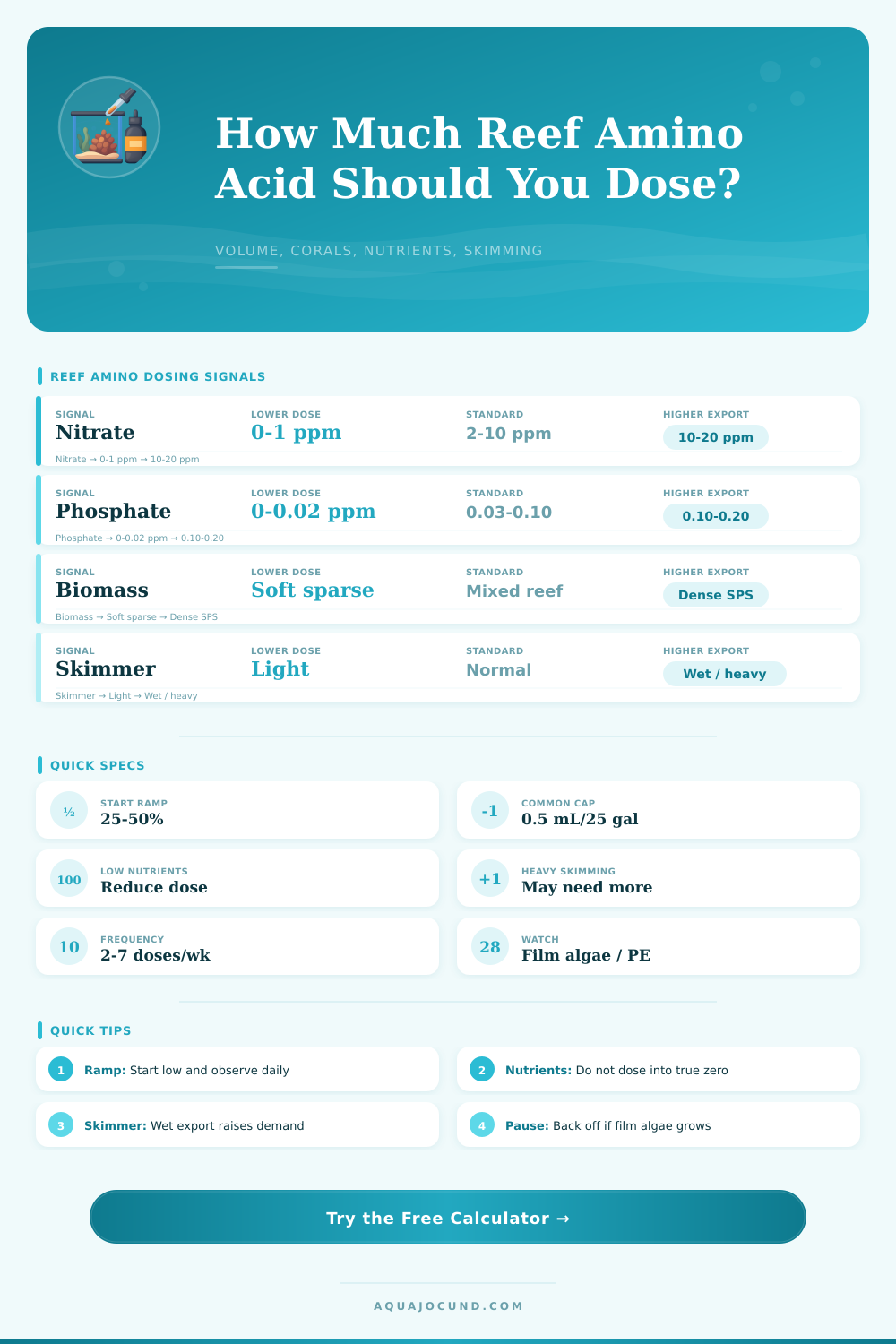
| True zero risk | 0-0.5 ppm | 0-0.01 ppm | Cut amino target sharply and stabilize nutrients first |
| Low nutrient reef | 0.5-2 ppm | 0.01-0.03 ppm | Use a slow ramp and watch for pale tissue or film |
| Balanced mixed reef | 2-10 ppm | 0.03-0.10 ppm | Standard ramp is usually appropriate |
| Higher nutrient reef | 10-25 ppm | 0.10-0.20 ppm | Keep amino dosing modest until export catches up |
| Excess nutrient signal | 25+ ppm | 0.20+ ppm | Reduce amino additions and verify feeding/export balance |
📐Common Reef Volume Examples
| System | Planning volume | Moderate mixed dose | Heavy export SPS dose |
|---|---|---|---|
| 13 gal nano reef | 49 L | 0.15 mL/day | 0.25 mL/day |
| 25 gal lagoon | 95 L | 0.30 mL/day | 0.50 mL/day |
| 40 breeder reef | 151 L | 0.50 mL/day | 0.85 mL/day |
| 75 gal display | 284 L | 0.95 mL/day | 1.55 mL/day |
| 120 gal with sump | 454 L | 1.50 mL/day | 2.50 mL/day |
📅Ramp Schedule Reference
| Ramp style | Start | Duration | When to use |
|---|---|---|---|
| Cautious first dose | 25% | 14-21 days | New amino product or very low nutrients |
| Standard reef ramp | 40-50% | 7-14 days | Stable mixed reef with measurable nutrients |
| Maintenance restart | 60-75% | 5-10 days | Previous dose was tolerated well |
| Expert monitored | 75-100% | 3-7 days | Dense coral load with strong testing rhythm |
So how do we feed our corals without compromising water clarity for reef keeping? On one hand, we want to see vibrant coral polyps extending; on the other hand, we don’t want to encourage a bloom of slime algae as excess nutrients escapes the filter. Dosing amino acids sits somewhere in the middle here. It is not just about dumping more food into the tank. But more importantly, it’s a management tool for the balance of what gets eaten by the corals vs. This is what gets filtered out before it affects anything else in your ecosystem.
To use the calculator (above), simply plug in your coral density and your system volume and let it take care of the rest, no guessing coefficients required. But what goes into those inputs? What are they and how should they be interpreted?
How to Use Amino Acid Dosing Correctly
First off, don’t start with your tank’s rated size but its actual water volume. Why? Because there’s plenty of displacement from rocks, sand, equipment, etc. Dosing for a 40 gallon display containing only 30 gallons of water will result in overdosing every time.
Next, think about your coral biomass. Does your tank contain just a few scattered frags on a rack, or have you built a mature garden filled with large polyp stony corals and Acropora? More tissue = greater metabolic demand. The tool accounts for this by adjusting the baseline dose accordingaly.
Where most hobbyists fall short is with nutrients. When they test and find that nitrates and phosphates is low, they think, “Oh good. Time to feed more.” Or they’re worried about adding anything because it might raise their nutrient levels. If you have adequate export methods, such as protein skimming, then amino acids can actualy help remove excess nutrients. How?
Here’s why: Protein skimming removes a lot of dissolved organics from the water column. It is an efficient export method, which means you can be more aggressive when dosing. You don’t risk an algae outbreak by dosing heavily. If you do light or dry skimming, those compounds remains floating around longer. To stop feeding nuisance growth instead of your livestock, you’ll have to limit your doses.
There are no shortcuts to ramping up slowly. Beneficial bacterial colonies must adjust themselves as well as corals to the new baseline level of organics. Going directly to the max dose will cause a bloom of bryopsis across glass or otherwise cause cloudy water. Based off how stable your system is, the reference table on the page provides conservative starting doses that you can adjust accordingly.
Start with maybe 25% of what you want to go to over two weeks, monitoring closely for tissue coloration changes and polyp extension. Go slower if they’re pale and looking hungry. Pull back if you notice any film algae. Dosing is something many folks do on autopilot; it’s a set-and-forget thing. But don’t; keep an eye out! The calculator offers a start point, but ultimately your eyes confirm.
When you adjust the skimmer, check the water clarity. Look for more tentacles moving around. It’s a subtle thing, but you’ll see. You also need to remember to only change one variable at a time (e.g., don’t alter your feeding regimen, lighting schedule, and amino dose at the same time; how will you know if/what caused any reaction?). That way you can accurately interpret the tank’s feedback.
At the end of the day, good reefkeeping isn’t a precise science of nailing specific chemical parameters. It’s an artful balance between a closed biological loop. Amino dosing helps this loop by making readily available forms of nitrogen and carbon for heterotrophic bacteria as well as corals. Done properly, it improves coral health and color without compromising water quality.
It’s not so much that you’re adding something, but rather adjusting the “engine” of your aquarium to make it run more smoothly. You should of begun with small amounts, observe carefully, and listen to what the tank tells you, it will signal when it is ready for additional levels.