Calcium Chloride Dosing Calculator
Estimate CaCl2 anhydrous or dihydrate dose, purity adjustment, stock solution volume, and daily split for a measured reef calcium correction.
🧪Tank, Calcium Target, And Calcium Chloride Inputs
⚗Calcium Source Comparison
📋Calcium Chloride Source Specs
| Source | Hydration Form | Calcium By Weight | Typical Purity Used |
|---|---|---|---|
| Anhydrous reef grade | CaCl2 | 36.11% | 95-99% |
| Anhydrous technical | CaCl2 | 36.11% | 90-96% |
| Lab anhydrous | CaCl2 | 36.11% | 99%+ |
| Reef dihydrate | CaCl2 dihydrate | 27.26% | 97-100% |
| Food dihydrate | CaCl2 dihydrate | 27.26% | 95-99% |
| Dihydrate flakes | CaCl2 dihydrate mix | 27.26% before impurity | 85-95% |
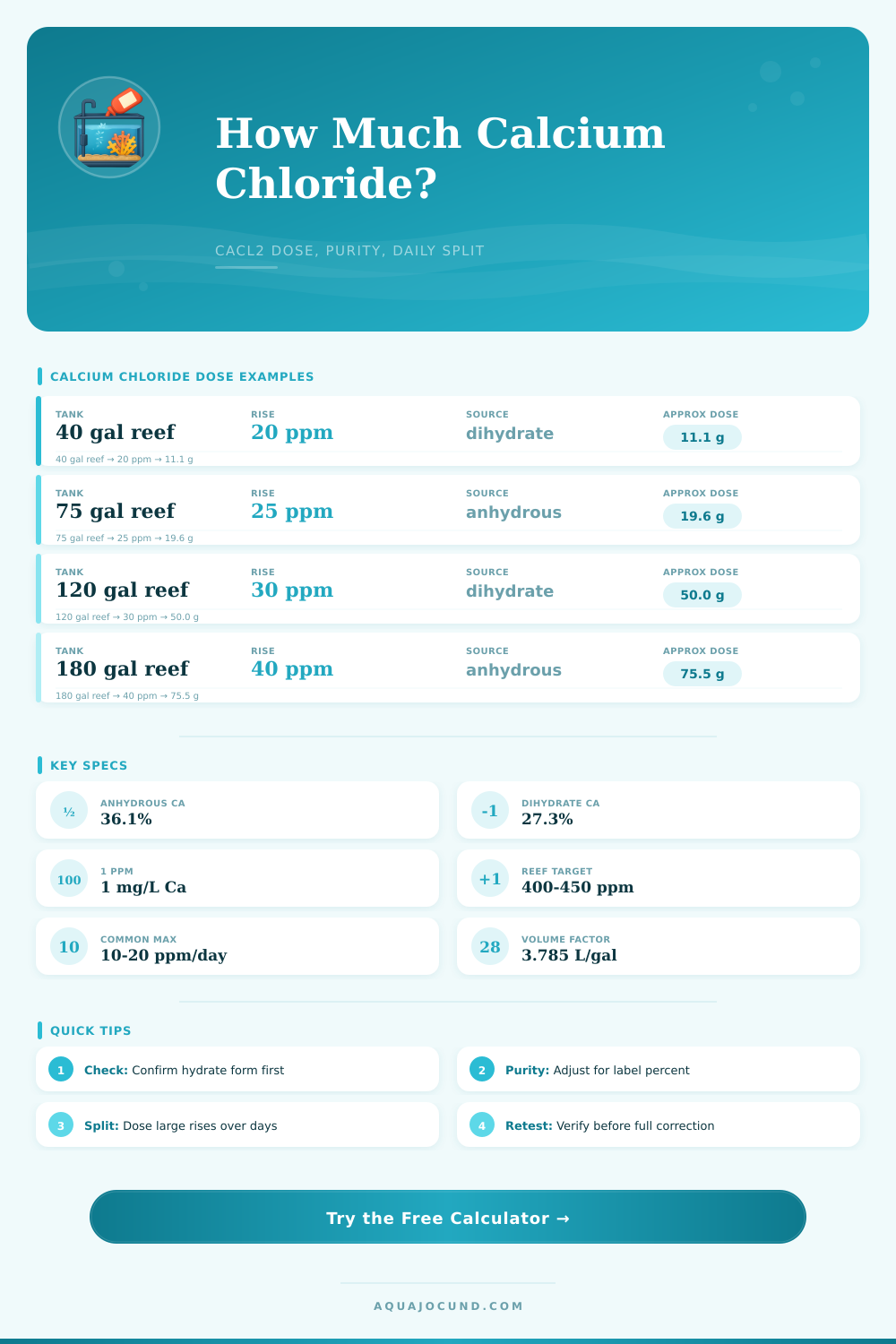
💧Common Tank Size Dose Examples
| Tank | Dimensions | Volume | 20 ppm Dihydrate Dose |
|---|---|---|---|
| 20 long | 30 x 12 x 12 in / 76 x 30 x 30 cm | 20 gal / 76 L | 5.6 g at 99% purity |
| 40 breeder | 36 x 18 x 16 in / 91 x 46 x 41 cm | 40 gal / 151 L | 11.2 g at 99% purity |
| 75 gallon | 48 x 18 x 21 in / 122 x 46 x 53 cm | 75 gal / 284 L | 21.0 g at 99% purity |
| 120 gallon | 48 x 24 x 24 in / 122 x 61 x 61 cm | 120 gal / 454 L | 33.6 g at 99% purity |
| 180 gallon | 72 x 24 x 24 in / 183 x 61 x 61 cm | 180 gal / 681 L | 50.4 g at 99% purity |
📈Correction And Stock Solution References
| Reference | Value | Use In Calculator | Notes |
|---|---|---|---|
| Elemental calcium ppm | 1 mg/L | Target minus current calcium | ppm calcium equals mg calcium per liter |
| Gentle correction | 5-10 ppm/day | Max daily rise | Useful after uncertain test results |
| Common correction | 10-20 ppm/day | Max daily rise | Typical reef range for planned correction |
| Fast correction cap | 20-30 ppm/day | Max daily rise | Retest before repeating large changes |
| 100 g/L dihydrate stock | ~27 mg/mL Ca before purity | Stock solution strength | Divide calcium need by stock mg/mL |
| 100 g/L anhydrous stock | ~36 mg/mL Ca before purity | Stock solution equivalent | More concentrated than dihydrate stock |
So there you go, the dreaded sinking feeling hits. Your coral polyp seem a little less perky today. Your test kit says your calcium is off it’s intended mark. Don’t panic, don’t start guessing wildly; it’s just another day in paradise on the reef.
But what’s the issue? Usually, it’s a matter of understanding the chemistry behind the white powder you’re about to dump into your aquarium. I’m talking about the chemistry behind the white powder you’re about to pour into your tank, specifically, calcium chloride. That stuff is typicaly used to address low calcium. However, most hobbyists runs into trouble because they assume each bottle of salt are created equal. Far from it.
How to Fix Calcium Levels Safely
Knowing how to match the correct hydration state (anhydrous vs. Knowing the hydration state (anhydrous vs. Dihydrate) determines everything, even more than nearly any other variable. Anhydrous calcium chloride has had water removed from the crystals, which means there is more pure calcium per gram. Dihydrate hasn’t, so there’s less product by weight for any given effect. This is where the common error occur. You cannot substitute a dihydrate label for an anhydrous dose and expect the correct water correction. Instead, you’ll drastically undercorrect. Conversely, if you do the opposite, you could over-dose on calcium, leading to precipitation problems with alkalinity.
Once you select your source, the calculator above perform the conversion math so you don’t have to manually figure out the stoichiometry, mistakes from which can wreck a tank in an afternoon. Purity also surprisingly impacts how well you dose something. Technical or food grade products may has a lower purity level than reef grade, which is marketed as being nearly perfect. But if they list a number less than 100% on the label, you’re paying for impurities and fillers without any benefit to your corals. So adjust accordingly so you can dose by active ingredients instead of total weight. That sounds like no big deal but it can result in slowly creeping off-target after months of supplementing if you don’t account for this. Keeping the delicate balance of major elements require accuracy, not guessing.
The other place that our intuition gets us is volume. When we have a 75g tank, there isn’t 75 gallons of water when you take into account all the displacement caused by equipment, sand, rock, etc. If you use the gross volume rather than the net water volume in your calculations, you will significantly overdose. To address this, the tool allows you to enter the displacement percentage or calculate it based off dimensions. This is much more accurate than estimating how much live rock is in your tank. Having a true sense of how many milliliters of water are actualy contacting the dosing point makes a noticeable difference, particularly in the nano world where each milliliter matter.
Now that you know how much (the dose), now what? You need to break the dose up into something sensible. Abrupt changes is not good for reef aquaria. You don’t want to add so much calcium that it shocks any sensitive animals or scales the heck out of pump heads and heater elements. By spreading out a big correction into a few hours or potentially multiple days, you give the biological system time to slowly adapt. The calculator will also break it down into individual doses and daily splits based off how often you want to give the dose. This ensures you never gives too much all at once. The pace is just as important as how the dose is chemically composed, because a living ecosystem value stability much more than perfect numbers.
Finally, regardless of the math, it’s time to test. While tests are not perfect (nor is every person), we have all made our fair share of mistakes. A dosage based off calculation is just a beginning. Always check your levels after dosing prior to taking any additional actions. Repeat this process enough times and you’ll become confident without going down the rabbit hole of following imaginary numbers.
In the end, success lie within maintaining stable levels while minimizing stress on your livestock. That means avoiding wild fluctuations and relying on slow and methodical application. You must also use proper chemical identification and accurate volume measurement. It transforms a possible nightmare into simple maintenance. Even if your corals don’t tell you directly, they’ll appreciate the precision.