Alkalinity Consumption Rate Calculator
Estimate reef alkalinity use from a measured dKH drop, tank volume, testing interval, coral demand band, supplement strength, correction need, and daily ml dose.
🧪Reef Demand Presets
⚙Alkalinity Consumption Inputs
Alkalinity Consumption Estimate
🪸Coral Demand Comparison Grid
🔬Alkalinity Conversion Reference
📊Supplement Strength Reference
| Supplement type | Modeled strength | Best use | Calculator note |
|---|---|---|---|
| Soda ash two-part, strong | 1.40 dKH per ml per gal | Separate alkalinity dosing | Raises pH more than bicarbonate mixes |
| Sodium bicarbonate two-part | 1.00 dKH per ml per gal | Gentler pH impact | Often chosen when pH rise is not wanted |
| Balanced two-part, typical | 1.25 dKH per ml per gal | Daily reef maintenance | Use label strength for exact products |
| All-in-one alkalinity solution | 0.65 dKH per ml per gal | Moderate balanced systems | Alkalinity may appear after biological conversion |
| Calcium formate style solution | 0.75 dKH per ml per gal | Balanced calcium and alkalinity demand | Track trend rather than one isolated test |
| Saturated kalkwasser | 0.030 dKH per ml per gal | Evaporation-limited support | Much weaker per ml than two-part solutions |
| Diluted alkalinity mix | 0.50 dKH per ml per gal | Small tanks or dosing pumps | Useful when tiny daily doses are hard to control |
📈Coral Load Demand Table
| Load category | Typical dKH/day | Testing interval | Interpretation |
|---|---|---|---|
| Fish only / live rock | 0.00-0.10 | Weekly to biweekly | Little skeletal uptake; changes may be water-change driven |
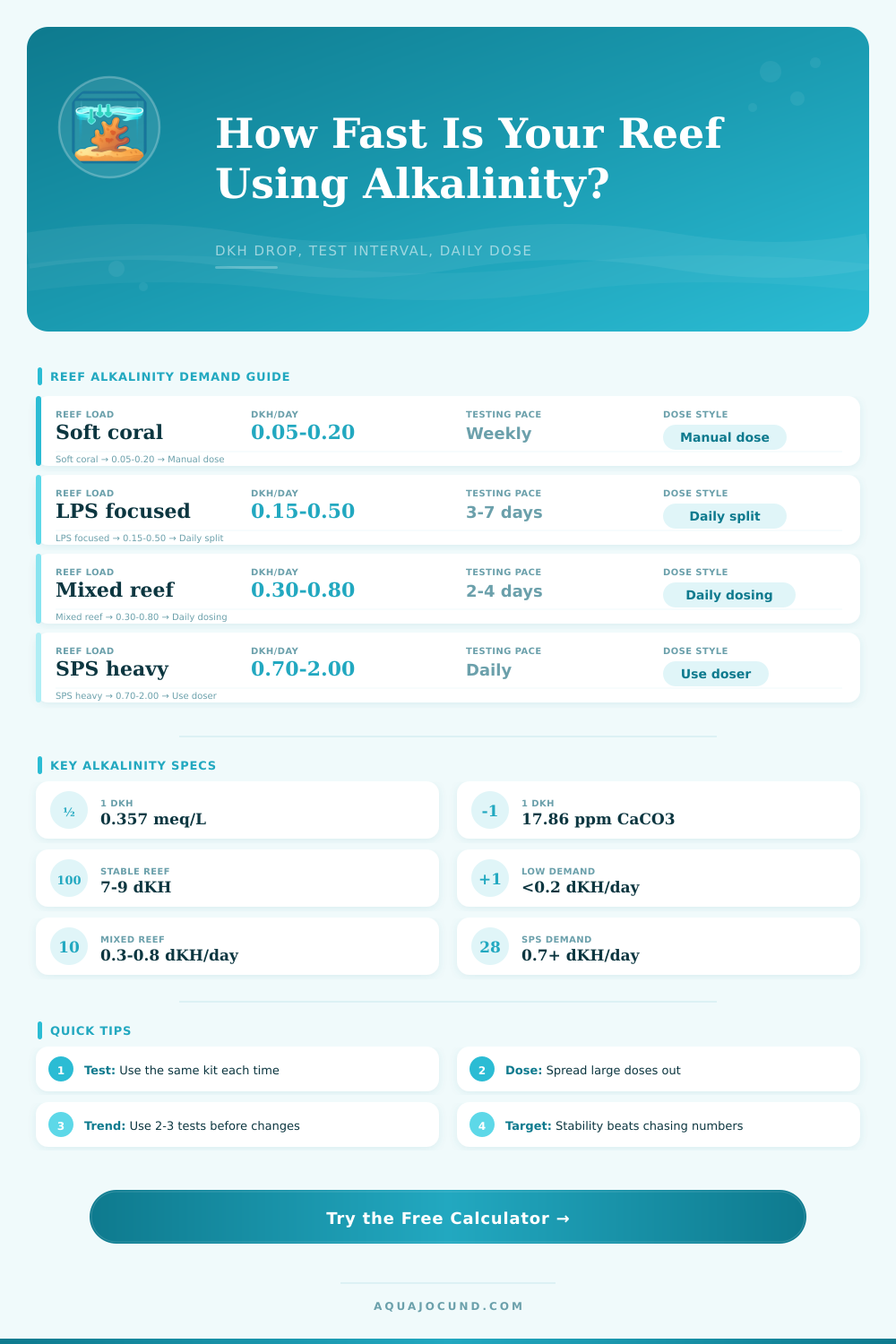
| Soft coral light load | 0.05-0.20 | Weekly | Low calcification, often manual dosing works |
| LPS focused reef | 0.15-0.50 | 3-7 days | Moderate skeletal growth and coralline demand |
| Mixed reef | 0.30-0.80 | 2-4 days | Daily dosing usually keeps swings smaller |
| SPS starting to grow | 0.50-1.20 | 1-3 days | Consumption can climb quickly after stability improves |
| SPS heavy reef | 0.70-2.00 | Daily | Automated dosing and frequent verification are common |
| Clams / coralline heavy | 1.00-2.50 | Daily | Demand may exceed simple manual schedules |
📐Common Tank Size Dose Examples
| System volume | 0.2 dKH/day | 0.5 dKH/day | 1.0 dKH/day |
|---|---|---|---|
| 20 gal / 76 L | 2.9 ml/day | 7.1 ml/day | 14.3 ml/day |
| 40 gal / 151 L | 5.7 ml/day | 14.3 ml/day | 28.6 ml/day |
| 55 gal / 208 L | 7.9 ml/day | 19.6 ml/day | 39.3 ml/day |
| 75 gal / 284 L | 10.7 ml/day | 26.8 ml/day | 53.6 ml/day |
| 120 gal / 454 L | 17.1 ml/day | 42.9 ml/day | 85.7 ml/day |
| 180 gal / 681 L | 25.7 ml/day | 64.3 ml/day | 128.6 ml/day |
⏱Testing Interval Planning Table
| Measured daily use | Suggested retest pace | Expected 3 day swing | Dosing approach |
|---|---|---|---|
| 0.00-0.10 dKH/day | 7-14 days | 0.00-0.30 dKH | Confirm trend before routine dosing |
| 0.10-0.30 dKH/day | 4-7 days | 0.30-0.90 dKH | Small daily dose or planned manual dose |
| 0.30-0.80 dKH/day | 2-4 days | 0.90-2.40 dKH | Daily split dosing gives steadier alkalinity |
| 0.80-1.50 dKH/day | Daily to 3 days | 2.40-4.50 dKH | Doser settings should be checked often |
| 1.50+ dKH/day | Daily | 4.50+ dKH | Verify test accuracy and divide dosing into many parts |
Alkalinity decreases in your reef tank, but why? Why is your alkalinity dropping so fast that you have to work harder just to keep up? Unfortunately, this isn’t always a dosage issue. Most of the time it’s because you don’t know how quickly your tank consumes alkalinity. What you don’t know, you can’t replace.
Alkalinity (also referred to as carbonate hardness) buffers seawater chemistry. It accepts hydrogen ions to keep pH steady. When calcium carbonate precipitates or corals create their skeletons, it takes away the buffering. Not all systems consume alkalinity at the same rate. For example, a fish only system doesn’t use much alkalinity and therefore remains stable. If you have a small-polyp stony coral tank, then it’ll burn though alkalinity quick and you’ll need to test it more frequently.
How to Fix Low Alkalinity in Your Reef Tank
After inputting your test readings, the calculator figure out the rest. You won’t have to guess about coefficients anymore. To get started, you just need two readings taken apart by some amount of time that you know. When most hobbyists test, it’s random or they have multiple kits which don’t necessarily agree with each other.
If you test today and then test again tomorrow, you’ll get a good sense of how much rate there is. But if you compare your test today versus last month, what does it tell you? What happens is that biological activity evolves over time. New rock doesn’t cure like old rock. The gap between the two tests tells the tool how much is being consumed per day. Then it compares that figure to average demand bands based off the type of reef and what is normal.
You then know if your tank are normal. Small-polyp stony corals is heavy users (top of consumption range). Large-polyp stony corals are right smack dab in the middle of consumption range. And soft corals rely less on calcification so they takes less alkalinity out of the water. If your drop matches a high consumption rate but you only have soft corals, something else is eating up the alkiness. It could be the rocks are still curing. Maybe you’ve got a ratio problem with Mg and Ca.
Check the coral reference table on that page. This lays out the demand of each coral type. This will also give you a sanity check on your numbers. Now that you know how fast it’s being consumed, how should you dose? If you’re losing very little (a tiny fraction per day), you could manually dose weekly but if you’re losing half a dKH in twenty-four hours, then manual weekly dosing isn’t going to work. Alkalinity will swing like crazy with this strategy, stressing your livestock and crashing your calcium levels.
Depending on your consumption rate, the calculator estimates how many milliliters/day of supplement you’ll need and what interval to test. You can fine tune these inputs for your supplement strength. Not all two-part solutions is created equally. If you assume the wrong strength, you will either overdose or underdose. It’s better to have a consistent level rather than having one perfect number, i.e., steady at eight dKH vs. It swings from 7-9. Ideally you want to match the consumption rate with the replacement rate so that water parameters remains constant.
Tanks with higher demand may require an automated doser while less demanding tanks can be fed manually at water change time. Dosing should of always be done consistently. Test regularly too. Alk tests have a margin of error, so don’t freak out if you see a poor result on one occasion, take a few more tests and check for a trend. Once you’ve identified a consistent reading, use the calculator to determine the new baseline. Continue to test until it stabilizes.
A stable tank is a happy tank. Understanding how resources are flowing will make all the difference rather than having perfect control of every single variable.