Substrate Slope Angle Calculator
Calculate aquarium substrate rise, run, slope angle, grade, volume, dry weight, compaction allowance, grain stability, and retaining hardscape demand.
⚙Unit System And Presets
📐Tank, Depth, And Stability Inputs
🌊Slope Stability Comparison Grid
🧪Substrate Material Data
| Substrate | Bulk Density | Base Stable Angle | Compaction |
|---|---|---|---|
| Fine sand, 0.2-0.6 mm | 92 lb/ft³ / 1474 kg/m³ | 10° underwater working angle | 6% typical settling |
| Coarse sand, 0.8-1.5 mm | 96 lb/ft³ / 1538 kg/m³ | 14° with light support | 7% typical settling |
| Aquarium soil, 2-4 mm | 52 lb/ft³ / 833 kg/m³ | 19° before safety margin | 16% granule breakdown allowance |
| Rounded gravel, 3-6 mm | 98 lb/ft³ / 1570 kg/m³ | 23° when toe is held | 5% typical settling |
| Crushed gravel, 4-8 mm | 105 lb/ft³ / 1682 kg/m³ | 28° from angular interlock | 4% typical settling |
| Cichlid aragonite, 1-3 mm | 88 lb/ft³ / 1410 kg/m³ | 16° with fish disturbance | 8% typical settling |
| Porous lava base, 5-12 mm | 48 lb/ft³ / 769 kg/m³ | 27° under a cap layer | 10% void filling allowance |
| Sand cap over soil | 70 lb/ft³ / 1122 kg/m³ | 13° limited by cap movement | 14% layered settling allowance |
📏Common Tank Slope Examples
| Tank | Footprint | 1.5 To 4 In Rise | Average Volume |
|---|---|---|---|
| 5.5 gallon | 16 x 8 in / 41 x 20 cm | 17.4° angle, 31% grade | 5.1 L before compaction |
| 10 gallon | 20 x 10 in / 51 x 25 cm | 14.0° angle, 25% grade | 9.0 L before compaction |
| 20 long | 30 x 12 in / 76 x 30 cm | 11.8° angle, 21% grade | 16.2 L before compaction |
| 40 breeder | 36 x 18 in / 91 x 46 cm | 7.9° angle, 14% grade | 29.2 L before compaction |
| 75 gallon | 48 x 18 in / 122 x 46 cm | 7.9° angle, 14% grade | 38.9 L before compaction |
| 125 gallon | 72 x 18 in / 183 x 46 cm | 7.9° angle, 14% grade | 58.4 L before compaction |
🪨Retaining Hardscape Guide
| Support Style | Angle Help | Best Use | Retaining Note |
|---|---|---|---|
| No retaining hardscape | 0° extra support | Low, broad slopes | Keep grade below the material working angle. |
| Front toe stones only | About +3° | Sand and shallow aqua soil banks | Locks the front edge so the slope does not creep forward. |
| Wood roots and pockets | About +4° | Natural planted slopes | Roots divide the slope into small cells. |
| Stone terraces / shelves | About +7° | Iwagumi, dutch, and display scapes | Each shelf reduces the active run and sliding mass. |
| Mesh bags below substrate | About +6° | Deep back corners and hidden height | Use as base volume, then cap with display substrate. |
| Retaining wall / full barrier | About +10° | Very steep rear banks | Needs covered edges so fish cannot dig into the wall. |
📊Angle, Rise, And Grade Reference
| Angle | Grade | Rise Over 12 In | Aquarium Meaning |
|---|---|---|---|
| 5° | 8.7% | 1.0 in / 2.7 cm | Gentle slope that most substrates hold easily. |
| 10° | 17.6% | 2.1 in / 5.4 cm | Upper practical range for unsupported fine sand. |
| 15° | 26.8% | 3.2 in / 8.2 cm | Needs coarser grains, planting, or toe support. |
| 20° | 36.4% | 4.4 in / 11.1 cm | Better as a terraced bank than one open slope. |
| 25° | 46.6% | 5.6 in / 14.2 cm | Usually requires stone shelves or mesh support. |
| 30° | 57.7% | 6.9 in / 17.6 cm | Retaining wall territory for most aquarium layouts. |
✅Calculation Tips
When most hobbyists set up their planted tanks, we go at it the way you would stack your fire wood. We heap the stuff in the back and let gravity take care of the rest. The water comes, the substrate settles and there’s that carefully angled backdrop sliding forward. Then there is your carpet of foreground, and it looks like an avalanche hit it. That’s what happens to almost all hobbyists when they get started.
When your tank either collapses in days or endures as a lasting landscape, it’s often not the lighting nor even the plants themselves. Often, it’s merely the angle of dirt beneath them. Slope stability is one of those things that sounds like math until you’ve got a tank with a slumping bank, then it’s pretty obvious that you should of known what the math says. What’s too far up? How high a back wall can I make before my substrate slides out from underneath me?
Why Your Planted Tank Slope Slides
That’s where that calculator comes into play. Enter your tank dimensions (and your substrate type) and it will let you know if you’re designing something physically possible or just good looking. No degree in geology required. You just need a willingness to realize that certain substrates don’t want to go downhill more than others.
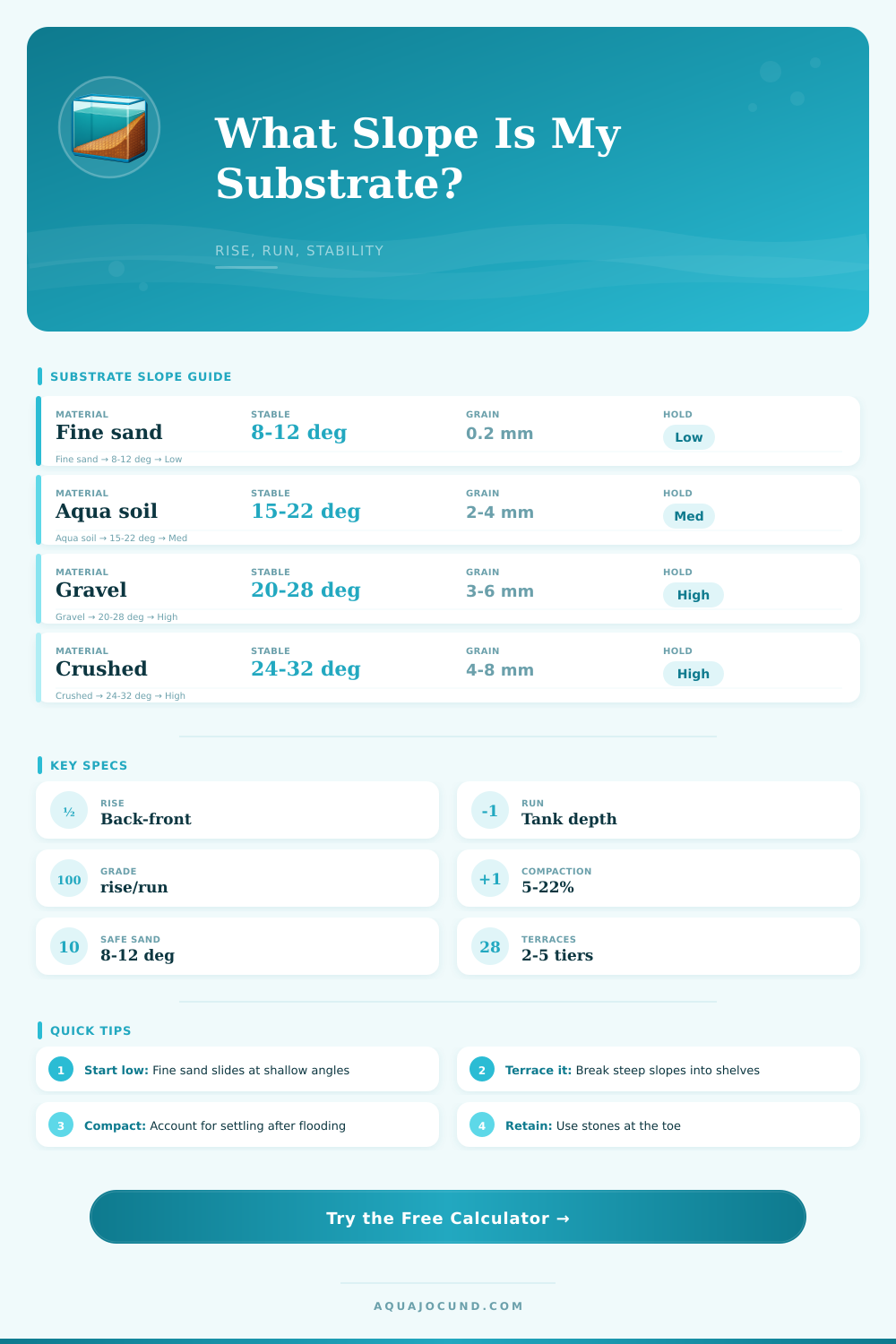
Substrate types is the greatest variable you’ll ever work with. Under pressure, fine sands act like liquids. When you place them in your tank and turn on the filter, what happens? Yup, they flow. And they don’t retain an angle much more then twelve degrees unless there’s something holding them in place. Place some fine sand into a dramatic looking mountain and then flip the light switch…it will flatten out within seconds.
Because of its shape, coarse substrates such as angular aquarium soils or crushed gravel lock into place better. They have enough friction between one another to hold at steeper angles up to twenty-five or even thirty degrees. These grain size differences is factored into the calculator, allowing you to avoid second guessing where your dirt fits in a bucket.
There’s also the trap of thinking about volume. How many gallons of substrate do I need? Many times people just think, “Oh yeah, I’ll need 5 gallons.” They don’t take into account how much of those 5 gallons will vanish upon first flood. When aquatic soils becomes wet, they breakdown. Some of them collapse under their own weight and then fill in all the spaces around individual grains. Depending on what type of soil you’re using, that could mean losing as much as 15% of your original height unless you account for it.
That’s where this tool comes in… it figures out what your “dry” weight will be and gives you a cushion so you know you’ll actualy have enough substrate left to hold the profile post-settling. Better to assume you need too much dirt than to run out and wind up with a flat, shallow tank.
Add in some hardscaping supports, and it’s another story altogether. What was seemingly an impossible steep grade on paper turns out to be doable when you throw in some wooden roots or stone terraces into the equation. Those hard landscape features serves as retaining walls, which means you can break up what would otherwise have been a long run of sloping grade into a series of shorter, more stable steps. Depending on the style of support added, there is different degrees of stability that will help your construction. Check the reference table on the page for that info.
This isn’t magic. It’s simply physics working with you, helping you cheat gravity a little bit. You also need to consider the flow of water in your tank. For example, although I could have a steep slope (bank) in my nano shrimp tank because the water there is fairly calm, a steeper slope would not work in a high-flow river scape for large cichlid. Why? The current pushes sideways against the bottom, which helps it slide. No matter how seemingly stable the angle may look, if your filter output is pointed straight at your back slope, you’re fighting a losing battle. Diffusing or changing the direction of the flow can save what might otherwise appear to be a perfect landscape on paper.
It’s not really about numbers either. It is more about how the material holds up in relation to run, rise, etc. Remember that you’re building something that exists underwater, which is subject to constant movement from surrounding water currents and curious fish. Hardscape can be used to support the substrate where you want to bend its limitations.
Get the angle correct, then the rest of the aquascape will fall into place naturaly. You must know what’s holding together under the surface long before you’ve even turned the lights on.