Driftwood Waterlog Time Calculator
Estimate how long aquarium driftwood may need to soak before it stays down, using species, cross-section, dryness, water temperature, weighting, and starting buoyancy.
⚙Unit System And Presets
🪵Driftwood Inputs
🪵Driftwood Comparison Grid
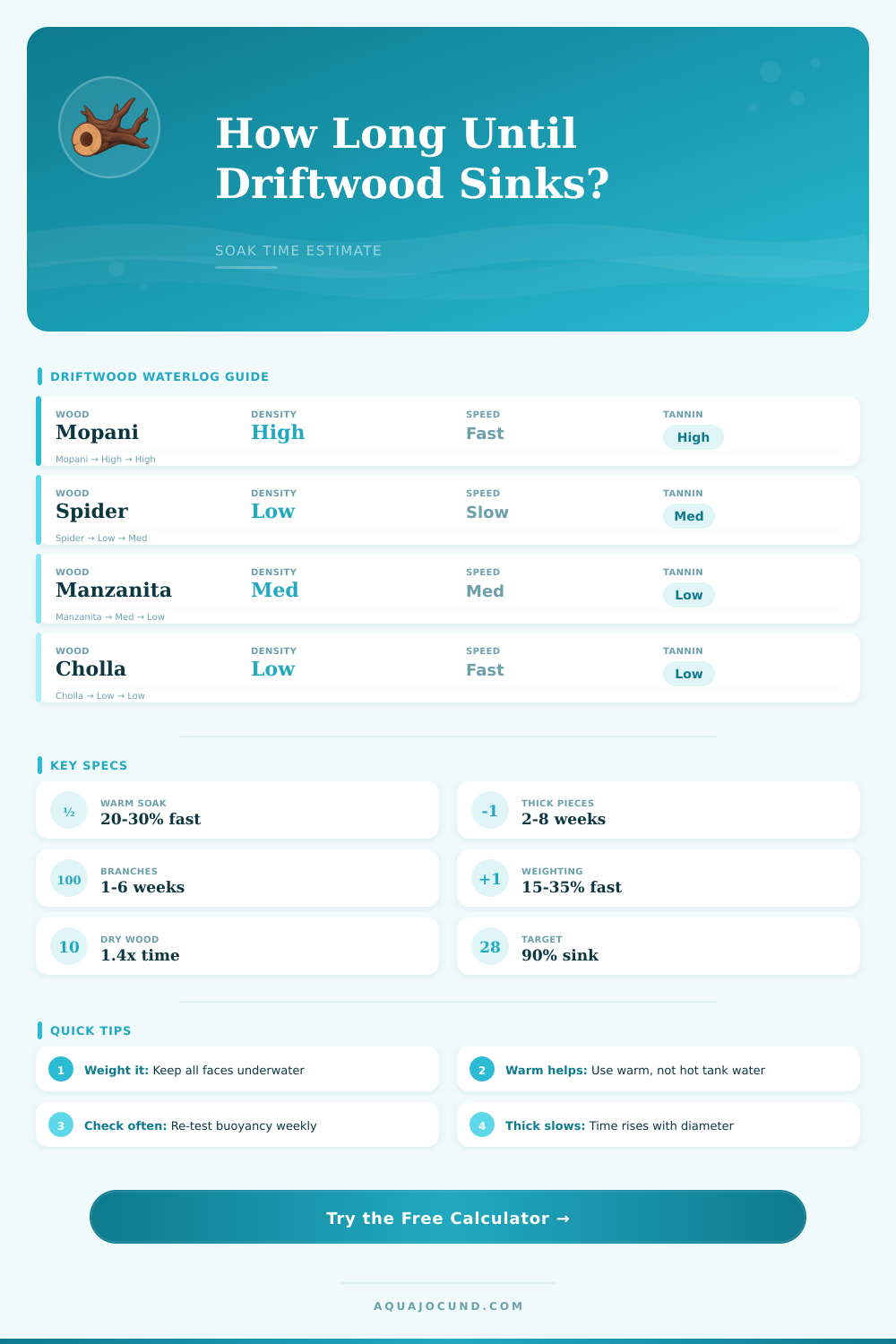
📊Species Waterlog Reference
| Wood Type | Specific Gravity | Typical Sink Speed | Tannin / Note |
|---|---|---|---|
| Mopani / African root | 0.75-0.90 | Fast to medium | Heavy core, strong initial staining. |
| Malaysian driftwood | 0.62-0.78 | Medium | Reliable aquarium wood with moderate pores. |
| Manzanita | 0.52-0.68 | Medium | Thin branches waterlog faster than forks. |
| Spider wood | 0.35-0.50 | Slow | Air pockets and root forks raise buoyancy. |
| Cholla wood | 0.30-0.42 | Fast to medium | Hollow structure fills from many openings. |
| Cork bark | 0.18-0.30 | Very slow | Often needs permanent anchoring. |
🌡Soak Condition Multipliers
| Condition | Faster Choice | Slower Choice | Calculator Effect |
|---|---|---|---|
| Temperature | 82-92°F warm bucket | 60-68°F cool room | Warm water lowers estimated days. |
| Weighting | Fully held underwater | Edges floating above water | Full contact improves uptake. |
| Dryness | Damp or recently rinsed | Kiln dried or bone dry | Dry cores add reserve time. |
| Surface prep | Scrubbed, cut, or drilled | Bark and dust left on | Open ends shorten the estimate. |
| Water changes | Frequent warm refresh | Stagnant dark soak | Refreshes mainly help surface flow. |
📏Common Aquarium Piece Sizes
| Use Case | Typical Size | Common Wood | Planning Range |
|---|---|---|---|
| Shrimp nano accent | 6 x 1 in / 15 x 2.5 cm | Cholla, spider root | 3-18 days |
| 10 gal branch | 12 x 2 in / 30 x 5 cm | Spider, manzanita | 1-5 weeks |
| 29 gal center root | 18 x 4 in / 46 x 10 cm | Mopani, Malaysian | 2-7 weeks |
| 55 gal branch network | 30 x 3 in / 76 x 8 cm | Manzanita, spider | 3-10 weeks |
| 75 gal root mass | 36 x 6 in / 91 x 15 cm | Malaysian, bogwood | 4-12 weeks |
🧪Buoyancy Check Schedule
| Check Point | What To Test | Good Sign | Keep Soaking If |
|---|---|---|---|
| Day 2-3 | Does it stay fully wet? | No dry upper face | It still bobs above water. |
| Week 1 | Push down and release | Rises slowly | It springs upward quickly. |
| Midpoint | Remove weight for 10 min | One end stays down | Both ends float high. |
| Final week | Leave unweighted overnight | Stays submerged | Any dry pocket returns. |
✅Calculation Tips
Why might it take up to three weeks before that spider wood sinks? You buy it to build out an aquascape and now you feel as if you’re fighting against physics. It’s frustrating! But what is even more significant than patience here is knowing about water displacement versus wood structure.
The table above calculates for the weight of your particular timber relative to buoyant forces. It accounts for cross-section area and density. So don’t wonder whether that mopani root is going to sink; let this do the math for you.
Why Does Driftwood Take So Long To Sink?
Different types of wood has different densities. For example, cork bark has a lot of air in it making it less dense than mopani. Mopani is dense and sinks fast. You’ll notice on the reference grid where certain wood will float or sink. If you find yourself with light wood, then you can weigh it down with rocks. Problem solved…or not. Because the wood still has air pockets inside that gives it buoyancy.
When those air pockets are filled with water, that’s when it truly sinks. The time varies with thickness. The thicker the core, the longer it will take since the water is coming in from the outside. If you enter the greatest dimension (thickest part) into the calculator, you’ll get a reasonable timeline and know that the water has to travel farthest to reach center of the wood. That way you don’t wait 10 days and see your outer shell be saturated but still have a dry interior.
Soaking times are also affected by temperature. Molecules in warmer water move faster, penetrating wood fibers quicker and more vigorously then colder molecules. You may be able to shorten the soaking time with warm water without killing off good bacteria or leeching out excessive amounts of tannin. The calculator accounts for thermal effect of soaking in a cool outdoor tub versus a warm bucket. That is handy if you’re waiting for big root mass to go down.
Dryness determines how difficult it will be to soak up water. Wood that is bone dry, that is to say not just slightly damp but lacking any moisture inside and with pores tightened down; soaks up more slowely than wet wood does. A piece of wood that’s been partly washed by rain soaks up faster as well. If you know it’s a piece of kiln dried wood, you can adjust your expectations to match.
Maintaining contact with water is key By weighting it down you keep it completely covered in water all the time. This helps it soak up water faster from all angles. It is better than having the wood partially out of the water which creates an obstacle for the water to get through.
Nature isn’t uniform, so results vary instead of happening in a single day. Dense knots or hollow spots will hold air pockets and take longer to saturate fully. Weekly checks allow for assessing where things are at and never give up on it. Pushing down, releasing then seeing how fast the wood bounces back to the top will tell you if it’s going slowly (filling in the middle) or needs more time yet since it snaps back so quickly.
Waiting for the driftwood to sink builds character. It takes time and respect for the wood to let it happen. And then when that root falls to the floor and doesn’t move again, you feel like it was all worth it. Struggling to make it float reinforces for me how much this isn’t just decoration, but a piece of livig history.
If you’ve done it right, it has its place in your tank. There’s nothing better than knowing that something is stable after weeks of staring at a bucket floating. You should of waited longer to see if the wood sinks naturaly. Mopani wood can be more luxurius than other types. The furnitures sits heavy in the water. It could of been easier with the right tools.
I recieved the shipment yesterday. Most people finds that patience is key. A armchair is not as heavy as wood. He should steers the boat better. He has to shares his secrets. Wood sink more slower than expected. He use a rope to tie it down. The water level rise quickly. It feels comfortabley in the tank.