Plenum Volume Calculator
Estimate void water capacity, eggcrate height, screen displacement, sand depth, footprint volume, and gentle water exchange for aquarium plenum beds.
📌Plenum Presets
🧪Plenum Design Comparison
📊Platform Material Displacement
| Platform | Typical Height | Open Area | Void Adjustment | Best Fit |
|---|---|---|---|---|
| Standard eggcrate | 0.38 in / 9.5 mm | 82-88% | Moderate ribs | Classic plenum plates |
| Heavy eggcrate | 0.50 in / 12.7 mm | 76-84% | More displacement | Larger unsupported spans |
| Perforated acrylic | 0.25 in / 6.4 mm | 55-70% | Hole pattern limited | Custom trays |
| Plastic drain mat | 0.40 in / 10 mm | 70-82% | Many small supports | Low profile builds |
| PVC pipe lattice | 0.75 in / 19 mm | 88-94% | Legs and pipes | Deep remote beds |
🌊Common Tank Footprints
| Tank | Inside Footprint | 1 Inch Raw Void | Typical Sand Cover | Notes |
|---|---|---|---|---|
| 10 gallon | 20 x 10 in / 51 x 25 cm | 0.87 gal / 3.3 L | 2.5-3.5 in | Nano or trial bed |
| 20 long | 30 x 12 in / 76 x 30 cm | 1.56 gal / 5.9 L | 3-4 in | Shallow display footprint |
| 40 breeder | 36 x 18 in / 91 x 46 cm | 2.81 gal / 10.6 L | 3.5-5 in | Wide, even plenum |
| 75 gallon | 48 x 18 in / 122 x 46 cm | 3.74 gal / 14.1 L | 4-5 in | Display or reef bed |
| 125 gallon | 72 x 18 in / 183 x 46 cm | 5.61 gal / 21.2 L | 4-6 in | Long bed needs support |
🔧Design Reference
| Design | Void Height | Screen Layers | Sand Depth | Exchange Style |
|---|---|---|---|---|
| Classic Jaubert style | 0.75-1.25 in / 19-32 mm | 2 | 4-5 in / 10-13 cm | Passive to very low |
| Refugium tray | 0.5-1 in / 13-25 mm | 1-2 | 3-4 in / 8-10 cm | Low tray turnover |
| Low uplift exchange | 1-1.5 in / 25-38 mm | 2-3 | 4-6 in / 10-15 cm | Metered uplift flow |
| Remote deep sand bed | 0.75-1.5 in / 19-38 mm | 2 | 5-6 in / 13-15 cm | Slow isolated pass |
| Low profile display | 0.4-0.75 in / 10-19 mm | 1 | 2-3 in / 5-8 cm | Mostly passive |
🧮Sand Porosity Estimates
| Sand Texture | Estimated Porosity | Exchange Drag | Void Note |
|---|---|---|---|
| Sugar fine aragonite | 38-42% | High | Keep exchange very gentle |
| Oolitic aragonite | 40-44% | High | Good seal over screen |
| Fine reef sand | 42-46% | Medium high | Common display choice |
| Medium aragonite | 44-48% | Medium | More pore water volume |
| Crushed coral | 48-55% | Low | Needs fine barrier mesh |
| Mixed grain bed | 42-50% | Variable | Settling changes over time |
Underneath your aquarium sand bed isn’t empty space. It’s a built reservoir of sorts, with water moving slow enough to allow the beneficial bacteria to filter out waste before it hits the top (the display column). Most hobbyists don’t realize how important it is to get this volume correct. There should be just enough void so that water doesn’t pool in any stagnant spots. However, there shouldn’t be too much void or the flow will rush right through without enough filtration to keep up.
What you’re creating here is really a hidden organ for your tank. Its size determine how well and how quietly it operates behind the scenes.
How to Size Your Aquarium Plenum Correctly
So what’s next? Most builders begin by figuring out the footprint, which is the amount of open space between the silicone gaps and the overflow boxes. This is your working space; each square inch of glass directly add to the storage capacity of the tank. After you enter this data into the calculator above (it does all the work from there), the only variable left is height.
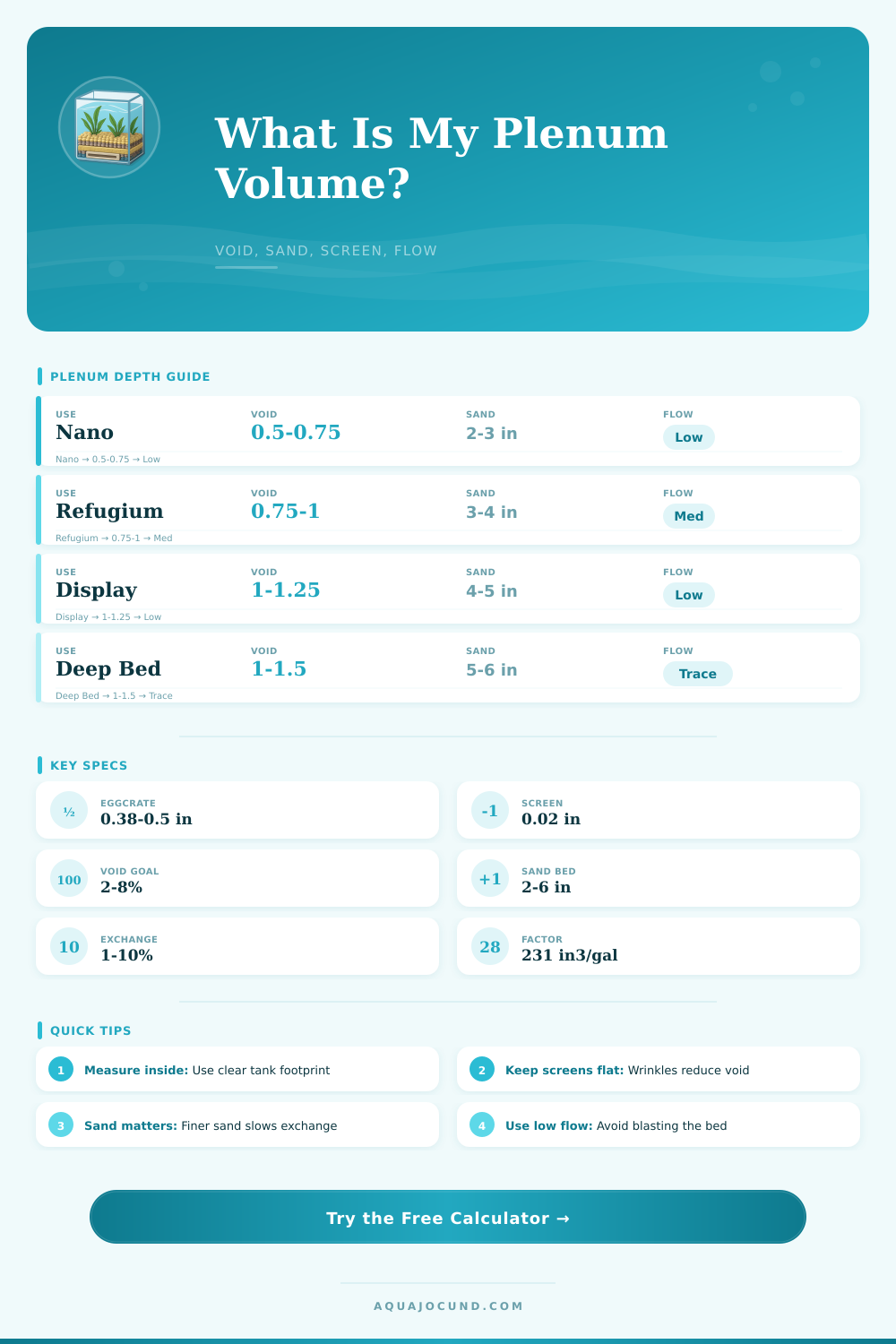
What do you want to create a void of? Typically, a traditional Jaubert design aims for approximately one inch of depth. It provides enough room to accommodate volume change without creating dead spots where debris collect and decomposes. But again, if you’re too shallow, ribs compresses the volume of space available for water. The result is less open area for water to move through. Less open area means the rate at which nutrients dilute in the system change. It seems minor, but it makes a big difference!
Surprisingly, platform material is something we give a lot of thought to in our builds, much more so than most folks envision when they initially start doodling designs. While it may feel sturdy, heavier grids and PVC lattice products will displace significantly more water. Even standard eggcrate plastic add thickness which ultimately eats away at your void depth. Because it’s taking up space, you need to consider how this actual physical displacement affects things. That water can’t take up any space in the volume occupied by the plastic.
The table on this page show a clear breakdown of these differences. It explains how certain materials, like a perforated acrylic plate, can achieve a sleeker look but with lower open area percentages different than a simple grid. In other words, a tradeoff exists between hydrodynamics versus durability. One is not inherently better than the other; your choice depends on whether you want more open space in a shallow setup or more strength in a deeper bed.
That’s because the sand layer above the substrate serve double duty: It’s biological habitat… and it’s also filter media. Finer grained sand creates more resistance to the water passing through it. As such, sugar fine aragonite, while beautiful, requires a very slow and gentle exchange rate to avoid any channeling and compaction. With coarser substrates (such as crushed coral), water flows more easily, which means you can get away with running a little higher turnover without disturbing the bed structure.
The calculator accounts for grain type and adjusts its exchange estimates to match. This allows you to visualize how much water actualy cycles through the system each day. That number, the number of times the water turns over per day; is key because it tells you whether or not your existing pump set-up is underfeeding or overworking the biological processes happening beneath the surface.
Another aspect to which novices fall prey is edge allowances (all tanks have some kind of border), and screens aren’t going to fit flush on that border. You want a bit of room there so that nothing tears through mesh at any sharp corner. Also, if there’s no clearance, the screen won’t let water flow along the sides (i.e., right next to the glass) but rather bangs into a plastic wall. Remove a couple of percentage points from each side to account for these dead spaces. This makes your plenum a more accurate estimate of how much actual volume you can fit in it, rather than what might of been possible if the geometry were perfect. That transforms that theoretical shape from pure math to a reality with its own constraints.
In the end, then, a plenum should be sized appropriately so it does its job quietly. No one sees the slow-moving water flowing through the space underneath your sand bed. No one sees the invisible bacteria churning away at nitrates in the darkness under the substrate. What you see, over time… Is that the water stays clear and your parameters is stable. If they’re consistently good without having to tweak something all the time, then you know there’s a hummin’ little engine tucked out of sight but running right below.
And that’s what it’s all about: matching that unseen capacity with the living thing you want to see thriving above it. That creates a system in which no drop is wasted, because everything counts.