Deep Sand Bed Volume Calculator
Size a deep sand bed from footprint, target depth, grain size, rock displacement, settling allowance, sand weight, and denitrification depth zones.
📏Deep Sand Bed Inputs
🌊DSB And Refugium Comparison Grid
Broad fine-sand footprint with visible bed height.
Separate tray or bucket style bed with easy isolation.
Sump footprint shared with macroalgae or rubble zones.
Includes a void space that should be subtracted.
⛏Sand Grain And Density Reference
📋Grain Size Suitability Table
| Sand Type | Typical Grain | Bulk Density | DSB Planning Note |
|---|---|---|---|
| Sugar-fine oolite aragonite | 0.1-0.3 mm | 1.25-1.35 kg/L | Fine grains build low-flow depth zones efficiently |
| Fine aragonite sand | 0.25-1.0 mm | 1.35-1.55 kg/L | Common classic DSB choice for reef footprints |
| Medium reef sand | 1.0-2.0 mm | 1.45-1.60 kg/L | Needs more depth to behave like a DSB |
| Fine silica sand | 0.2-0.8 mm | 1.50-1.70 kg/L | Dense inert grains increase bag weight quickly |
| Dense black aquarium sand | 0.4-1.2 mm | 1.65-1.90 kg/L | Heavy sand uses fewer liters per bag weight |
| Coarse crushed coral | 2.0-5.0 mm | 1.10-1.35 kg/L | Large pores limit fine DSB stratification |
| Mud and fine sand blend | 0.05-0.5 mm | 0.95-1.20 kg/L | Light wet blends vary by moisture and packing |
| Mixed refugium grade | 0.5-2.5 mm | 1.25-1.45 kg/L | Useful for sump beds with mixed particle sizes |
🧪Depth Zone Reference
| Depth Zone | Typical Range | Calculator Treatment | Planning Meaning |
|---|---|---|---|
| Aerobic surface | 0-0.75 in | Top cap volume | Highly oxygenated surface sand layer |
| Transition layer | 0.75-3 in | Suboxic buffer volume | Oxygen drops as depth and fine packing increase |
| Anoxic DSB zone | 3-6 in | Effective denitrification volume | Main deep bed zone used for nitrate planning |
| Extra deep reserve | Over 6 in | Tracked separately | Often better in remote beds or refugium trays |
💧Common Footprint Examples
| Setup | Inside Footprint | 5 in Fine Sand | Approx Dry Weight |
|---|---|---|---|
| 10 gallon display | 20 x 10 in (51 x 25 cm) | 16.4 L before allowance | 47 lb at 1.30 kg/L |
| 20 long refugium | 30 x 12 in (76 x 30 cm) | 29.5 L before allowance | 85 lb at 1.30 kg/L |
| 29 gallon display | 30 x 12 in (76 x 30 cm) | 29.5 L before allowance | 85 lb at 1.30 kg/L |
| 40 breeder reef | 36 x 18 in (91 x 46 cm) | 53.1 L before allowance | 152 lb at 1.30 kg/L |
| 55 gallon display | 48 x 13 in (122 x 33 cm) | 51.1 L before allowance | 146 lb at 1.30 kg/L |
| 75 gallon reef | 48 x 18 in (122 x 46 cm) | 70.8 L before allowance | 203 lb at 1.30 kg/L |
| 125 gallon display | 72 x 18 in (183 x 46 cm) | 106.2 L before allowance | 304 lb at 1.30 kg/L |
| Remote 18 in round tub | 254 sq in (1641 sq cm) | 20.8 L before allowance | 60 lb at 1.30 kg/L |
⚙Displacement And Allowance Guide
| Adjustment | Typical Range | Use More When | Use Less When |
|---|---|---|---|
| Open sand coverage | 50-100% | Large open refugium trays need most of the footprint | Rock islands, baffles, or macro baskets cover area |
| Buried displacement | 0-25% | Rock bases, pipe stands, or plenum voids sit inside the bed | The bed is a plain tray with open sand only |
| Settling allowance | 5-15% | Fine sand is rinsed, stirred, or leveled after filling | Coarser grains hold their height with larger voids |
| Leveling reserve | 5-20% | You want a flat final depth after scraping and smoothing | You can accept a slightly lower final sand line |
There’s a box of sand. It’s expensive… Enough for one meal away from home. Twenty-pounds, according to label. The photo on bag features a clean stretch of snow-white dune along the tank floor. You set the box down on the floor, open it, and then scoop. Then, realizing the bed is only inches deep, you scatter it about.
This is how most beginning reefers learn the importance of doing the math before buying substrate. Doing so will also save you money and prevent heartache when you find yourself short of sand halfway through your set-up.
How to Calculate the Right Amount of Sand
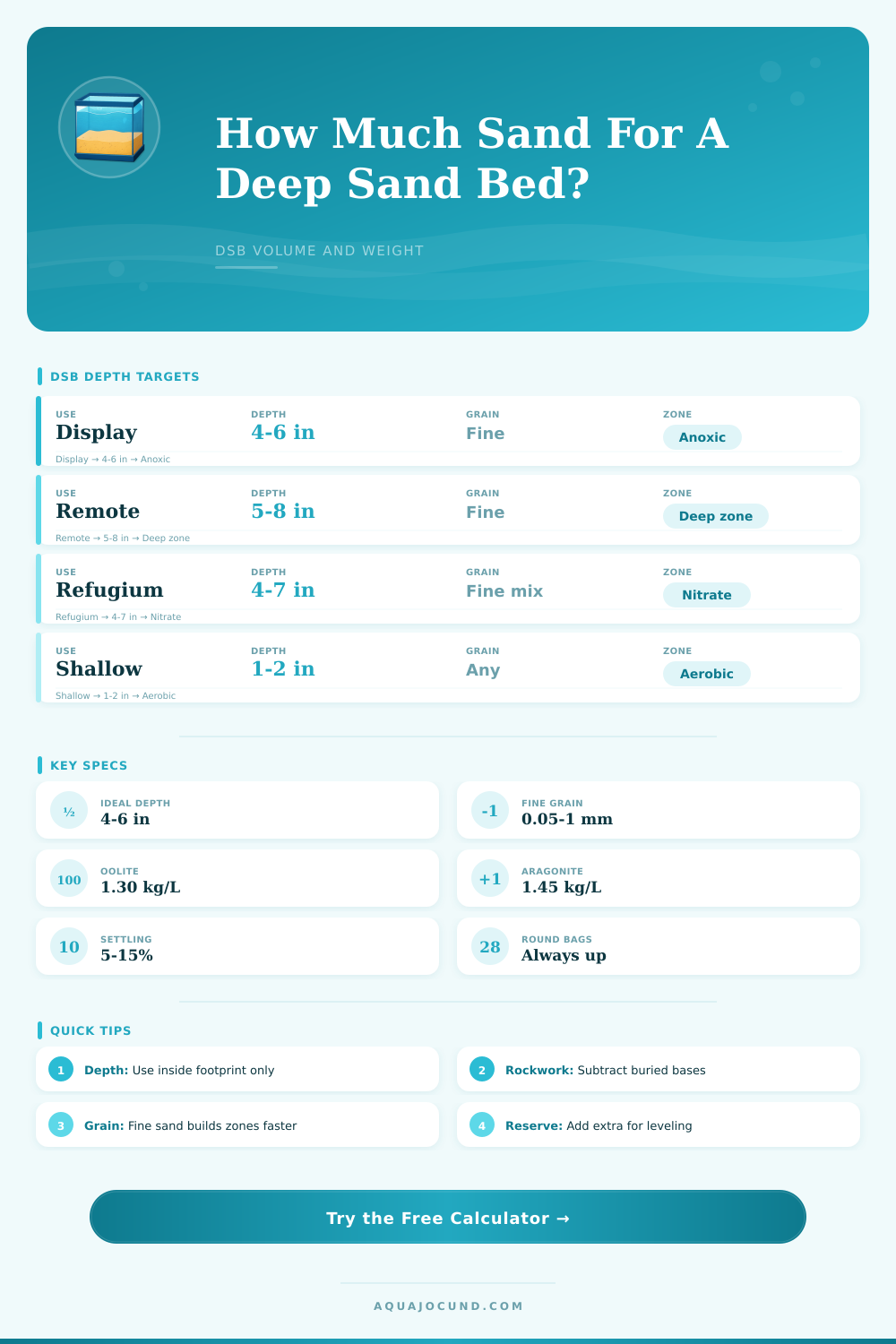
Deep sand beds aren’t merely pretty gravels. Rather they’re biological filters whose effectiveness depend on particular depth zones for processing waste. That’s the basic idea. It is simple. But making it work take some time. To establish a real deep sand bed, you want to have sufficient vertical thickness so there are areas (anoxic zones) where good bacteria can converts nitrate into nitrogen gas. For a display tank, this typically translates in 4-6″ of fine substrate. In fact, a depth of five to eight inches is common for remote trays. Go too shallow and you probably won’t be able to get any denitrification. Make it too thick and you’ll need a backhoe to level out the mess.
The calculator above do all the math for you when you enter your target depth and footprint area. Then it converts those measurements into gallons, liters, or dry weight so that all you have to do is plan layout.
Many people fail to realize that there are also rocks and equipment taking up space inside the sand column. That includes plenum pipes and rock bases buried under your bed. Those displace volume that would of been filled with sand if not ignored. Ordering less because of that will result in a shortage. With this tool you can enter how much of that is displaced, so final order takes into account the voids left behind from your hardscape. A simple adjustment to what you enter makes all the difference as you smooth out the last layer.
And then there’s grain size. Sugar-fine oolite aragonite packs more tightly than coarse crushed coral, so it’ll form those life-saving anaerobic layers more quickly. But fine sand will settle more dramatic when you’re leveling it off with your first bucket of water. Before reaching for your level, factor that in and make sure you have a little bit of a settling allowance so you don’t end up with a skimpy-looking bed when the tank has filled and settled. Experience is more important than raw geometry at this point. Leave yourself some room to scrape down any high spots but not so much that you expose rock bases or glass itself.
The other type of bed involves those in the tank, such as your display tank vs. It is a remote bed. If it’s a remote bed, you can dig down deeper without having to worry about substrate being stirred up from other livestock in main view area. Since these beds are remote, a five-to-eight-inch deep tray is the norm. They are easier to work with and less prone to being disturbed by curious tangs.
Another variable that impacts this equation is the weight. More dense sands (e.g., black aquarium gravel) will hold fewer bags but also puts more strain on the stand unless spread out evenly.
The single most important part may be planning for the footprint properly. For this, measure across the inside of the glass-to-glass distance. This number must account for any baffle or overflow box space as well. If you use the outside dimension of tank, you’re almost assured to over-order. From there, add in the depth you want, and the calculator will estimate the bulk density based off the type of sand you picked.
This takes away the guesswork on one of the most boring aspects of setting up a tank and leaves you with a definite number of bags to purchase and amount of weight to work with. There is nothing more satisfying than pouring the last bag into your tank and knowing you made it to your desired water depth. You no longer have to deal with the frustration of extra bags taking up space in your garage for years. You also won’t have to panic about running out halfway through filling your tank. Always measure twice, calculate once, and round up just a little to compensate for those inevitible spills as you level the substrate.