Sand Bed Depth Calculator
Size aquarium sand bed depth from tank footprint, grain size, burrowing livestock, compaction, anaerobic risk, and bag weight.
📏Footprint, Grain, Livestock, And Bag Inputs
🐟Sand Type And Species Fit
🌊Sand Grain And Density Reference
| Sand Type | Typical Grain Size | Bulk Density | Planning Behavior |
|---|---|---|---|
| Sugar-fine aragonite | 0.1-0.5 mm | 1.45 kg/L | Packs tightly, use reserve and watch deep zones |
| Oolite reef sand | 0.2-1.0 mm | 1.35 kg/L | Soft for sifters, moves easily in high flow |
| Fine aragonite sand | 0.5-1.5 mm | 1.35 kg/L | Good all-around reef and burrower grain |
| Washed river sand | 0.2-1.0 mm | 1.55 kg/L | Dense, smooth, and useful for bottom feeders |
| Pool filter sand | 0.45-0.85 mm | 1.50 kg/L | Uniform grain with moderate compaction |
| Medium aquarium sand | 1.0-2.0 mm | 1.45 kg/L | Less compacted, less soft for delicate barbels |
| Coarse sand blend | 2.0-4.0 mm | 1.40 kg/L | Open voids lower gas-pocket risk but reduce burrowing comfort |
| Crushed coral sand | 2.0-5.0 mm | 1.30 kg/L | Irregular grains and lower compaction than fine sand |
🧪Livestock Burrowing Depth Reference
| Livestock Group | Minimum Depth | Preferred Grain | Calculator Adjustment |
|---|---|---|---|
| No burrowing livestock | 0.5-1 in | Any aquarium sand | Depth follows the selected layout goal |
| Shrimp or small snails | 0.75-1.25 in | Fine to medium inert sand | Adds a shallow grazing buffer |
| Corydoras or small sifters | 1-2 in | Smooth fine sand | Raises shallow beds to protect digging room |
| Small loaches | 1.5-2.5 in | Smooth fine or river sand | Raises depth for partial burying behavior |
| Sand-sifting gobies | 2-3 in | Fine reef sand | Balances sifting depth with oxygenated surface area |
| Jawfish or pistol shrimp pair | 4-6 in | Fine sand with mixed rubble | Forces deep burrow structure depth |
| Burrowing eel or wrasse | 3-4 in | Fine to medium reef sand | Raises depth for full-body cover zones |
| Soft-bottom ray or large sifter | 2-4 in | Fine smooth sand | Uses a wider soft footprint with moderate depth |
📋Common Tank Sand Amount Guide
| Tank | Inside Footprint | 1 in Bed | 2.5 in Bed |
|---|---|---|---|
| 5.5 gallon | 16 x 8 in (41 x 20 cm) | 2.1 L / 6.8 lb | 5.2 L / 16.9 lb |
| 10 gallon | 20 x 10 in (51 x 25 cm) | 3.3 L / 10.8 lb | 8.2 L / 27.1 lb |
| 20 gallon long | 30 x 12 in (76 x 30 cm) | 5.9 L / 19.2 lb | 14.7 L / 48.0 lb |
| 29 gallon | 30 x 12 in (76 x 30 cm) | 5.9 L / 19.2 lb | 14.7 L / 48.0 lb |
| 40 breeder | 36 x 18 in (91 x 46 cm) | 10.6 L / 34.5 lb | 26.5 L / 86.3 lb |
| 55 gallon | 48 x 13 in (122 x 33 cm) | 10.2 L / 33.2 lb | 25.6 L / 83.1 lb |
| 75 gallon | 48 x 18 in (122 x 46 cm) | 14.2 L / 46.0 lb | 35.4 L / 115.1 lb |
| 125 gallon | 72 x 18 in (183 x 46 cm) | 21.2 L / 69.1 lb | 53.1 L / 172.7 lb |
⚠Anaerobic Risk Planning Table
| Risk Band | Typical Trigger | Depth Pattern | Calculator Meaning |
|---|---|---|---|
| Low | Shallow or open-grain bed | Under 2 in for fine sand | Mostly oxygenated surface bed |
| Moderate | Fine sand getting deeper | 2-3 in with low disturbance | Watch compacted zones and buried decor |
| High | Deep fine bed without a DSB goal | 3-4 in with tight grains | Depth is beyond a simple decorative bed |
| Managed deep bed | Intentional deep sand bed | 4-6 in with stable fine sand | Anaerobic zones are part of the design |
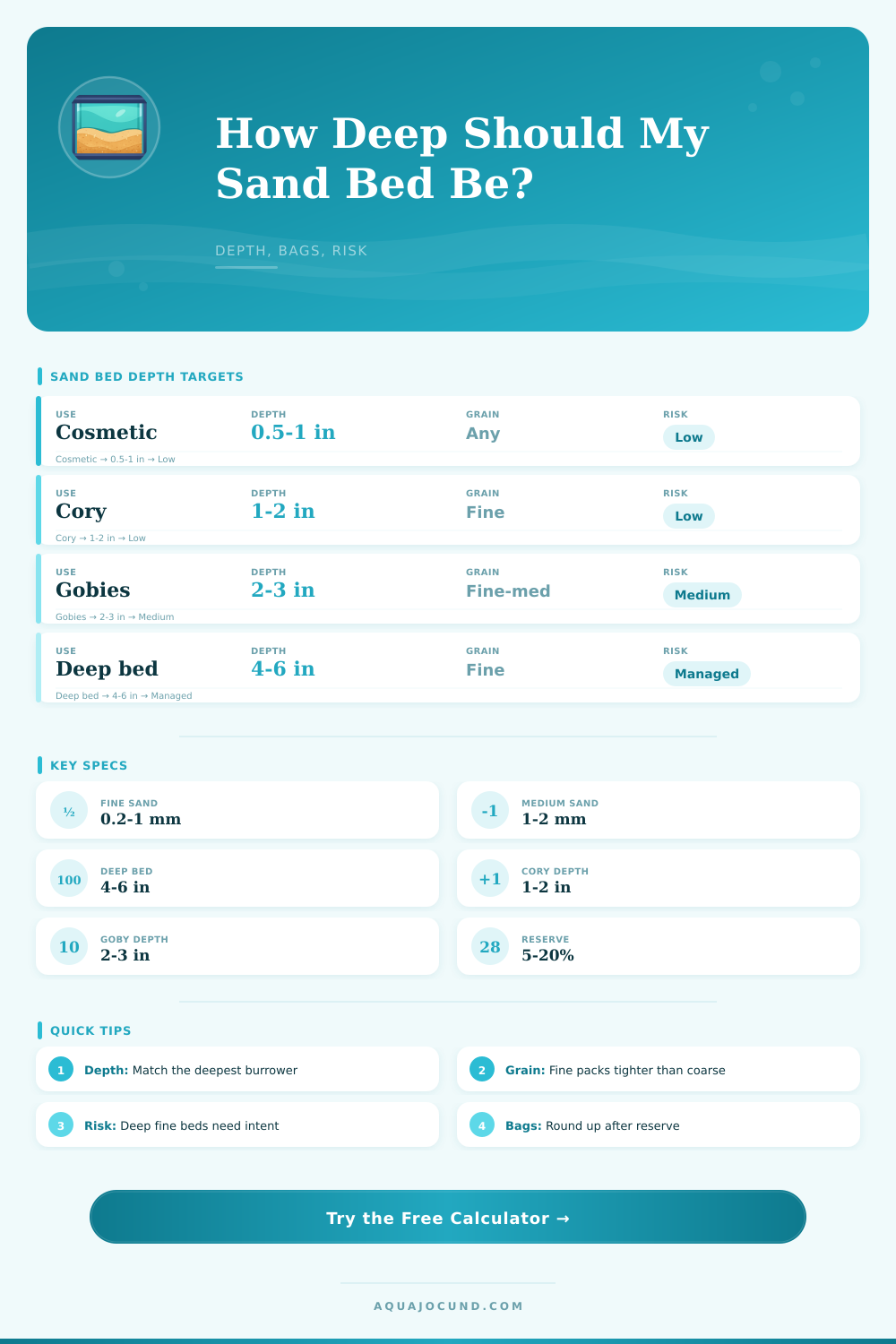
Whether your view of bottom of an unfilled aquarium is bare or covered with lots and lots of substrate, you’re faced with a dilemma. Do I go with a nice-looking, inert layer of cosmetic gravel that serves no purpose beyond looks? Or do I go with such a thickness of something like sand that it’s reminiscent of a submerged car? Somewhere in between is ideal. There should be enough space for digging but not so much depth that it creates potentially lethal anaerobic conditions.
Far too many hobbyists makes the mistake of thinking in terms of quantity instead of behavior. Gallons of substrate doesn’t matter to fish. Does it allow them to bury themselves if they wish to do so, or does it offer a goby a good place to hide? The answer is the latter. You can also see that the calculator above will do all of the work for you. Now, how does one operate it? Knowing what goes into the calculator will let you make better decisions about your sand selection.
How to Choose the Right Sand for Your Fish Tank
Grain size makes a big difference. For example, fine grained sand such as aragonite look nice. It’s soft to the touch and feels luxurius. In addition, shrimp and other sifting species is able to filter it easily. Unfortunately, it doesn’t do well under greater depths. Why? Because it compacts. When compacted, it’s a problem. You’ll create an oxygen depleted layer, which produce hydrogen sulfide that can kills livestock instantly if stirred up.
Fortunately for you, some bacteria love the environment, but not the kind that improve water chemistry. They’re the bad kind of bacteria. They’ll actualy screw with the water chemistry instead of helping it. So basically, you’ve got a loaf of bread baking at base of your aquarium. Only instead of yeast, you get hydrogen sulfide. Hydrogen sulfide has the characteristic smell of rotten eggs. If it gets disturbed, it will kill anything living in the tank immediately.
What’s important here isn’t the size of the tank but what you put in it. A single betta in a five gallon bucket will appear normal with less than an inch of sand. It doesn’t have to dig a deep trench to hide. By contrast, pistol shrimp and jawfish is architectural diggers, they create elaborate tunnels with multiple entries/exits. If the sand is too shallow, these animals panic.
Because it understands that things like a two-inch layer can be dangerous when six inches are required for comfort, the tool varies its recommendation accordingly. That is, it knows the appropriate substrate depend on the tenants and not vice versa. Match the tenant to the substrate; don’t adjust the tenant to fit the substrate. Most folks don’t realize this, but displacement matters as well. A rock sitting on the sand occupy some volume. So does driftwood.
The calculator asks for a percentage of displaced volume so you do not buy too little sand and end up with a patchy, uneven look. The calculator includes an option to specify how much volume your rocks or other materials displace. That way you don’t buy just enough sand to make it look uneven. This is because sand settles. It sink down into the voids left behind by the bigger particles and becomes denser until it reaches a steady-state. You may pour it on and measure the bed and find that it’s two inches deep… today. By next week, it could of settled to one and a half inches. A ten or fifteen percent buffer gives you enough extra to make up for compaction over time.
Most guides do not address risk management. Fine grains in a deep bed carry high risk, and coarse grains in a shallow bed carry low risk because free-flowing water sweep away waste products. Management determines whether a deep bed of fine grains is a deep sand bed ecosystem or just a mess. Maintenance and intent matter. Unless you’re willing to frequently probe the substrate to remove waste before toxic gases accumulate, go for a shallow bed or use coarser grain. That’s what the depth-grain interaction in the table on the page show: depth and grain size each determine different biological environments.
In the end this is about creating a usable habitat in which your fish can behave naturaly and that you can manage. There’s no need to make it complicated but recognize that there’s some physics at play with whatever substrate you select. Sand is heavy, it will settle, and it changes the flow characteristics of the water across the tank bottom. Doing it correctly from the beginning avoids expensive renovations later on. Invest in an additional bag of sand now rather than breaking out the shovel and removing a compacted and settled bed several months later.
Think about the fish behavior first, test the grain size against their requirements, and then let the numbers comes from those decisions. So, your tank stays clean and stable. Your livestock feel comfortabley and get what they require to thrive.