Substrate Cap Thickness Calculator
Estimate the cap depth, volume, weight, and disturbance buffer for dirted or soil-based aquarium substrates.
📏Tank Area And Soil Cap Inputs
🌊Cap Material Comparison
📋Cap Material Thickness Reference
| Cap Material | Typical Grain Size | Bulk Density | Cap Behavior |
|---|---|---|---|
| Fine aquarium sand | 0.3-1 mm | 1.45 kg/L | Seals soil well but compacts if too deep |
| Pool filter sand | 0.5-1.2 mm | 1.50 kg/L | Stable, washable, and easy to slope |
| Coarse sand blend | 1-2 mm | 1.48 kg/L | Good flow with moderate soil sealing |
| Fine rounded gravel | 2-4 mm | 1.55 kg/L | Needs extra depth because gaps are larger |
| Sand and fine gravel mix | 1-4 mm | 1.52 kg/L | Locks slopes but should not be too coarse |
| Inert blasting sand | 0.4-1.5 mm | 1.60 kg/L | Dense cap with strong hold on soil fines |
| Aqua soil top cap | 2-5 mm | 0.88 kg/L | Light granules need deeper cover over dirt |
| Aragonite sand cap | 0.5-2 mm | 1.35 kg/L | Useful where carbonate buffering is intended |
💧Common Dirted Tank Footprints
| Tank | Inside Footprint | 1.5 in Average Cap | 2.25 in Average Cap |
|---|---|---|---|
| 5.5 gallon | 16 x 8 in (41 x 20 cm) | 3.1 L before slope | 4.7 L before slope |
| 10 gallon | 20 x 10 in (51 x 25 cm) | 4.9 L before slope | 7.4 L before slope |
| 20 gallon long | 30 x 12 in (76 x 30 cm) | 8.8 L before slope | 13.3 L before slope |
| 29 gallon | 30 x 12 in (76 x 30 cm) | 8.8 L before slope | 13.3 L before slope |
| 40 breeder | 36 x 18 in (91 x 46 cm) | 15.9 L before slope | 23.9 L before slope |
| 55 gallon | 48 x 13 in (122 x 33 cm) | 15.3 L before slope | 23.0 L before slope |
| 75 gallon | 48 x 18 in (122 x 46 cm) | 21.2 L before slope | 31.9 L before slope |
| 125 gallon | 72 x 18 in (183 x 46 cm) | 31.9 L before slope | 47.8 L before slope |
🌱Root And Disturbance Buffer Guide
| Situation | Root Depth | Risk Level | Suggested Buffer |
|---|---|---|---|
| Carpet plants trimmed in place | 0.5-1 in (1.3-2.5 cm) | Low to medium | Use 0.4-0.6 in above root zone |
| Stem plants replanted often | 1-2 in (2.5-5.1 cm) | Medium to high | Use 0.6-0.9 in above root zone |
| Sword or crypt root feeders | 2-3 in (5.1-7.6 cm) | Medium | Use wider zones around crowns |
| Corys, loaches, or diggers | Surface to 1 in (2.5 cm) | High | Add cap depth at feeding lanes |
| Goldfish or cichlid digging | 1-2.5 in (2.5-6.4 cm) | Very high | Use a heavy cap or avoid exposed soil |
⚙Thickness Target Reference
| Cap Goal | Fine Sand | Pool Sand | Fine Gravel |
|---|---|---|---|
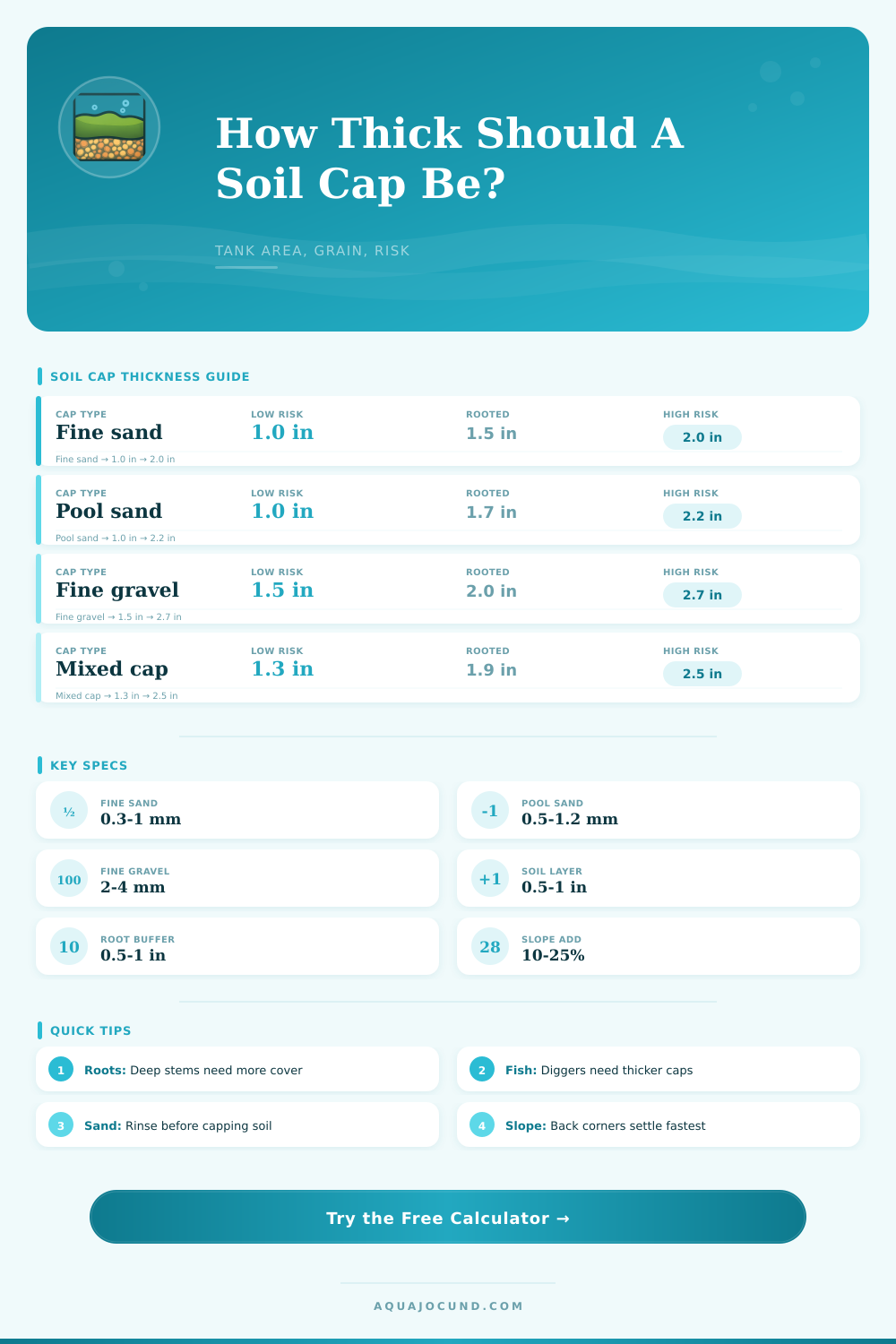
| Seal a thin 0.5 in soil layer | 1-1.25 in | 1.1-1.4 in | 1.5-1.8 in |
| Normal dirted planted tank | 1.25-1.75 in | 1.5-2 in | 2-2.5 in |
| Frequent stem replanting | 1.75-2.25 in | 2-2.5 in | 2.5-3 in |
| Heavy digger disturbance | 2.25-3 in | 2.5-3.25 in | 3-4 in |
The planted tank hobby has its own brand of frustration. You buy some aquasoil, spend hours setting it up and shaping the slope for depth. You pick out your plant according to their root structure. You fill the tank with water and start the filter. Suddenly clouds of brown dust swirl out from substrate. The grain size were wrong. Or maybe the cap layer was too thin. Almost every plant geek go through that learning curve of substrate physics.
The issue is this: Plants require air while soil requires sealing. If the cap layer are too thin, water will pushes soil particles up into gaps in your gravel or sand. This results in cloudy water and ultimately take oxygen away from plant roots (rotting them). Too much of the cap layer will form pockets that do not has enough oxygen. In these pockets harmful bacteria flourish. These bacteria produce a gas called hydrogen sulfide which instantly kill livestock. You have to balance permeability with containment.
How to Choose the Right Substrate for Your Tank
Once you input your tank dimensions into the calculator above, it takes care of the volume math. Knowing what those inputs represent prevent costly errors down the road. How does grain size affect the performance of the cap? Everything. The smaller the particle (i.e., fine sands) the tighter they fits against one another. Forming a dense barrier capable of locking soil in place even when very thin layers is used. This is great for low-tech or shrimp tanks with shallow rooted plants that is not disturbed much. But fine sand will compact. Pack it in too tightly initially and you’ll end up with a barrier that stop both water flow and gas exchange.
Coarse materials such as gravel provide more substantial spaces between grains. This increase water circulation, but soil particles can also easily slide through gaps unless the layer of cap material is quite deep. Think of it as a sieve and you’re building one, so the size of those holes determines how much material you need to stop anything from leaking out.
Note: Unless I say otherwise, I took all the photos shown above.
There’s also a variable added by the behavior of the roots themselves. Plants that carpet the substrate sends down shallow, tight-rooted mats, which constantly disturb the top few millimeters of substrate. Root feeders (e.g., crypts, swords) and stem plants tends to push their roots downward in search of nutrients toward the nutrient-rich layer of soil beneath. If you replant stems, then you’re literally punching holes in your protective barrier, each hole a potential leak point for soil fines. To account for this, you can adjust the disturbance risk in the calculator, which essentially creates a buffer zone based off how much your planting habits or livestock disturb the area. A peaceful community tank full of tetras will behave very different than a tank home to curious goldfish or digging corydoras who’ll consider your substrate as an all-you-can-dig buffet.
A slope adds extra volume, which you might underestimate. Mathematically, that slight increase in slope from front glass to back wall increases the average depth across your entire footprint. If you have a slope, add this amount so you buy sufficient gravel or sand to meet the minimum thickness recommendations, including on the shallow end right next to the front. Why do many aquarists skimp here? They think “I just need an inch of depth in the back” since the front isn’t even a half-inch! Leaks begin where the thin spot is…not necessarily the average depth. You should of looked at the slope more carefuly.
If you’re working on a second floor tank or just something larger in general, weight becomes an issue. People underestimates it. What’s the approximate bulk weight? That will tell you how much weight the stand can bear and give you an idea about the physical work involved. And that weight affects settling as well. Substrate settles. New substrate will shrink ten to twenty percent in the first few weeks. Plan ahead so you don’t accidentally expose those layers below once things have settled down.
How do I know what thickness to use? It’s not really a matter of looking at charts; it’s much more a case of matching properties of the materials to the biology that will live in them. Fine grain and gentle inhabitants mean a thin cap, while coarser media and active diggers means a thicker cap. But knowing this stuff takes time and experience, which comes from observing your individual plants in action. Go conservative, see if there are any clarity problems on your first couple water changes, and tweak as needed. Some extra sand is well worth a crystal clear tank.