Substrate Depth Slope Calculator
Calculate aquarium substrate slope angle, average bed depth, adjusted volume, bag count, and dry weight from tank footprint and front-to-back depth.
📏Footprint, Depth, And Slope Inputs
🌊Substrate Comparison Grid
📋Slope Angle Reference
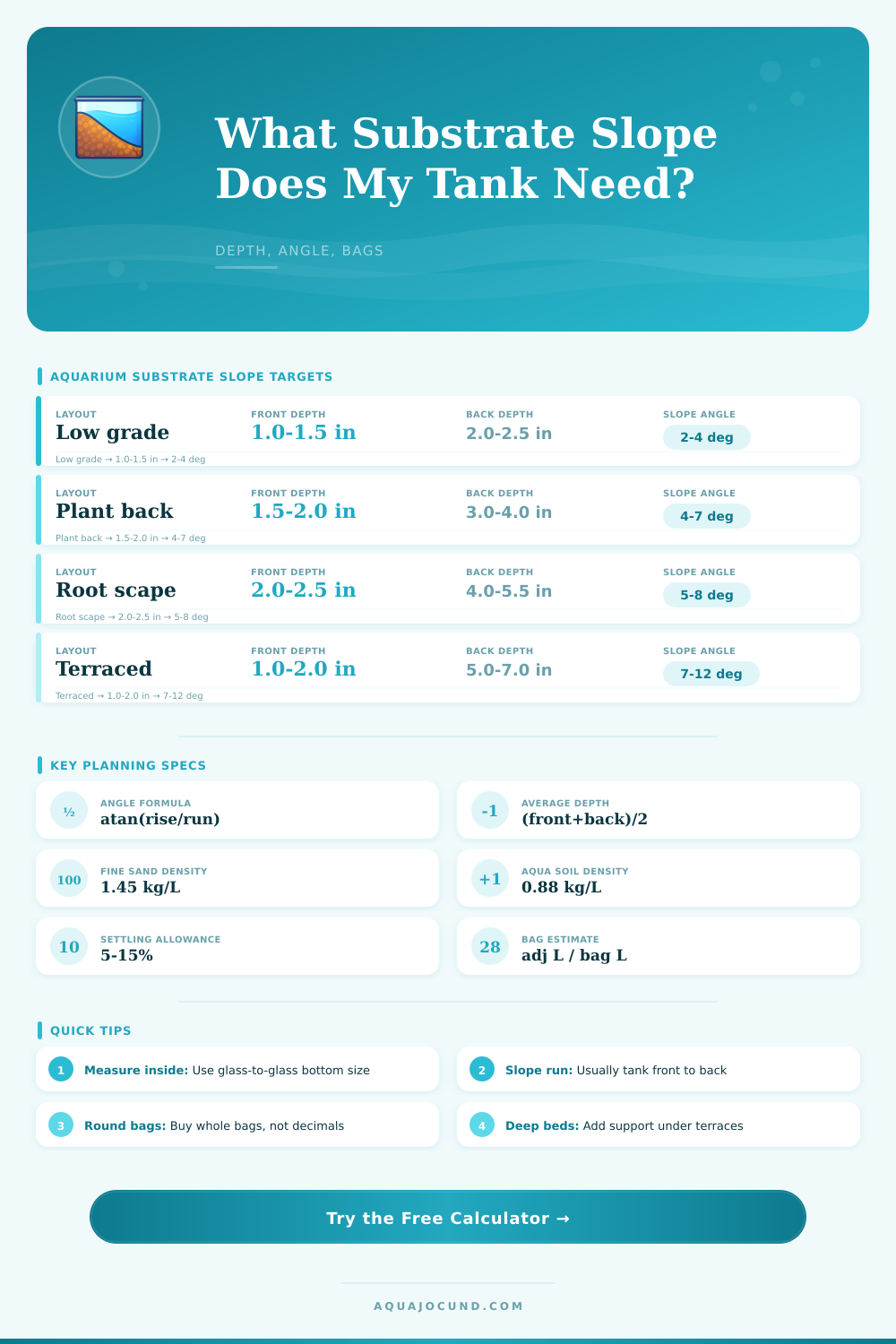
| Angle Range | Rise Over 12 in Run | Common Use | Planning Note |
|---|---|---|---|
| 1-3 deg | 0.2-0.6 in | Subtle visual grade | Easy to maintain with sand or gravel |
| 3-6 deg | 0.6-1.3 in | Most planted background slopes | Works well with roots and foreground clearance |
| 6-9 deg | 1.3-1.9 in | High rear plant bed | Use structure if fish or flow push the substrate |
| 9-12 deg | 1.9-2.6 in | Terraced aquascape base | Plan rock edges, mesh, or retaining lines |
| 12 deg plus | 2.6 in plus | Special hardscape mound | Usually needs physical support to hold shape |
💧Common Tank Slope Estimates
| Tank | Inside Footprint | 1.5 to 3 in Slope | 2 to 4 in Slope |
|---|---|---|---|
| 5.5 gallon | 16 x 8 in (41 x 20 cm) | 4.7 L raw, 10.6 deg | 6.2 L raw, 14.0 deg |
| 10 gallon | 20 x 10 in (51 x 25 cm) | 7.4 L raw, 8.5 deg | 9.8 L raw, 11.3 deg |
| 20 gallon long | 30 x 12 in (76 x 30 cm) | 13.3 L raw, 7.1 deg | 17.7 L raw, 9.5 deg |
| 29 gallon | 30 x 12 in (76 x 30 cm) | 13.3 L raw, 7.1 deg | 17.7 L raw, 9.5 deg |
| 40 breeder | 36 x 18 in (91 x 46 cm) | 23.9 L raw, 4.8 deg | 31.9 L raw, 6.3 deg |
| 55 gallon | 48 x 13 in (122 x 33 cm) | 23.0 L raw, 6.6 deg | 30.7 L raw, 8.7 deg |
| 75 gallon | 48 x 18 in (122 x 46 cm) | 31.9 L raw, 4.8 deg | 42.5 L raw, 6.3 deg |
| 125 gallon | 72 x 18 in (183 x 46 cm) | 47.8 L raw, 4.8 deg | 63.7 L raw, 6.3 deg |
⚙Substrate Density And Slope Behavior
| Substrate | Typical Density | Slope Holding | Compaction Guide |
|---|---|---|---|
| Aquarium aqua soil | 0.75-0.95 kg/L | Good when planted, can roll at steep faces | 10-15% |
| Fine inert sand | 1.35-1.55 kg/L | Smooth grades flatten with flow and digging | 8-12% |
| Pool filter sand | 1.45-1.60 kg/L | Stable at mild angles, poor for steep mounds | 6-10% |
| Rounded gravel | 1.45-1.65 kg/L | Coarse pieces roll unless contained | 4-8% |
| Crushed coral or aragonite | 1.20-1.45 kg/L | Irregular pieces grip better than round gravel | 5-9% |
| Crushed lava rock | 0.55-0.85 kg/L | Excellent hidden support for high rear slopes | 5-8% |
| Mineral soil with cap | 0.95-1.15 kg/L | Needs cap thickness at the front and rear | 12-18% |
| Planted mineral mix | 1.05-1.25 kg/L | Moderate holding with roots or retaining edges | 9-13% |
⛏Allowance Planning Table
| Adjustment | Typical Range | Use More When | Use Less When |
|---|---|---|---|
| Buried displacement | 0-25% | Rock bases, wood feet, crates, or mesh fill the bed | The footprint is open and evenly filled |
| Compaction and settling | 5-15% | Fine sand, soil, rinsed media, or deep rear beds settle | Coarse gravel or lava structure keeps voids |
| Shaping reserve | 5-20% | You want extra height at corners or room to re-sculpt | The slope is simple and bag rounding already adds extra |
| Steep-slope support | Needed above 9 deg | Fish dig, flow is strong, or the mound is exposed | Plants, stone edges, or retaining strips hold the bed |
The root of most aquascaping problems starts long before any plant gets into water. Maybe you spread a substrate that’s too thin across the tank floor or perhaps you use a thick layer that causes your stand to groan from the weight. The true design occurs when you plan for the slope and depth of the bed. Will the roots suffocate in shallow gravel? Or will they breathe easy?
Once you know your tank dimensions, the calculator above takes care of the geometry. You won’t have to guess how many bag are required to fill the uneven space between glass walls.
Planning Your Substrate
Start with the material. How does your substrate behave under water? Under pressure? Fine sand compacts significantly more than coarse gravel; meaning you’ll need more starting material to get to the same finished depth after it settle. Some aqua soils expand during wetting, others shrinks over time as they break down. The calculator takes such differences in density into account by default. It will adjust its weight estimates accordingly. This way you won’t be surprised by how heavy loads are when you carry them into your house.
While something like pool filter sand may look like similar volume on paper compared to a light mineral mix, it’s much denser and creates a very different kind of structural load on your stand. Most folks forgets about this aspect until they hear their floorboards starting to creak.
It’s just trigonometry used in making things look good. It’s creating a gradual incline with a deeper portion toward the rear (where plants anchor roots) and shallower up front (for easier upkeep). That slope determine the angle. Aka the “rise over run” ratio. A steeper grade conserves area; a gentle grade looks good but must be wider horizontally to provide sufficient depth.
How do you know if the angle is too extreme? If fish swim by or water pushes against it, the plant might slide down. That’s why table on the page outlines how changing just a few degrees can make a design go from stable to not-so-stable. And the calculator converts your back and front depth requirements to exact angle so you see if this thing will stand up to water pressure or not.
It’s easy to lose track of volume displacement (i.e., substrate doesn’t replace physical space taken by rocks, wood bases, etc.). Mesh support, rock, driftwood. All those things occupies space. Sure, they can be covered with substrate. But if you build a large hardscape centerpiece, you’ll have oddly shaped leftover spaces for the substrate that are much smaller than tank’s total surface area would suggest.
In fact, the software let you enter a percentage of what you want deducted for rocks, driftwood, and other hardscape. That way, you won’t buy more than needed which ends up collecting dust in a closet. Plus, it leaves room for shaping and compaction. Because humans aren’t machines, we make substrates beds that aren’t even. Also, substrate settles. Buying bags whole forces you to round up a bit, and that ensures you don’t compromise your plan during reshaping.
That’s where the trick comes in, juggling these factors before even cracking the first bag. If you have a steep backside (more than a nine degree slope), then you’ll need to add some structure, while also providing nutrients to the plant from a deep bed of food. Otherwise, water flow and gravity will smooth out what you’ve built into a flat surface over time. You could of prevented this by using rocks held in place or buried lava rock foundations to anchor it down.
It isn’t rocket science, literally (mathematically) speaking. But it does require knowing something about how things like flow and weight interact with each other within a limited space, like the limits of a glass box. The numbers show you where to go but your eyes keep the image in motion. Get the foundation correct…and the rest of it falls into place.
Planting happens naturaly next. The depth you give it determines how far up it goes on the slope, and it fills in where you made the curves. Once the slope stands up to time and force of flow…it all works.