Substrate Volume Liter Calculator
Estimate aquarium substrate liters from tank footprint, front and back depth, slope, displacement, material density, and bag size.
📏Tank Footprint And Bed Inputs
🌊Substrate Material Comparison
📋Bulk Density And Bag Reference
| Material | Typical Bulk Density | Common Bag Volume | Planning Note |
|---|---|---|---|
| Aquarium aqua soil | 0.75-0.95 kg/L | 8-9 L | Light granules settle and crush over time |
| Fine inert sand | 1.35-1.55 kg/L | 5-10 L | Fine grains need a settling allowance |
| Pool filter sand | 1.45-1.60 kg/L | 10-25 kg bags | Weight listed bags need density conversion |
| Rounded gravel | 1.45-1.65 kg/L | 5-20 L | Voids stay larger than compact sand |
| Crushed coral or aragonite | 1.20-1.45 kg/L | 5-10 L | Irregular particles vary by moisture |
| Crushed lava rock | 0.55-0.85 kg/L | 5-20 L | Porous base layer uses much less weight |
| Mineral soil with cap | 0.95-1.15 kg/L | Mixed layers | Calculate total volume before splitting layers |
| Planted mineral mix | 1.05-1.25 kg/L | 5-10 L | Often heavier than aqua soil granules |
💧Common Tank Size Guide
| Tank | Inside Footprint | 1.5 in Front / 3 in Back | 2 in Front / 4 in Back |
|---|---|---|---|
| 5.5 gallon | 16 x 8 in (41 x 20 cm) | 4.7 L before allowance | 6.2 L before allowance |
| 10 gallon | 20 x 10 in (51 x 25 cm) | 7.4 L before allowance | 9.8 L before allowance |
| 20 gallon long | 30 x 12 in (76 x 30 cm) | 13.3 L before allowance | 17.7 L before allowance |
| 29 gallon | 30 x 12 in (76 x 30 cm) | 13.3 L before allowance | 17.7 L before allowance |
| 40 breeder | 36 x 18 in (91 x 46 cm) | 23.9 L before allowance | 31.9 L before allowance |
| 55 gallon | 48 x 13 in (122 x 33 cm) | 23.0 L before allowance | 30.7 L before allowance |
| 75 gallon | 48 x 18 in (122 x 46 cm) | 31.9 L before allowance | 42.5 L before allowance |
| 125 gallon | 72 x 18 in (183 x 46 cm) | 47.8 L before allowance | 63.7 L before allowance |
⛏Depth And Slope Planning
| Layout | Front Depth | Back Depth | Average Depth Used |
|---|---|---|---|
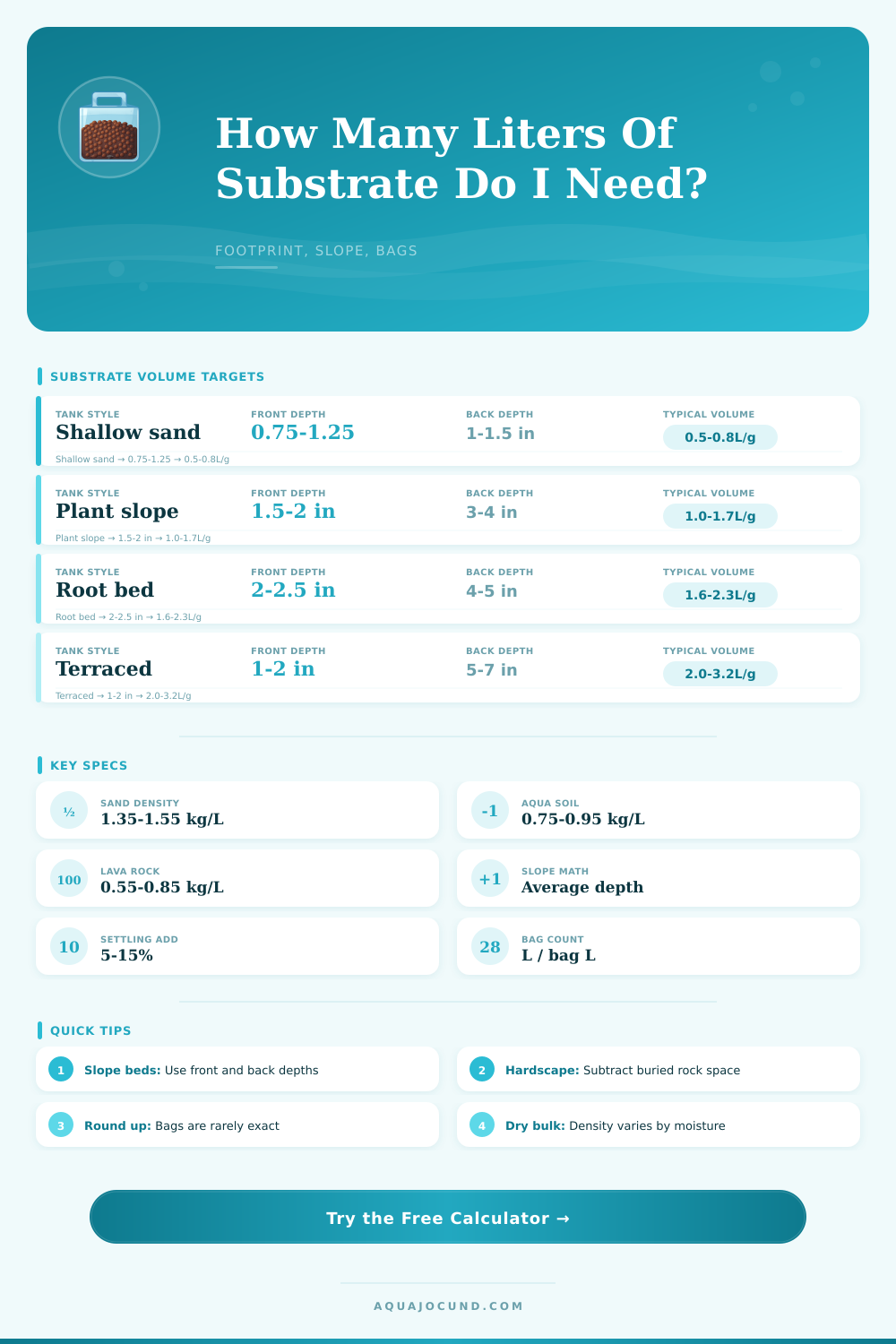
| Cosmetic sand strip | 0.5-1 in (1.3-2.5 cm) | 0.75-1.25 in (1.9-3.2 cm) | 0.6-1.1 in (1.6-2.9 cm) |
| General low-tech bed | 1-1.5 in (2.5-3.8 cm) | 2-2.5 in (5.1-6.4 cm) | 1.5-2 in (3.8-5.1 cm) |
| Planted stem slope | 1.5-2 in (3.8-5.1 cm) | 3-4 in (7.6-10.2 cm) | 2.25-3 in (5.7-7.6 cm) |
| Root-heavy background | 2-2.5 in (5.1-6.4 cm) | 4-5 in (10.2-12.7 cm) | 3-3.75 in (7.6-9.5 cm) |
| Terraced aquascape | 1-2 in (2.5-5.1 cm) | 5-7 in (12.7-17.8 cm) | 3-4.5 in (7.6-11.4 cm) |
⚙Allowance Reference
| Adjustment | Typical Range | Use More When | Use Less When |
|---|---|---|---|
| Buried hardscape displacement | 0-25% | Large rock bases or mesh platforms occupy the bed | The substrate covers a plain empty footprint |
| Settling and compaction | 5-15% | Fine sand, soil, rinsed media, or deep slopes settle | Coarse gravel or porous rock keeps larger voids |
| Extra shaping reserve | 5-20% | You need raised corners, paths, or replanting buffer | The layout is flat and the bag size rounds up cleanly |
| Bag rounding | Always round up | Exact volume lands close to the next whole bag | You already own matching leftover substrate |
If you’re wondering how many liters of substrate to put in your fish tank, this calculator ends that guesswork. It turns those hazy estimates into exact measurements that you know are accuratey. You select your gravel or sand, measure out your tank, and when it comes time to check out at the register (the math starts to get fuzzy). With this calculator, you’ll always have just the right amount for your set-up.
Substrate covers the floor and provides a 3 dimensional space for plant roots and bacteria. Aquatic plants needs something to anchor into and get nutrition from, which is why most people think of it like a flat carpet over bottom. If you underestimate how much your tank need vertically, then it will look thin and have trouble holding its shape as things settle.
How to Use the Fish Tank Substrate Calculator
For rectangular standard tanks (or even curved bowls that don’t conform to easy length x width formulas), the calculator takes care of the geometry for you.
If you’re doing a sloped bed, you’ll use more substrate than on a flat bed. A slope causes the substrate to run deeper at the back corner (where you have more area) compared to front edge. Your perspective also makes the change in height look smaller then it actualy is. For a straight incline, the calculator estimates volume by averaging the depth at the front and the back.
Back. This way, you only enter the two extremes: the shallowest part close to the glass and the deepest part touching the back wall. Then, the system will calculate the rest.
Every item buried, be it a driftwood branch, rock, cave, etc., decreases the amount of volume for your tank since each object takes up space that can’t be filled by sand., decreases the amount of surface area for your tank since each object takes up space that can’t be filled by sand. For example, if your tank layout include lots of rock bases, then all that rock displaces the area that could of been covered with substrate. You don’t want to buy more than what’s needed to cover empty areas surrounding your décor, so the calculator lets you account for this lost space. This saves you money and the inconvenince of lugging around unnecessary bags.
Eventually the aqua soil and fine sand compact over time. As they settle, surface drops. If there is no reserve to buffer this, you’ll see your slope flattened in weeks and exposed roots. If there is no reserve to buffer this, you’ll see your slope flattened in weeks and exposed roots. The tool allows for inputs of shaping reserves and settling allowances to ensure that you has enough material to maintain the look once laid out. These are actual percentages of how these things behave in the real world with growth of plants and water weight on them, not some arbitrary guess.
Weight is how much the material weighs. This determines how hard it’s going to be to move and lift. For example, one bag of silica sand might weigh the same as another filled with lava rock, yet the former is considerably lighter than the latter. Understanding the material’s bulk density allows you to plan accordingly when moving and picking up bags of substrate. The tables on this page contains this information so you can know how much your haul will weigh.
If you plan carefully, then your aquarium set-up will not be a guessing game. Knowing exactly how many liters you need means you can walk into the store with confidence and return home without buying things you don’t need. It’s the difference between a disorganized experiment and a thoughtful aquascape, there’s no wasted space; each grain has its spot. The numbers are exact and explicit, the result is in your hands.