Aquarium LED Count Calculator
Estimate how many LED fixtures, bars, modules, or spot units you need from tank footprint, output rating, PAR goal, beam angle, mounting height, and plant demand.
💡LED Count Presets
📐Tank, LED, and PAR Inputs
LED Count Results
⚙LED Type Comparison
| LED type | Typical use | Lumens per watt | PAR behavior |
|---|---|---|---|
| Basic white strip | Viewing, moss, epiphytes | 80-110 | Efficient but shallow punch |
| Full spectrum planted bar | Most planted aquariums | 75-100 | Balanced spread and color |
| RGB planted bar | Color plants and display tanks | 55-85 | Lower lumens but strong plant spectrum |
| COB module | DIY arrays and pendant builds | 90-130 | High center output, needs spacing |
| Lens spotlight | Deep tanks, ripples, accents | 70-105 | Strong punch with narrow coverage |
| Wide panel LED | Even coverage over shallow tanks | 80-115 | Best uniformity, lower shimmer |
| Reef puck LED | Marine and mixed reef tanks | 45-75 | High PAR in blue-heavy spectrum |
| Waterproof flood LED | Utility, sump, pond edge | 85-120 | Broad output, less spectrum control |
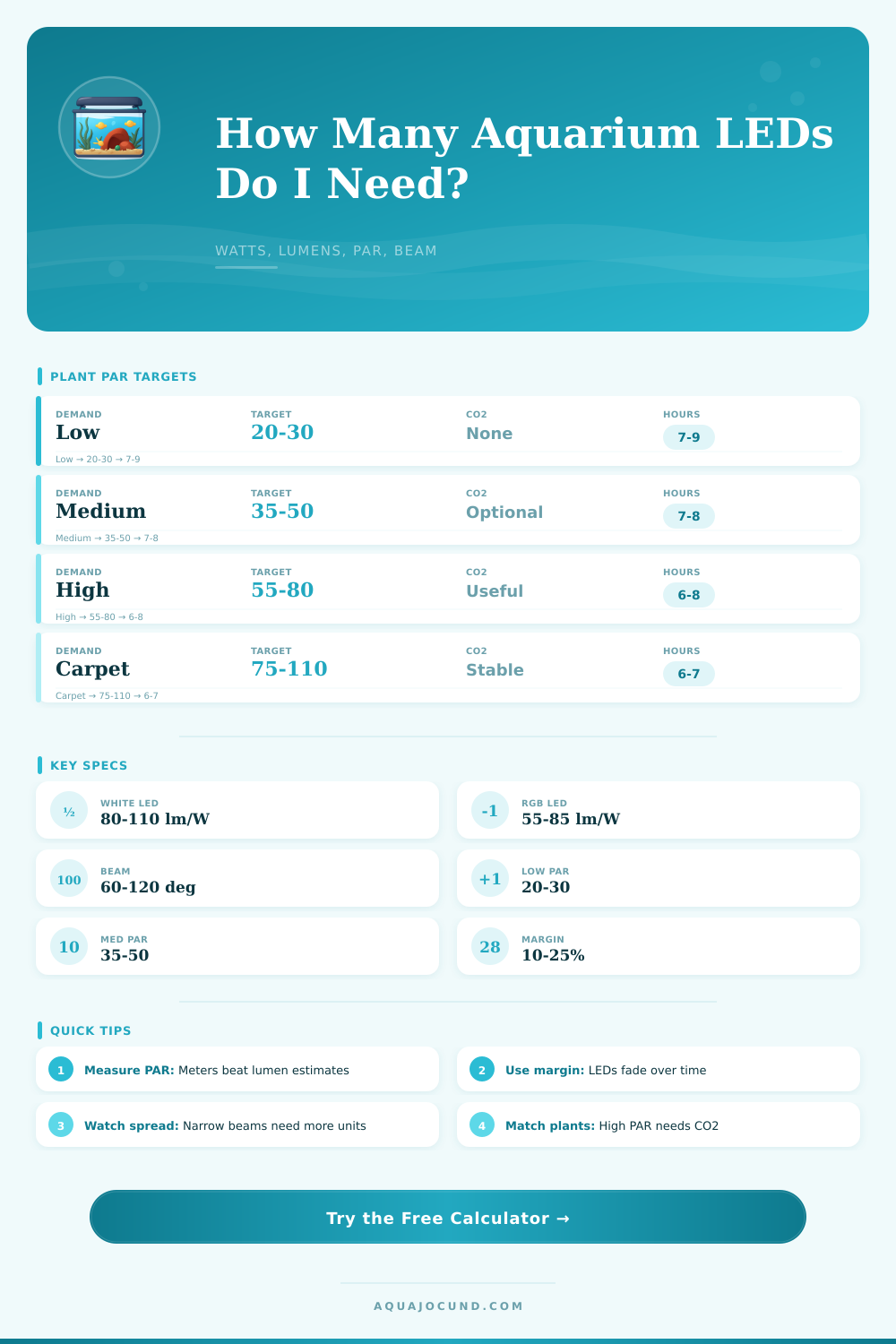
🌿PAR Demand Targets
| Demand | Substrate PAR target | Typical photoperiod | Notes |
|---|---|---|---|
| Viewing only | 8-18 PAR | 6-10 hours | Brightness for fish viewing, not plant growth |
| Low light plants | 20-30 PAR | 7-9 hours | Anubias, moss, fern, crypts |
| Medium planted tank | 35-50 PAR | 7-8 hours | Most stems, swords, rosettes |
| High light stems | 55-80 PAR | 6-8 hours | CO2 stability becomes important |
| Carpet aquascape | 75-110 PAR | 6-7 hours | Requires strong spread and stable CO2 |
| Mixed reef target | 90-160 PAR | 7-10 hours | Use coral-specific PAR mapping when possible |
📏Common Tank Size Examples
| Tank | Dimensions | Footprint | Typical LED count range |
|---|---|---|---|
| 5.5 gal | 16 x 8 x 10 in / 41 x 20 x 25 cm | 128 sq in / 826 sq cm | 1 small strip or module |
| 10 gal | 20 x 10 x 12 in / 51 x 25 x 30 cm | 200 sq in / 1290 sq cm | 1 bar, 1-2 modules |
| 20 long | 30 x 12 x 12 in / 76 x 30 x 30 cm | 360 sq in / 2323 sq cm | 1 long bar, 2 spot units |
| 29 gal | 30 x 12 x 18 in / 76 x 30 x 46 cm | 360 sq in / 2323 sq cm | 1-2 bars for depth |
| 40 breeder | 36 x 18 x 16 in / 91 x 46 x 41 cm | 648 sq in / 4181 sq cm | 1 wide panel or 2 bars |
| 75 gal | 48 x 18 x 21 in / 122 x 46 x 53 cm | 864 sq in / 5574 sq cm | 2 bars or 3-4 puck units |
| 125 gal | 72 x 18 x 21 in / 183 x 46 x 53 cm | 1296 sq in / 8361 sq cm | 3 bars or 4-6 modules |
🔍Beam Angle and Mounting Reference
| Beam angle | Best role | Spread result | Count effect |
|---|---|---|---|
| 30-45 degrees | Deep spotlight | Small cone, high center PAR | More units for even coverage |
| 60 degrees | Pendant or puck light | Medium cone with visible shimmer | Moderate count, careful spacing |
| 90 degrees | Most bars and panels | Good coverage at common heights | Balanced count for planted tanks |
| 120 degrees | Wide strip or panel | Broad spread, lower center punch | Fewer shadows, may need wattage |
| 150+ degrees | Very diffuse light | Wide spill outside narrow tanks | Good uniformity, less depth reach |
I’m sure you’ve noticed ads for tank lighting featuring attractive blue LED strips that will fit into a tank of any dimension. High wattage assures good growth and perfect color, they promise! But one error many beginning aquarists make is purchasing lighting by wattage rather than planning their light delivery. How much electricity does it consume? That’s what watts tell you. They don’t reveal how much usable photosynthetically active radiation hits your substrate. Knowing the distinction save you money and keeps algae outbreaks away.
After you input your plant requirements and the footprint of your tank along with its beam angle, the calculator do all the math for you. There’s no need to guess about how many units is necessary to cover the tank’s surface area evenly. Common sense might tell you that a single high-output bar will light a long tank equally well, but how light works don’t agree. The farther away you get from the light source, the more intensity it loses. Why? This happens because of something called the inverse square law. This basically means the corners of your aquarium often recieve only a fraction of the light found in the tank’s center.
Why Watts Are Not Enough for Your Tank Light
Therefore, multiple lower-output fixtures tend to work best compared to a single powerful unit. They’ll provide even coverage, this avoids hotspots that can stress your livestock and promote biological growth in the middle of your tank.
How much light do you need? This is mostly about which plants you’re growing, not how big your tank is. Light requirements vary widely based off plant choice: A carpet of red stem plants at the bottom of a 40 long will require much higher photon flux (PAR) then a single clump of moss in a nano cube. Selecting your actual plant demand from the tool allows it to adjust accordingally. For instance, if you select high light plants, which grow quickly and voraciously, then it will calculate higher target PAR numbers to reflect the fact that they want their leaves consistently saturated. Conversely, low light plants such as Java Fern or Anubias prefers more gentle light levels that mimic shaded forest floors. To prevent overpowering delicate plants with lights designed to compete for space, make sure you adjust the light intensity to suit their biology.
The other variable that catches folks off guard is beam angle. Some lamps like these use a narrow spot lens which produces a bright cone of light that puts a shimmery pattern on the gravel. It looks cool from afar, but it casts big chunks of the tank into darkness (unless you space multiple unit carefully). Other lamps use wider panels and they spread that same amount of total output more broadly. It dims the most intense areas at any one spot but makes the overall look more uniform. Biologically speaking, this is better for evenness. Visually, it’s less dramatic. That’s an optics-based tradeoff: Do you want more punch or more spread?
This calculator takes the geometry into account and lets you visualize what number of fixtures it will take to get your desired PAR levels throughout the entire water column. There’s another hidden factor regarding light delivery, water clarity. Before light reaches plant leaves, it passes through particles in the water which scatter and absorb light. Essentially, these particles reduces the available output of even high-end LED arrays. So if you’re running a bit of haze due to recent water changes or some tannins from your driftwood, more light will be lost to absorption compared to someone running clear water. By taking this into account, you could of avoid having too little light in your setup and seeing the light blocked by the water instead of by a lack of equipment. A little buffer built into your calculation will help offset this expected decline. That way even on cloudy days or days where your maintenance is a tiny bit late, your plants is still getting plenty of juice.
It’s not just about having more light! The goal is balanced light (for proper photosynthesis) and consistent light (to support the metabolism of the plants you’ve selected). Light should never be so much as to produce excess energy (excess energy = excess nutrients = algae blooms!). While using a hand held light meter to read actual PAR at the substrate level is always the gold standard, these are estimates and thus can still be used to create appropriate plans. Begin low and see what happens after a few weeks. Then adjust how long and how much light you provide based on how fast the plants are actually growing compared to how fast they could grow with maximum light.
Slow and steady good growth = good lights. Good lights reward patience with healthy-looking plants and stable water parameters. Good lights also make maintenance doable by all parties involved.