Photoperiod Calculator for Planted Tanks
Estimate daily light hours from PAR, CO2, nutrients, plant mass, algae pressure, and ramp timing.
Recommended schedule
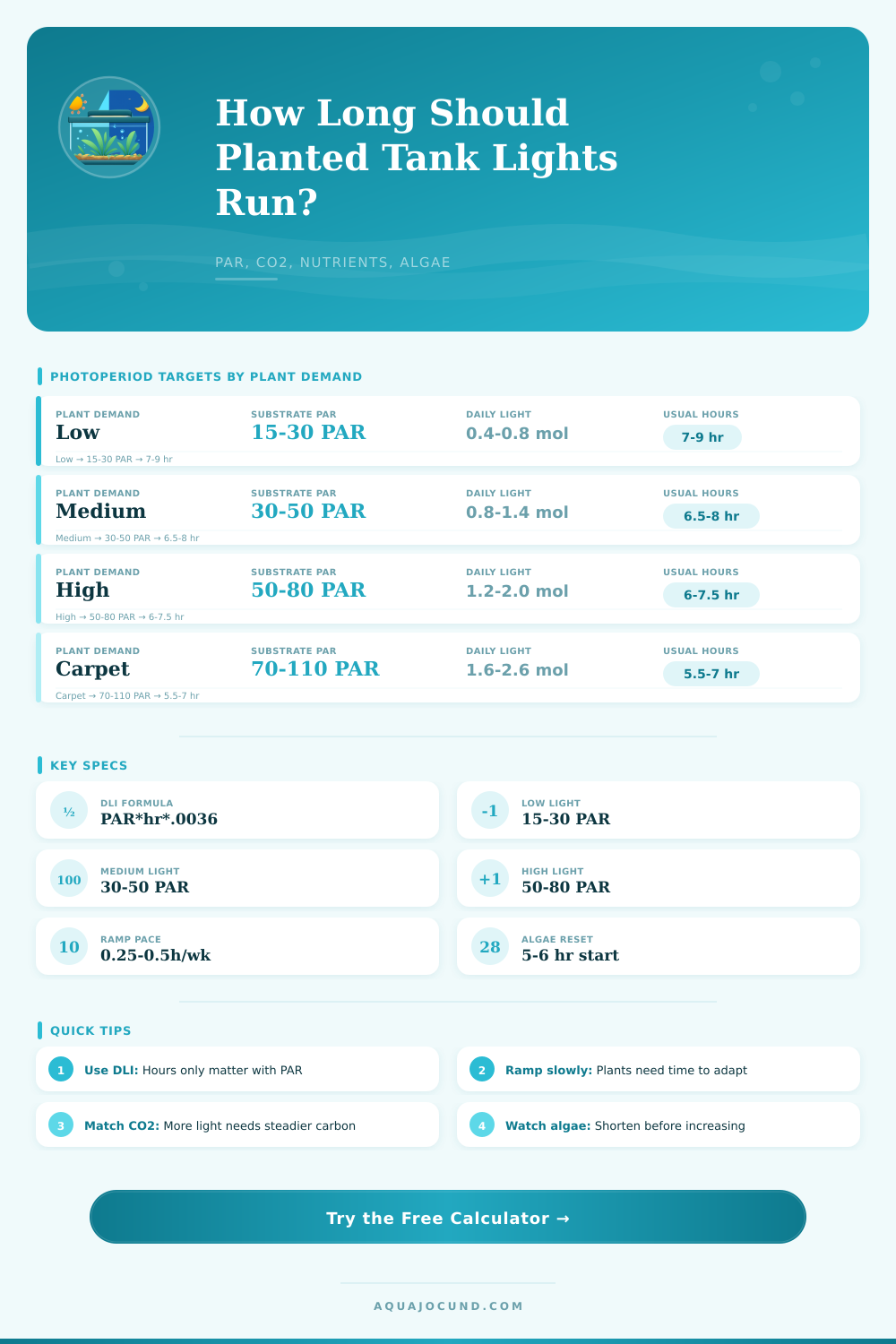
| Plant group | Substrate PAR | DLI target | Common photoperiod | CO2 expectation |
|---|---|---|---|---|
| Anubias, Java fern, Buce | 15-30 PAR | 0.35-0.85 mol/m²/day | 7-9 hr | Not required |
| Crypts, moss, easy stems | 25-45 PAR | 0.7-1.25 mol/m²/day | 6.5-8 hr | Helpful but optional |
| Fast stems and color plants | 45-75 PAR | 1.2-2.0 mol/m²/day | 6-7.5 hr | Recommended |
| Carpets and dense Dutch tanks | 70-110 PAR | 1.6-2.7 mol/m²/day | 5.5-7 hr | Stable injection |
| Condition | Safe light effect | Photoperiod cue | Risk note |
|---|---|---|---|
| No added CO2 | Caps high PAR DLI | Usually 6-8 hr | Long bright days often trigger algae |
| Stable injected CO2 | Raises usable DLI | 6-8 hr can work | Gas timing should precede lights |
| Lean nutrients | Narrows upper range | Shorten by 0.25-1 hr | Deficiency and algae can overlap |
| EI style dosing | Supports higher uptake | Match CO2 before extending | Water changes keep margin wide |
| Immature tank | Temporarily lowers target | Start near 5-6 hr | Increase only after stable growth |
| Tank example | Volume | PAR range | Typical target | Ramp style |
|---|---|---|---|---|
| Low tech nano | 5-10 gal / 19-38 L | 15-30 PAR | 7-8 hr | 0.25 hr weekly |
| 20 gal mixed plants | 20 gal / 76 L | 30-50 PAR | 6.5-7.5 hr | 0.25-0.5 hr weekly |
| 40 breeder stem tank | 40 gal / 151 L | 45-75 PAR | 6-7 hr | 0.5 hr weekly |
| High tech carpet tank | 20-75 gal / 76-284 L | 70-110 PAR | 5.5-7 hr | 0.25 hr after trim or algae |
| Situation | Starting window | Increase size | Hold before next step |
|---|---|---|---|
| New aquascape | 5-6 hr | 0.25 hr | 5-7 days |
| Healthy established tank | Current schedule | 0.25-0.5 hr | 7 days |
| After heavy trimming | Reduce 0.5-1 hr | 0.25 hr | 5-10 days |
| Active algae cleanup | 5-6 hr | None until stable | 10-14 days |
Green water = death (or at least an algae-covered planted tank failure) by way of most other causes. So you dose your fertilizers on time, use the proper bulbs, and wait for a lush carpet of plants. Algae shows up instead. Rarely is it equipment’s fault. Almost always, it’s length of light cycle. More means better…right? Wrong! Aquatic plants is not like field crops or even houseplants. What works in one environment doesn’t necessarily work in another.
Plants crave carbon and intensity as much as they do time. However, instead of guessing about how your schedule compares with safety, plug your CO2 and substrate PAR values into the calculator at the top of this page, and it’ll do all the work for you. It calculates your Daily Light Integral, the amount of photosynthetically active radiation (PAR) a plant experiences in any 24-hour period. Since plants can handles more light during fewer hours or less intense light spread throughout longer periods, it also factors that in. It multiplies your time and PAR values. It then returns a target number of hours for you based off the gas and nutrient levels in your tank.
How to Stop Algae in Your Aquarium
Many hobbyists think of light as an on/off switch. They blast their fixtures at full power from dawn to dusk. Then they complain about cyanobacteria blooms occurring overnight. Changing lights and/or increasing CO2 without adjusting photoperiod is asking for trouble. Plants are slow adapters! Gradually increase the length of time the lights are on. Increase the time by small amounts over several weeks, as tool suggests. This gives time for plant biomass to develop and soak up excess nutrients before algae has a chance.
Slow process? Yes. But patience lead to a stable aquarium. Everything depend on the carbon. This formula revolves around carbon dioxide as well. Without consistent injection, plants reaches a metabolic limit very rapidly. Increasing your light duration without increasing your carbon won’t increase your growth. Doing so just leaves excess energy in water column which feeds algae, not stems. If you select no or low added CO2, the calculator will reduce its recommendations to match. This recognizes biological fact that you need to match your light duration with what your system can actualy process. You can’t cheat the chemistry. If there’s no carbon, the lights goes off sooner.
Similarly, a tank that maintains consistent lean parameters have less margin for error. A fluctuating environment will support opportunist algal growth and impede growth of slower growing plant species. Your dosing method (high dose EI or simpler low tech fertilizer regimes) matter too. The amount of time you can safely run lights before reaching an unsafe level depends on this. That is why it is factored into the tool. It is not just about how much light you have, but how well your nutrient regime support that light.
The last test for greedy is algae. If you’re noticing anything like fuzz on your hardscape or dust on your leaves, the calculator suggest shortening the day. That’s counterintuitive; who doesn’t want more of something? But here you must break the chain and let algae have no chance at winning. Because algae can beat plants for resources in long days, it win. So cut down the hours, starve the algae, and maintain sufficient light to sustain healthy plant. Maintain this shorter regimen until the nuisance goes away, then slowly ramp up again.
On the page itself it lays out the reference tables for various types of plantings… Ranging from high-tech carpet tanks to low-tech moss scapes, with their respective PAR ranges and target hours. And you don’t want to grow as fast as you can at any cost. You want to hit the sweet spot where plants are happy but don’t invite competition. That’s what this tool does: It tells you your number.
Now go do it.