Planted Tank Light Intensity Calculator
Estimate substrate PAR, average spread, lumen and watt targets, DLI, and photoperiod fit from tank depth, fixture type, plant demand, and CO2 level.
💡Planted Light Presets
📐Tank, Fixture, and Plant Inputs
Planted Tank Light Estimate
🌱Plant Light Demand Comparison
📊Fixture Profile Reference
| Profile | Typical 12 in PAR | Beam spread | Use case |
|---|---|---|---|
| Low output LED strip | 35-60 center PAR | 110° wide | Low light shallow tanks |
| Standard planted LED bar | 70-110 center PAR | 120° wide | Most low to medium planted tanks |
| High output RGB planted bar | 120-190 center PAR | 115° wide | CO2 tanks and red stems |
| T5HO twin tube | 95-150 center PAR | 130° broad | Even spread over long tanks |
| Wide panel LED | 80-140 center PAR | 140° broad | Cube tanks and wide aquascapes |
| Narrow pendant spotlight | 170-260 center PAR | 70° focused | Deep tanks with smaller footprint |
| Waterproof flood style LED | 60-120 center PAR | 100° medium | Utility or riparium lighting |
| Custom measured fixture | User entered | 100° default | Use PAR meter or fixture map data |
📏Common Tank Light Starting Points
| Tank size | Dimensions | Volume | Typical planted target |
|---|---|---|---|
| 5.5 gallon | 16 x 8 x 10 in / 41 x 20 x 25 cm | 21 L | 15-35 PAR, 300-700 lumens |
| 10 gallon | 20 x 10 x 12 in / 51 x 25 x 30 cm | 38 L | 20-45 PAR, 700-1400 lumens |
| 20 long | 30 x 12 x 12 in / 76 x 30 x 30 cm | 76 L | 30-70 PAR, 1500-3000 lumens |
| 29 gallon | 30 x 12 x 18 in / 76 x 30 x 46 cm | 110 L | 35-80 PAR, 2200-4200 lumens |
| 40 breeder | 36 x 18 x 16 in / 91 x 46 x 41 cm | 151 L | 35-80 PAR, 3000-5500 lumens |
| 75 gallon | 48 x 18 x 21 in / 122 x 46 x 53 cm | 284 L | 40-90 PAR, 5500-9500 lumens |
⏱PAR and Photoperiod Guide
| Average substrate PAR | 6 hr DLI | 8 hr DLI | CO2 and nutrient note |
|---|---|---|---|
| 15 PAR | 0.32 mol/m2/day | 0.43 mol/m2/day | Suitable for slow low-light plants |
| 30 PAR | 0.65 mol/m2/day | 0.86 mol/m2/day | Good low-tech planted range |
| 50 PAR | 1.08 mol/m2/day | 1.44 mol/m2/day | Medium demand, steady nutrients |
| 75 PAR | 1.62 mol/m2/day | 2.16 mol/m2/day | Stable CO2 strongly recommended |
| 100 PAR | 2.16 mol/m2/day | 2.88 mol/m2/day | High-tech range with tight balance |
🔍Depth and Spread Adjustment Guide
| Factor | Low impact | Moderate impact | High impact |
|---|---|---|---|
| Water depth | 8-12 in / 20-30 cm | 13-18 in / 33-46 cm | 20+ in / 51+ cm |
| Mounting height | 0-2 in / 0-5 cm | 3-6 in / 8-15 cm | 8+ in / 20+ cm |
| Fixture spread | Beam covers tank width | Edges slightly dim | Spotlight center hotspot |
| Surface obstruction | 0-10% | 15-30% | 40%+ blocked or shaded |
| Water color | Polished clear | Light tannins | Dark tint or haze |
You’ve installed your new lights over the tank, waited… and hoped. But unfortunatly, those stem plant aren’t looking anything like the lush forest pictured in the product photo. Instead, they’re reaching for the sky, like some sort of desperate plant survivors. Algae grow on the glass. This isn’t normally about the bulb. More often than not, it’s a matter of mismatch: What the light offers vs. It is what water column will let through.
Aquarium lighting are never a constant amount. It’s a moving target defined by the clarity, depth, and even the particular growth needs of your greenery. Light output (watts, lumens) is where most hobbyists begin, but they’re a measure of the source, not the destination. A high-wattage bulb isn’t impressive if half its energy are lost due to distance or absorbed by tannin-stained water.
Understanding Aquarium Lighting Needs
To account for this, we plugged in your fixture specs and tank dimensions into calculator above and let the math do the work for you (no need to guess about conversions and coefficients). It converts raw output into PAR at the substrate, i.e., what actualy reaches the root zone, the real currency of plant growth. This change in perspective make all the difference because you are not just buying power; you are buying light that actually reaches the root zone.
Light intensity also depends greatly on how deep water is. Every inch of water will soak up part of the spectrum. This include the red part, which is what colored stems want to take pigment from. Your low angle fixture might light middle of your tank perfectly well. However, all that light can gets absorbed before it reach the edges, leaving them starved.
In this case, the tool factors in the spread and calculates an estimate of average coverage over footprint. This reminds you that while peak intensity is important, uniformity are also important. Having a nice hot spot in the middle does you no good if foreground carpet remains in shadow, and so again you should of consider the average and not just the maximum.
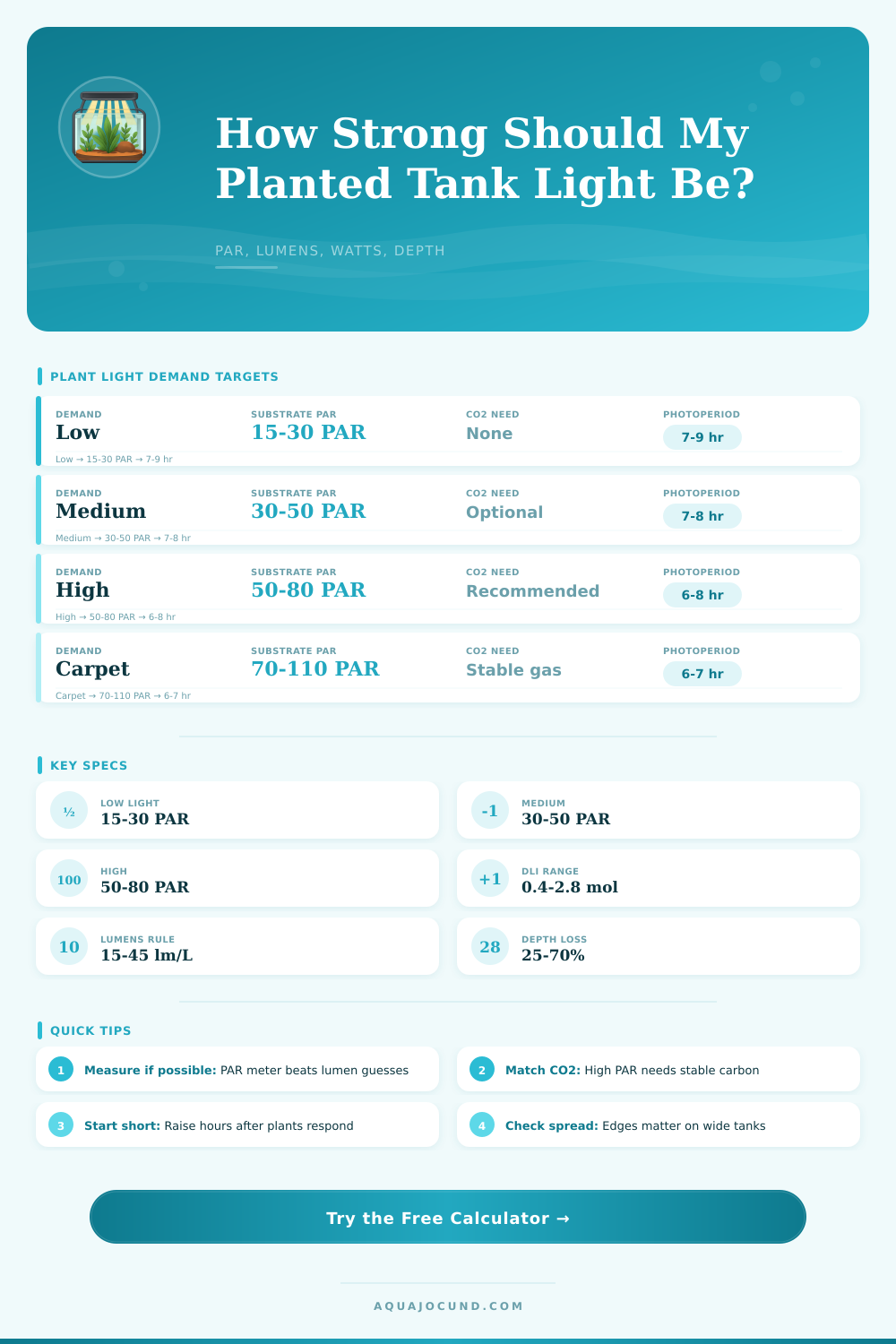
And then there’s the matter of demand. Not every plant are equally demanding. Low light and neglect suit plants like anubias and moss. However, carpeting species like dwarf gabon or hygrophila need someone who is very dedicated. You can push them to the max without corresponding stable CO2 injection. Without sufficient carbon to fuel the photosynthesis process, all that extra energy go somewhere, namely algae.
The chart on the page matches the appropriate PAR range with the required carbon concentration. You won’t be able to outrun biology with a few more photons. The amount of light each day become a balancing act: Short days are possible in high-intensity environments, but long ones may be necessary where there’s insufficient light during the day to gather enough energy. But beware of stretching out periods to make up for weak light. That just provides more time for algae to multiply without delivering a surge of intensity that plants can rapidly take up.
The Daily Light Integral (the total number of photons delivered each day) is calculated and shown on the page so you can determine if upgrading your equipment are warranted, or whether to tinker with the timer. Light transmission is also heavily influenced by water clarity, a brand-new tank full of crystal clear water will transmit light very well. A mature tank that’s slightly hazy or has some floating plants in it will reduce it 20% or even more. And this attenuation add up fast.
You can account for both tint and surface obstruction (which reflects real-world, livig environment conditions) with the tool. It makes you think about the worst case scenario instead of the idealized setup day conditions. In short, it’s all about balance. You want to find the sweet spot where your plants grows well and algae doesn’t get too much of a foothold.
To do that, you need more than some arbitrary wattage rule; you need to understand how light interacts with water. You also have to look at substrate PAR and match it to your plants’ needs. Then you manage the tank. You let the numbers tell you what to do and then check if it worked by looking at your plant.
Begin with an estimate, pay close attention to your plants, and tweak accordingly. Most folks forget this. It isn’t like turning on lights, it’s managing a variable.