Micro Nutrient Dosing Calculator Planted
Estimate planted aquarium trace and iron dosing from tank volume, dry mix iron percentage, stock solution strength, weekly frequency, plant demand, water changes, and chelate behavior.
🌿Trace Dosing Presets
📐Tank Volume and Micro Mix Inputs
Micro Nutrient Dose Estimate
⚙Micro Mix Comparison Grid
🔬Chelated Mix Reference
| Mix type | Fe used | Best range | Trace note |
|---|---|---|---|
| CSM+B trace blend | 7.0% | Most planted tanks | Broad micros with boron |
| General EDTA trace | 6.5% | Soft to neutral water | Good short-term availability |
| DTPA iron trace | 11.0% | Neutral to harder water | Stable iron reference |
| Gluconate light trace | 1.5% | Small frequent doses | Fast uptake, shorter reserve |
| Ferrous sulfate stock | 20.0% | Special iron correction | Not a complete trace blend |
| Low-iron commercial trace | 0.32% | Daily trace dosing | Large liquid volumes |
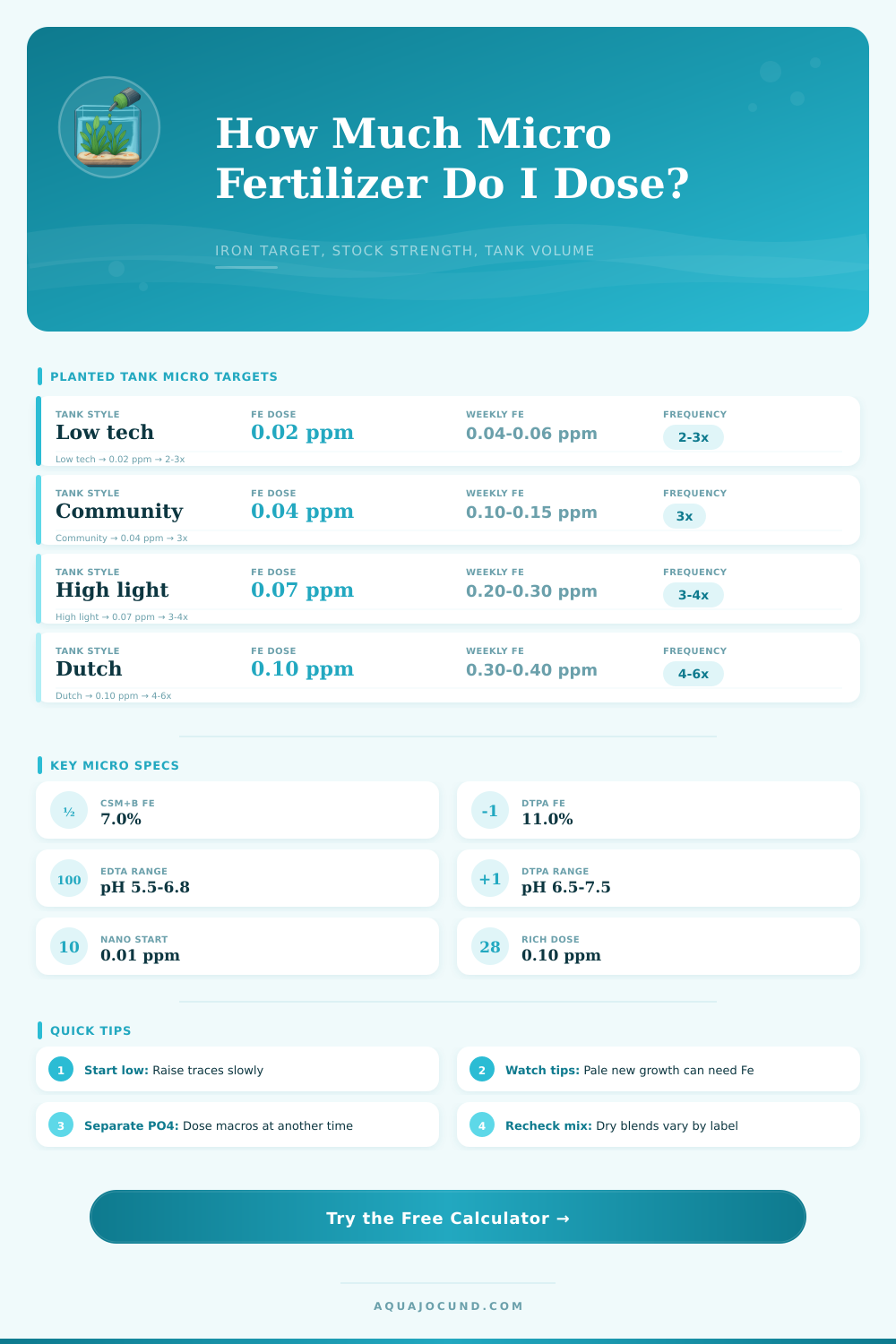
📊Iron Target Guide
| Tank style | Per dose Fe | Weekly Fe | Schedule |
|---|---|---|---|
| Very low light rhizomes | 0.01-0.02 ppm | 0.02-0.05 ppm | 1-2 small doses |
| Low tech mixed plants | 0.02-0.04 ppm | 0.05-0.12 ppm | 2-3 doses |
| Moderate community planted | 0.04-0.06 ppm | 0.12-0.20 ppm | 3 doses |
| High light stems | 0.06-0.09 ppm | 0.20-0.35 ppm | 3-4 doses |
| Dutch heavy growth | 0.08-0.12 ppm | 0.30-0.45 ppm | 4-6 doses |
📏Common Tank Starting Doses
| Tank size | Dimensions | Volume | 0.05 ppm Fe need |
|---|---|---|---|
| 10 gallon | 20 x 10 x 12 in / 51 x 25 x 30 cm | 38 L | 1.9 mg Fe per dose |
| 20 long | 30 x 12 x 12 in / 76 x 30 x 30 cm | 76 L | 3.8 mg Fe per dose |
| 40 breeder | 36 x 18 x 16 in / 91 x 46 x 41 cm | 151 L | 7.6 mg Fe per dose |
| 55 gallon | 48 x 13 x 21 in / 122 x 33 x 53 cm | 208 L | 10.4 mg Fe per dose |
| 75 gallon | 48 x 18 x 21 in / 122 x 46 x 53 cm | 284 L | 14.2 mg Fe per dose |
| 125 gallon | 72 x 18 x 21 in / 183 x 46 x 53 cm | 473 L | 23.7 mg Fe per dose |
💧Stock Solution Strength Examples
| Stock recipe | 7% Fe blend | Fe per mL | Use case |
|---|---|---|---|
| 5 g in 500 mL | 350 mg Fe total | 0.70 mg/mL | Nano and cautious dosing |
| 10 g in 500 mL | 700 mg Fe total | 1.40 mg/mL | Common mixed tank stock |
| 20 g in 500 mL | 1400 mg Fe total | 2.80 mg/mL | Large tanks, smaller pumps |
| 30 g in 1000 mL | 2100 mg Fe total | 2.10 mg/mL | Stable liter bottle stock |
You spent hours aquascaping midground stems and foreground carpet, but a week later everything turn pale yellow. Isn’t that frustrating? You probably have a lot of phosphates and nitrates in the water. And the cause of this problem is most likely hiding under the hood, in trace elements, particulary iron.
Iron are required by plants to produce chlorophyll. If they don’t get enough, they can’t use all available light regardless of how bright your fixtures may be. Iron, however, is notoriously difficult to dose correctly. Too little and your plants will go visually hungry, too much and you’ll invite algal blooms that destroy the appearance you’ve slaved over.
How to Use Iron Correctly in Your Aquarium
When you know amount of stock solution and how much water is in your tank, all that has to happen is that you plug it into this calculator. It will do the rest of the math for you, eliminating any need to guess conversions and coefficients. Most hobbyists start by estimating their water volume. If you choose the right shape, the calculator take into account thickness of glass and displacement caused by substrate.
Why does that matter? Because dosing into a twenty gallon nominal tank full of soil is not the same thing than dosing into twenty gallons of water. That disparity can change your concentration by almost fifteen percent. That’s enough to push a balance system either into explosion or stagnation.
Most folks botch the chemistry part here: They don’t understand which kind of chelate they have. Harder water (pH rising above seven) doesn’t keep dissolving power very well over time, including with iron. You can see from the chart on page that it’s the EDTA-type bonds that fall apart fast; DTPA iron stays dissolved at high pH.
If you’re treating mostly softer acid water where mosses and ferns thrive, then perhaps an EDTA-based chelated iron mix will work but only temporarilly. Many of us have hard alkaline tap water. In these cases, you want the stronger hold provided by gluconates or DTPA forms. This keeps iron dissolved so it can be taken up, instead of settling out as unseen muck on bottom.
Start with a smaller safe percentage. If you’re not sure your dry mix is pure, dial it down on the calculator to less than eighty percent (or even lower). Better to go easy on the overdose and ramp up, rather than put too much heavy metal in at once and shock your tank. You should of gone slow.
Examine emerging plant growth, not older leaves, Iron deficiency will manifest as yellowing between the veins first on newer growth. Veins remain green; the tissue between them will be pale. This is your visual clue that the plant is actively growing but starving for resources for its new tissue.
Don’t dose micro and macro all at once, you’ll end up precipitating some of the chemicals out of solution in the water column. Iron, in particular, loves to form a phosphate bond, which will remove phosphorus from solution as well without it being available for uptake by plants. Giving it a little time, such as a few hours, makes it much more effective. Dosing at different times of day is even better. It’s just one small logistical thing that can return huge benefits for plant health.
A little goes a long way. Consistency trumps intensity, always. Dosing a smaller amount 3-4 times a week keep concentrations stable and prevents spikes that algae feed on. It tells you exactly how many milliliters of your particular stock solution to add for each dose based off your desired iron concentration. For most community tanks, ~zero point zero five parts per million per dose is sufficient. That’s basically what the natural iron concentration is in certain tropical river systems.
If your plants are pale but otherwise growing well (even under good light and with adequate CO2), bump up the target accordingly. Maintain consistency with your records, keep them simple. If you mixed up a new bottle of stock, note it down, and if your plants start to change colors after a few weeks, make note of that too.
Remember, those numbers on the screen are just an estimated starting point, an estimated number for optimal conditions. No formula can account for every single variable in your tank: different plant species, root feeding habits, flow rates, etc. Let your eyes be the final adjustment; use the math as your starting point. Ultimately though, aquatic plant cultivation isn’t an exact science of chemistry; rather, it’s an observational science.
The volume and concentration parts are taken out of the equation with the calculator; you now have a clean starting line to work with. Now it simply becomes a matter of watching the response of your aquascape to these measured, constant inputs. If the stems are strong and leaves remain a nice dark green, then you’ve found the correct input amount for your particular system. And that patience you exercised in building the aquascape will serve you well again as you maintain it, making complex chemistry into simple routine care.