CO2 Regulator Bubble Count Calculator
Convert regulator bubble count to CO2 flow, compare tank demand, score needle valve stability, and estimate cylinder runtime.
🐟Named CO2 Presets
💧Tank Demand and Bubble Counter
⚙Regulator, Needle Valve, and Cylinder
CO2 Regulator Bubble Count Estimate
🧪Regulator and Bubble Counter Comparison
📋Bubble Counter Calibration Table
| Counter type | Estimated bubble volume | Best BPM range | Calculation note |
|---|---|---|---|
| Nano glass counter | 0.035 ml per bubble | 5 to 80 BPM | Small bubbles make BPM look higher |
| Standard check counter | 0.050 ml per bubble | 10 to 120 BPM | Common aquarium planning baseline |
| Inline bubble counter | 0.055 ml per bubble | 15 to 150 BPM | Often slightly larger bubbles |
| Large acrylic counter | 0.075 ml per bubble | 10 to 90 BPM | Lower BPM can still mean high flow |
| Calibrated lab counter | 0.040 ml per bubble | 5 to 100 BPM | Use when repeatability matters |
| Unknown bubble size | 0.050 ml per bubble | Use as estimate | Confirm with plant and drop-check response |
⚖Regulator Stability Reference
| Regulator setup | Stability level | Pressure behavior | Needle valve note |
|---|---|---|---|
| Dual stage precision valve | Excellent | Best end-of-tank control | Suited to nano and low BPM work |
| Dual stage aquarium regulator | Strong | Very steady working pressure | Good for most planted aquariums |
| Single stage quality valve | Moderate | Watch cylinder end pressure | Works best in mid BPM ranges |
| Basic single stage | Variable | More drift as cylinder empties | Recheck after each adjustment |
| Soda or paintball mini | Light duty | Small cylinders change faster | Use conservative bubble rates |
🌱Common Planted Tank Bubble Ranges
| Tank size | Typical start BPM | Flow estimate | Adjustment cue |
|---|---|---|---|
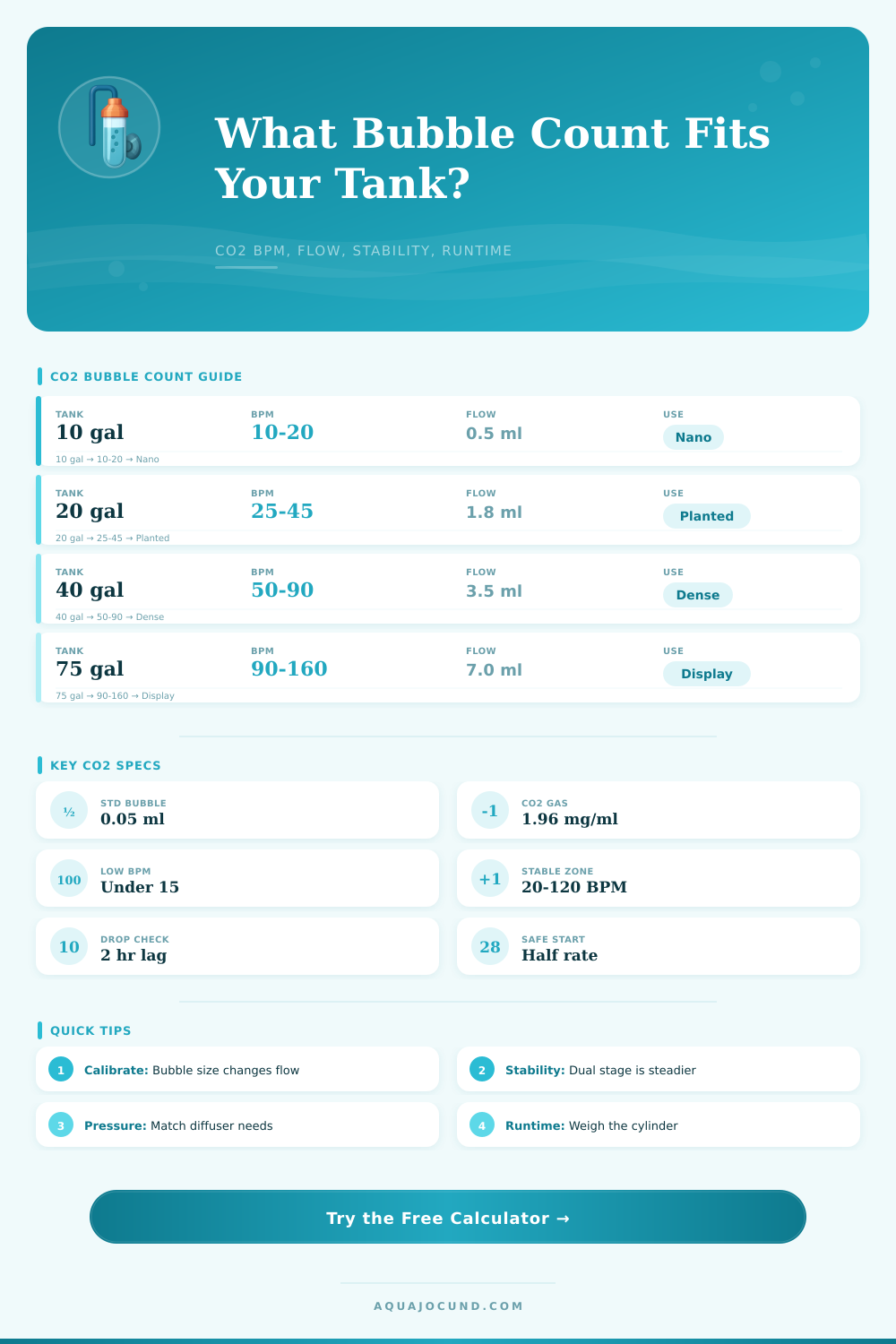
| 5 gallon nano | 4 to 10 BPM | 0.2 to 0.5 ml/min | Change slowly, watch livestock |
| 10 gallon planted | 10 to 25 BPM | 0.5 to 1.3 ml/min | Check before lights peak |
| 20 gallon long | 25 to 50 BPM | 1.3 to 2.5 ml/min | Surface loss changes demand |
| 40 breeder | 45 to 90 BPM | 2.3 to 4.5 ml/min | Distribution matters as much as BPM |
| 75 gallon display | 85 to 160 BPM | 4.3 to 8.0 ml/min | Inline gear is easier to stabilize |
| 125 gallon aquascape | 140 to 260 BPM | 7.0 to 13.0 ml/min | Consider reactor efficiency |
⏱Cylinder Runtime Reference
| Cylinder size | Usable CO2 | At 1 ml/min for 7 hr | At 5 ml/min for 7 hr |
|---|---|---|---|
| 20 oz paintball | 510 g | 62 days | 12 days |
| 2.5 lb cylinder | 1,020 g | 124 days | 25 days |
| 5 lb cylinder | 2,041 g | 248 days | 50 days |
| 10 lb cylinder | 4,082 g | 496 days | 99 days |
| 20 lb cylinder | 8,165 g | 992 days | 198 days |
“Use a counter.” Set it, wait for bubbles to start rising, then see if you can get number of bubbles per second close to some “rule of thumb” you read somewhere on the Internet. Unfortunately, bubbles per second isn’t a standard way of measuring carbon dioxide delivery. For starters, its just a visual representation of flow rate. And as any good scientist know, stand-ins only work if you understand what they mean. Your hardware creates bubbles of all different sizes. What works for thirty beats per second in a big acrylic counter might be half the amount delivered by thirty beats per second in a nano counter. Know the difference and you’ll enjoy a carpet of dwarf grass. Fail to grasp the principle and you’re going to end up with algae-filled tanks and starving plant.
Now, after entering target parameters and tank volume into calculator (above), it does the work for you. The tool removes guesswork of those numbers and helps you consider things most people don’t think about until they crash their pH. You have to consider amount of surface agitation running. When that filter spits back out on water, it’s creating what we call a “degassing” effect, stripping Co2 directly out of the solution. So if you’re dealing with constant gas release, you’ll require far more injection than someone who has a quiet, covered sump. That’s where the question regarding surface movement come into play. It is not just decorative turbulence. Leak in your carbon budget.
Why counting bubbles is not enough
Not all regulators are made alike. As that cylinder pressure lowers, the regulator pressure also lowers. You might have your needle valve dialed in perfectly on day one. However, it will be wildly surging by week three if tank pressure lowers enough to throw off the single stage balance. The dual-stage regulators addresses this by stabilizing the middle pressure prior to the needle valve. This matters more then you might think. The steadier the pressure, the more it allow the bubble count to be a repeatable metric. You can trust it. If the pressure is swinging, then the bubbles are just noise.
What about your plant’s actual consumption of carbon dioxide? That occurs during the light cycle, as soon as photosynthesis takes effect. Injecting two hours before lights turn on gives the water time to soak in without hitting them with high levels all at once. This allows your livestock to get used to it gradually instead of seeing a sudden change in their environment. Runtime is estimated using those day/night cycles. The calculator estimates runtime based off these daily cycles; if you run a five-pound cylinder at a moderate flow, you might expect it to last several months. However, if you over-inject thinking “more bubbles, more growth,” then you’ll empty that tank within weeks. Once plants can’t take in any additional carbon, there’s no advantage gained from overfilling them.
The last part is calibration. And most bubble counters are guesses that has never been calibrated. A stock check valve counter comes with an assumed volume for each bubble. Depending upon age, type, etc., your actual flow rate may be more or less than what it’s defaulting to. The only way to know if you’ve got the right amount coming out is NOT to just stare at them bubbles longer… look at the plants. Are they growing new leaves? Is algae retreating? THOSE are the signs that matter most.
These tables and tools on this page get you started, but nature finally paints finishing line. Go easy, go slow, and listen to the ecosystem itself for when it’s had enough. Patience is a virtue. Especially in a slow-moving game like this, but it pays off in a clearer, greener tank.