CO2 Diffuser Size Calculator
Size ceramic discs, atomizers, inline diffusers, and reactors from tank volume, bubble rate, working pressure, water flow, and target CO2 rise.
🐟Real Planted Tank Presets
🌊Tank, CO2, Pressure, and Flow
CO2 Diffuser Sizing Result
📊Diffuser Type Comparison Grid
🔧Diffuser and Reactor Specification Table
| Type | Typical Pressure | Useful Range | Sizing Note |
|---|---|---|---|
| Nano ceramic disc | 15-25 psi | 0.3-1.5 bps | Small tanks, short bubble paths |
| Standard ceramic disc | 20-30 psi | 0.8-3.0 bps | Common 15-35 gal planted tanks |
| Large ceramic disc | 20-35 psi | 2.0-5.0 bps | Larger tanks needing broad mist spread |
| In-tank atomizer | 30-45 psi | 1.0-4.5 bps | Fine mist, higher back pressure |
| Inline diffuser | 25-40 psi | 2.0-6.0 bps | Canister return line with steady flow |
| Inline reactor | 8-20 psi | 3.0-10.0 bps | High dissolution, less visible mist |
| Sump reactor | 8-20 psi | 4.0-12.0 bps | Large systems and high off-gassing layouts |
| Ladder or bell diffuser | 5-15 psi | 0.2-1.5 bps | Low-pressure, low-demand setups |
📐Common Tank Size Starting Points
| Tank Size | Volume | Flow Target | Diffuser Starting Point |
|---|---|---|---|
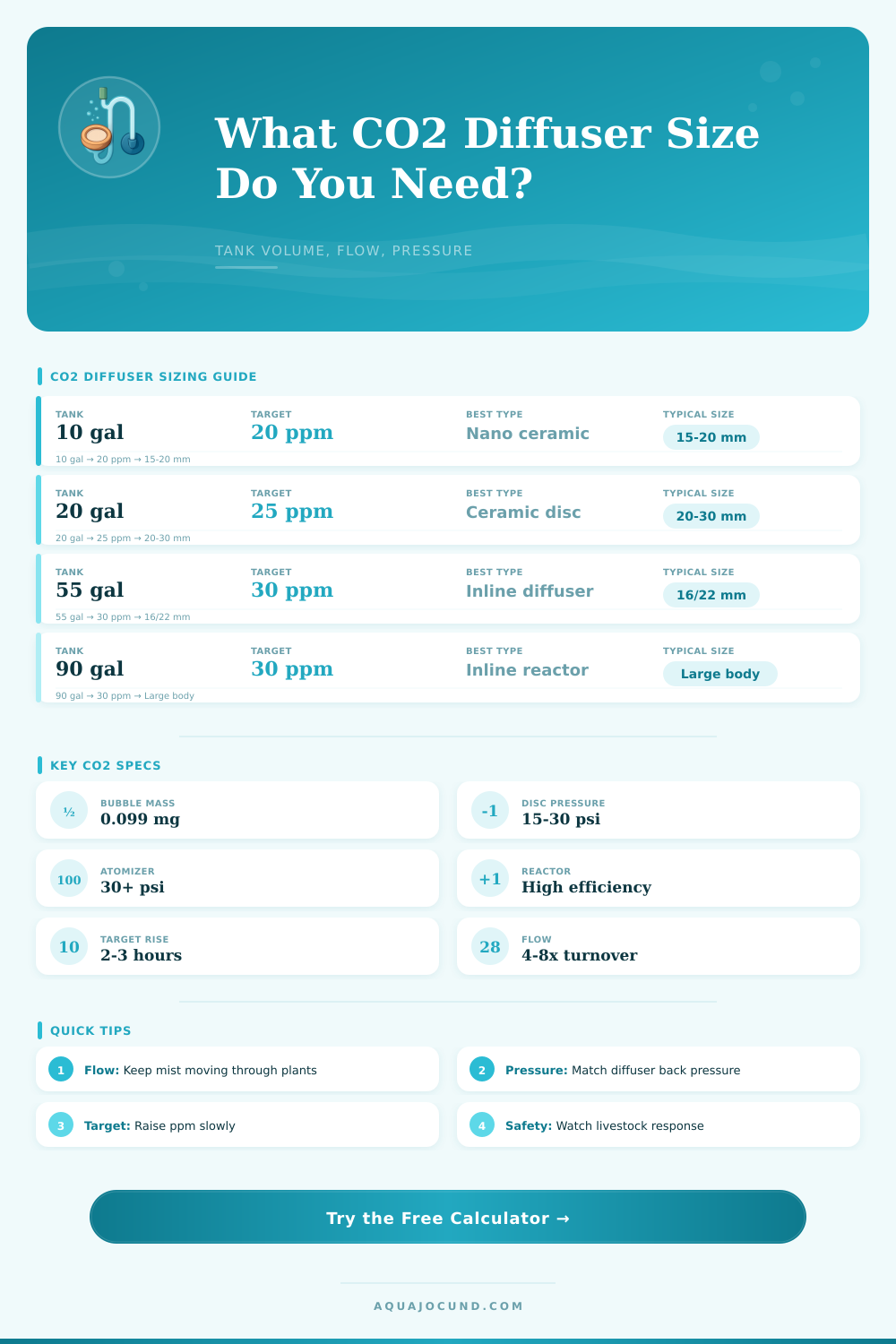
| Nano planted cube | 5-10 gal / 19-38 L | 30-80 gph / 115-300 L/h | 15-20 mm nano ceramic disc |
| Standard 20 gal | 20 gal / 76 L | 80-160 gph / 300-600 L/h | 20-25 mm ceramic disc |
| 40 breeder | 40 gal / 151 L | 160-320 gph / 600-1,200 L/h | 30 mm disc or small inline diffuser |
| 55 gal planted | 55 gal / 208 L | 220-440 gph / 830-1,665 L/h | Inline diffuser or medium reactor |
| 75-90 gal aquascape | 75-90 gal / 284-341 L | 300-720 gph / 1,135-2,725 L/h | Inline reactor or large reactor |
🫧Bubble Rate and CO2 Delivery Reference
| Bubble Rate | Raw CO2 Gas | At 55% Disc Efficiency | At 90% Reactor Efficiency |
|---|---|---|---|
| 0.5 bps | 178 mg/hour | 98 mg/hour dissolved | 160 mg/hour dissolved |
| 1.0 bps | 356 mg/hour | 196 mg/hour dissolved | 320 mg/hour dissolved |
| 2.0 bps | 712 mg/hour | 392 mg/hour dissolved | 641 mg/hour dissolved |
| 4.0 bps | 1,425 mg/hour | 784 mg/hour dissolved | 1,282 mg/hour dissolved |
| 6.0 bps | 2,137 mg/hour | 1,175 mg/hour dissolved | 1,923 mg/hour dissolved |
⚙Pressure and Flow Interpretation
| Input | Low Reading | Good Range | Oversized or Risky Reading |
|---|---|---|---|
| Working pressure | Disc may burp large bubbles | Meets diffuser minimum | Too high for weak tubing or fittings |
| Flow turnover | CO2 stays in one corner | 4-8x tank volume per hour | Too much surface loss if ripple is strong |
| Bubble rate | Cannot reach target on schedule | Matches diffuser capacity | Fish may see fast ppm swings |
| Target rise time | Slow ramp before lights | 2-3 hours for many tanks | Very fast ramp needs careful observation |
You sit down next to your tank and notice that little puffs of white rising from one of its corners, wafting upward, popping at the water’s surface and vanishing into air beyond the tank’s rim. You see nothing. But beneath the surface, a silent chemistry happen that will either keep your aquarium alive with thriving plants or let it slowly die. The real issue isn’t just producing bubbles; more importantly, how much CO2 is actualy dissolving before it escapes?
Hobbyists generally rely on a counting method, looking at the tick-tick-ticking of the bubble counter in the corner, as if frequency can be used as a stand-in for effectiveness. This is where folks go wrong. Frequency measure how aggressively the gas is forcing itself out, but it doesn’t measure whether any of it are being consumed by plants.
Stop Counting Bubbles to Help Your Plants Grow
As far as I’m concerned, the tool above does the calculation by calculating weight of the required carbon dioxide for your water chemistry targets. Feed it volume of your tank, the flow rate through your filter, and the regulator’s pressure output and it tells you whether the diffuser you selected is up to the task of dissolving that much gas…or falling short…or overloading your setup. In other words, it takes an abstract goal and transforms it into a concrete limit on your hardware’s capacity.
Does the equipment you have installed close the gap between ambient air levels and the concentrated carbon that high-tech plant need? Most people don’t think about it, but pressure is a significant factor. Ceramic discs are designed to force gas through very small pores. This breaks the gas into a fine mist that stays suspended long enough to dissolve. Without sufficient pressure, however, those pores simply expels large bubbles that immediately rise to the top and dissapears. For the gas to stay fragmented, there must be enough back pressure.
The calculator accounts for this by ensuring that the pressure of your regulator setting corresponds with the resistance of the type of diffuser you’re using. An inline reactor differs greatly from a nano disc due to difference in pore size and surface area. While one requires a steady flow to function efficienty, the other desires a gentle push. By matching the pressure, you ensure that neither the livestock nor the plants lacks nutrients.
It also takes flow rate into account, which is typically overlooked until issues arise. Sure, maybe your diffuser is filling the water with enough dissolved carbon, but how does it get up onto the leaves? If you have a filter that’s generating a dead spot in the corner, half your tank’s suffering from carbon starvation while the other half’s getting overdosed. Flow turnover helps guarantee that the gas is being distributed evenly, so the tool takes this into account as well. You don’t want it pooling; you want it spreading out like a mist.
That’s actualy part of the reason why inline reactors tend to work better in large tanks (despite their less-dramatic appearance). They inject the gas right into the return line, using the pump’s energy to fully dissolve the stuff before it even reaches the main display area. The outcome is consistent enrichment, not a chaotic cloud of released bubbles.
Volume isn’t everything; timing it correctly is also critical. Plants absorbs carbon while the lights are on. Adding gas when the lights are off wastes money and risks drastic pH fluctuations overnight. To avoid this, the calculator lets you specify a ramp time so the concentration increases slowly before photosynthesis kicks in. A gradual increase of two or three hours allows your livestock to adjust without shocking them with a sudden acid environment change. This will smooth out the transition from low-to-high carbon concentrations.
Many people rush the process and end up panicking after seeing their fish gasping at the surface because they rapidly changed concentrations. You should of saved your budget (and ecosystem) when you exercise patience here.
In the end, right-sizing your gear takes the guesswork out of aquascaping. It’s no longer about counting bubbles. It’s about working with true dissolved concentrations. Balance is key. Dissolved CO2 can either restrict growth or pose toxicity risks if there’s too much or too little. And achieving this happy medium will take some insight into the connection between flow, pressure, and dissolution efficiency in your unique set up.
Once you get all these variables aligned, it’s no longer about the bubbles, per se. They’re just a nice side effect. Instead, it’s about what occurs beneath them. Your plants are growing and drinking. The tank is stable.