CO2 Drop Checker Fluid Calculator
Plan 4 dKH reference solution, dilution ratio, indicator drops, spare volume, and refill timing for one or more aquarium CO2 drop checkers.
🧪Named Drop Checker Presets
💧Fluid Batch Inputs
Drop Checker Fluid Plan
📊Solution and Indicator Comparison Grid
⚗4 dKH Dilution Reference
| Stock strength | Stock for 50 mL target | DI water for 50 mL | Dilution ratio |
|---|---|---|---|
| 20 dKH | 10.0 mL | 40.0 mL | 1 part stock to 4 parts DI |
| 40 dKH | 5.0 mL | 45.0 mL | 1 part stock to 9 parts DI |
| 80 dKH | 2.5 mL | 47.5 mL | 1 part stock to 19 parts DI |
| 100 dKH | 2.0 mL | 48.0 mL | 1 part stock to 24 parts DI |
| 200 dKH | 1.0 mL | 49.0 mL | 1 part stock to 49 parts DI |
🧪Indicator Profile Reference
| Indicator profile | Default dose | Best use | Mixing note |
|---|---|---|---|
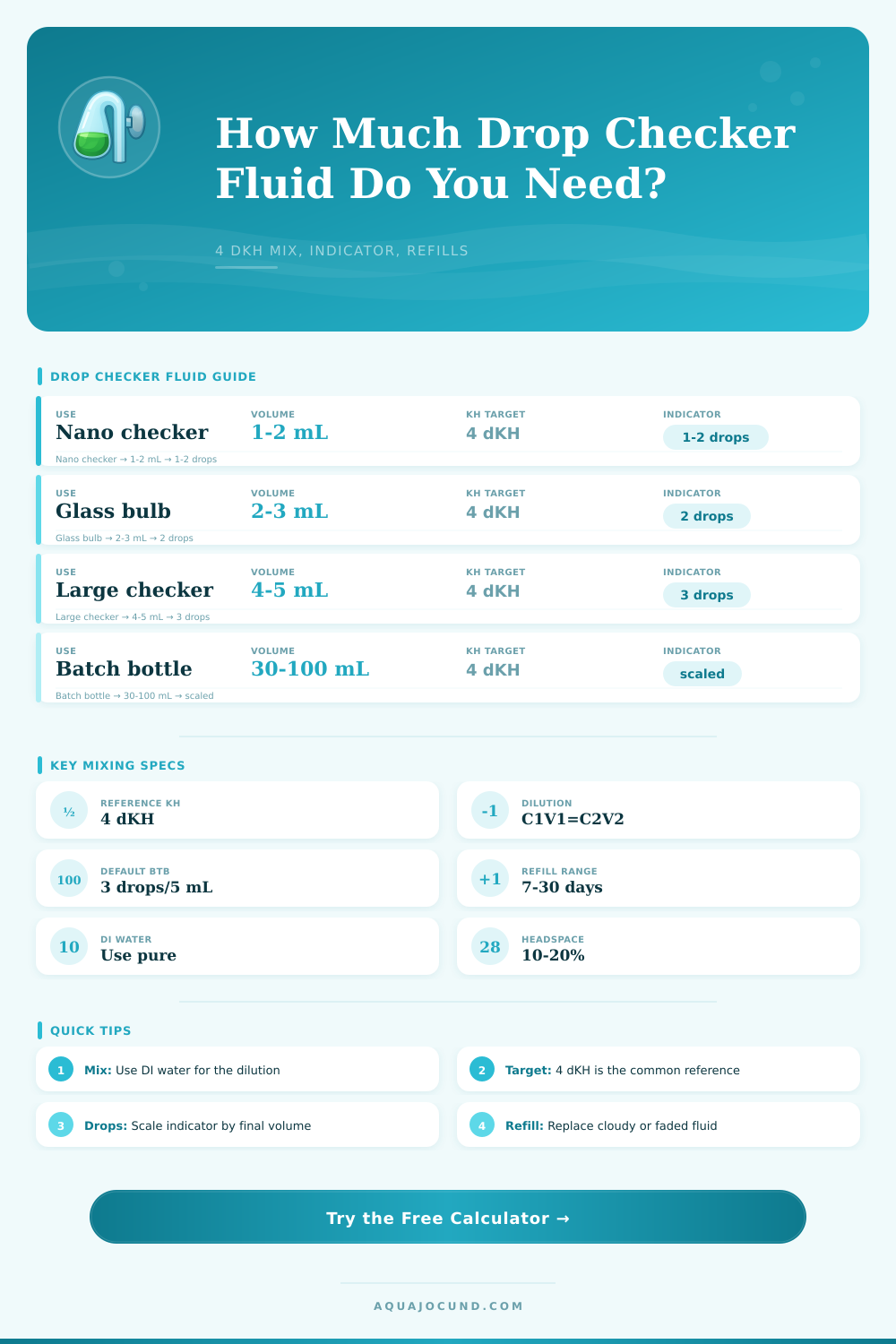
| Standard BTB aquarium indicator | 3 drops / 5 mL | Most glass checkers | Clear blue-green-yellow shift |
| Concentrated BTB indicator | 2 drops / 5 mL | Small bulbs | Use fewer drops to avoid dark color |
| Dilute hobby indicator | 5 drops / 5 mL | Large bells | Needs more drops for visible color |
| Lab 0.04% bromothymol blue | 3 drops / 5 mL | Repeatable batches | Keep dropper size consistent |
| Low-stain indicator blend | 2.5 drops / 5 mL | Acrylic or white seals | Round to practical whole drops |
| Premixed drop checker reagent | 0 drops / 5 mL | Ready-to-use fluid | No extra indicator needed |
📐Common Drop Checker Volumes
| Checker style | Typical chamber | Fluid for 8 refills | Indicator at 3 drops / 5 mL |
|---|---|---|---|
| Nano glass bulb | 1.5 mL | 12 mL | 7 drops |
| Standard glass bulb | 2.5 mL | 20 mL | 12 drops |
| Large glass bell | 4.0 mL | 32 mL | 19 drops |
| Wide acrylic checker | 5.0 mL | 40 mL | 24 drops |
| Dual checker setup | 2 x 2.5 mL | 40 mL | 24 drops |
🗓Refill Planning Reference
| Interval | 30 mL bottle with 2.5 mL checker | 60 mL bottle with 2.5 mL checker | When to choose it |
|---|---|---|---|
| 7 days | About 12 weeks | About 24 weeks | High light CO2 tuning |
| 14 days | About 24 weeks | About 48 weeks | Normal planted tank routine |
| 21 days | About 36 weeks | About 72 weeks | Stable low-maintenance tank |
| 30 days | About 51 weeks | About 103 weeks | Backup estimate only; color may fade |
Green is good, yellow is bad, most planted tank hobbyists has heard that adage (or something similar) about drop checkers. Not many realize what’s actualy going on when you see that green color begin to fade toward a dull lime. This is typically the initial clue that your CO2 injection has gone out of range, sometimes even before plants exhibit any outward signs of distress. While it may seem like nothing more than water changing color, in reality the color change represent the breaking down (or contamination by tank water) of the reference solution within the checker, making it impossible to use as a visual cue.
How do you plan ahead for this? Well, that’s where the real difference between a tank that will crash and one that won’t comes into play. A tank that won’t comes into play.
How to Mix Drop Checker Solution Correctly
A good starting point for all drop checkers is 4 dKH. Why? A KH around this value provide the right buffering capacity to mimic most natural environments (like a planted tank), but is still sensitive enough to respond to changes in CO2 levels via coloration. Remember, unless your drop checker has exactly 4 dKH of alkalinity in its reference solution, the pH change caused by CO2 will not occur at the proper concentrations to initiate a color change from the bromothymol blue indicator. Every time you prepare a batch, you must starts with the exact same baseline of 4 dKH.
Fortunately, there’s a calculator on this page which will automate the dilution calculations for you, simply use whatever concentrated stock solution you happen to have lying around, then dilute it appropriately with distilled water. To be clear, most people also makes the mistake of mixing this in aquarium water or even tap water. This adds an unknown variable that can throw off the calibration. Stick with pure distilled or deionized water so there’s nothing getting in the way of the chemical reaction. This may seem like a minor step to skip but it’ll turn your drop checker from a reliable gauge to a guessing game.
Enter the amount you want to mix up (batch size) and the strength of the stock solution. The tool on top will do all the volume math for you, so you won’t have to worry about making manual math mistakes during a routine refilling.
Dosage of indicator itself can be inconsistent as well. If you add too much, it will be a dark solution (muddy) that doesn’t get any darker (and maybe even lighter). If you add too little, the solution will be pale and hard to see against light in your tank. Each brand have their own concentration, so knowing how they measure up to each other is important. The tables referenced by the calculator gives the default ratio for common diluted and concentrate indicators. This way, you know what to do if you change brands or notice yours is weaker than normal.
However, how often you mix also play a significant role in refill schedules. Even when mixed properly, the bromothymol blue fades over time due to oxidation and light exposure, which is why fresh fluid stay vibrant longer then old. If you don’t want to rely on weakened solution at crucial times when plants are growing or fish is stressed, then establishing a consistent refill routine makes sense. For most aquariums, a twice-monthly routine is convenient while still being reliable.
It’s not just what goes into your flask but also how it is stored that will help determine its longevity. Keeping your indicator in a dark bottle ensures it won’t be broken down by UV exposure and bleached out of existence with prolonged use. Finally, to avoid building up pressure when storing your flask or bottle, leave a little bit of air space on top. Make sure there isn’t enough air for oxygen to touch the solution, as this will change its chemical makeup. These may sound like small things, but they makes all the difference in how long a batch of dye lasts before needing to be replaced.
So, all in all, a drop checker can be whatever its contents make it. Treating your reference solution with as much care as your water parameters would of help you trust what you see in the visual feedback. If the color change is consistent and clearly there, then you have no doubt that your CO2 levels are supporting your aquatic ecosystem without guessing. Taking care with each step from mixing to storing will keep that green hue bright so your tank stays healthy for months to come.