🐟 Betta Water Volume Calculator
Estimate true usable water after fill height, substrate, decor, heater, filter, and planned water changes.
📊 Betta Water Volume Results
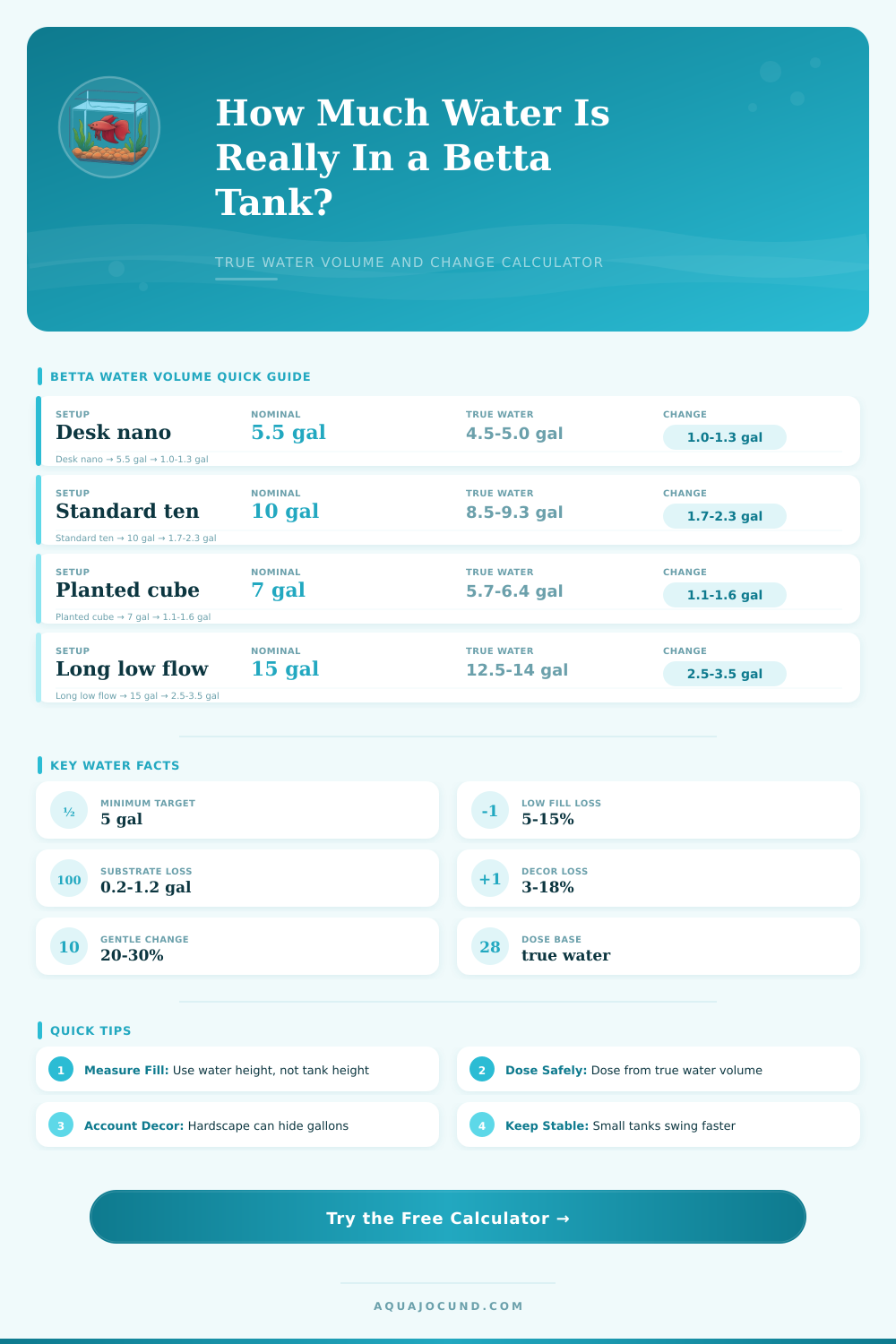
| Tank | Inside Dimensions | Nominal Water | Typical True Water | 25% Change |
|---|---|---|---|---|
| 5.5 gal rectangle | 16 x 8 x 10 in / 41 x 20 x 25 cm | 5.5 gal / 20.8 L | 4.5-5.0 gal / 17-19 L | 1.1-1.3 gal / 4.3-4.7 L |
| 10 gal standard | 20 x 10 x 12 in / 51 x 25 x 30 cm | 10 gal / 37.9 L | 8.5-9.3 gal / 32-35 L | 2.1-2.3 gal / 8.0-8.8 L |
| 6 gal cube | 12 x 12 x 12 in / 30 x 30 x 30 cm | 7.5 gal / 28.4 L raw cube | 5.4-6.2 gal / 20-23 L | 1.4-1.6 gal / 5.1-5.9 L |
| 15 gal long | 24 x 12 x 12 in / 61 x 30 x 30 cm | 15 gal / 56.8 L | 12.5-14 gal / 47-53 L | 3.1-3.5 gal / 12-13 L |
| Item | Low Setup | Moderate Setup | Heavy Setup | Calculator Method |
|---|---|---|---|---|
| Substrate | 0-4% of footprint volume | 6-10% | 12-18% | Footprint x depth x packing factor |
| Plants and hides | 2-4% of water | 6-9% | 12-18% | Percent of filled volume |
| Internal heater | 0.02 gal / 0.08 L | 0.05 gal / 0.19 L | 0.10 gal / 0.38 L | Preset physical allowance |
| Filter body | 0.00-0.05 gal | 0.08-0.18 gal | 0.35+ gal | Preset in-tank allowance |
| True Water | Stability | Change Range | Dose Base | Notes |
|---|---|---|---|---|
| Under 4 gal / 15 L | Low reserve | 15-25% | True water only | Small errors matter more |
| 4-6 gal / 15-23 L | Usable nano | 20-30% | True water minus 5% | Common compact betta range |
| 7-10 gal / 26-38 L | Good reserve | 20-35% | True water estimate | More forgiving for routine changes |
| 12+ gal / 45+ L | High reserve | 20-35% | True water estimate | Best for planted or divided displays |
| True Water | 15% | 20% | 25% | 30% |
|---|---|---|---|---|
| 5 gal / 18.9 L | 0.75 gal / 2.8 L | 1.0 gal / 3.8 L | 1.25 gal / 4.7 L | 1.5 gal / 5.7 L |
| 8 gal / 30.3 L | 1.2 gal / 4.5 L | 1.6 gal / 6.1 L | 2.0 gal / 7.6 L | 2.4 gal / 9.1 L |
| 10 gal / 37.9 L | 1.5 gal / 5.7 L | 2.0 gal / 7.6 L | 2.5 gal / 9.5 L | 3.0 gal / 11.4 L |
| 14 gal / 53.0 L | 2.1 gal / 8.0 L | 2.8 gal / 10.6 L | 3.5 gal / 13.2 L | 4.2 gal / 15.9 L |
If you’ve ever purchased a ten gallon tank, then you probably did so out of convenience, after all, it’s ‘standard’ sized for keeping a betta. And yet, while you might think you have plenty of room in that tank because the glass says so, that number represent maximum capacity, not usable water volume. Throw in a heater, some sand, maybe a couple other pieces of equipment, and what was once an empty 10g now has lot less room for fish themselves.
Why does this matter? Because it affects how you manage the tank. This page’s calculator will do the math for you. All you have to do is input information about your tank (dimensions) and equipment (e.g., sand, rock). It calculate the real water volume. Many times manufacturers specify the volume with empty space above the rim or an outside measurement. But in order for filtration to be effective, you want to know volume of liquid inside the tank. Otherwise, you run the risk of overdosing your fish if you dose based off what the bottle says rather than how much water you have.
Why Real Water Volume Matters for Your Betta
To begin, measure actual height of the water inside the tank after you have added your substrate. A lot of folks will add a layer of sand until they feel like the tank is filled, not realizing that an inch of sand displace almost a quart of water in a ten-gallon tank. Rocks and driftwood displace even more!
The tool automaticly accounts for the volume occupied by decor and the thickness of the substrate so you don’t have to figure it out yourself. Less water also gets used by heaters and filters. You have an internal heater located somewhere in the water column, and if it’s a hang-on-back type, its components is located in the tank as well. Both of these things take up water that could be used to biologicaly filter the water. To account for this, the calculator let you enter your equipment (it comes with pre-sets for common equipment) so you can deduct the amount they displace from your tank’s volume. That way, small tanks maintains water parameters better.
Now that you’ve determined your actual water volume, you can start planning for maintenance. For example, small volumes of water will also change chemistry and temperature faster then large volumes. That is, a five-gallon tank with only three gallons of actual water react more quickly to waste than a larger tank. Here’s the reference table relating reserve volume to stability.
If your true water is less than four gallons, you want to change water more frequently. Use smaller increments so you do not shock your fish. This is where many new aquarists go wrong. Eight gallons is not the same as fifteen gallons. Thirty percent of one tank size isn’t the same as thirty percent for another tank size. The calculator tell you exactly how much water to change with every change. No more accidentally siphoning too much water because you guessed based on the gallon size label. It will also tell you the right amount and temperature of conditioned fresh water to use. This helps your water conditions matches the tank.
You don’t want to micromanage each drop. You want to know what your limits are for your set-up. That way, you would of known what filter size to get and how much salt to dose. It transforms guesswork into a manageable routine. No need to worry if you’re going to add too much salt or miss an area in the gravel. Accurate numbers lead the way.
What matters most for a healthy betta isn’t what the sticker on the tank says but rather what the water inside that tank are like. That’s why getting this number right requires some additional effort up front. But long term, your fish will be more stable. What the store said the tank was doesn’t matter to your fish. The fish only cares about its water environment. So make sure you have a clear understanding of how much actual usable water there is.